SM-86(Lipid 5)
DC31024
Recommended because it shares a closely related research category or delivery context. Formulation and performance are product- and study-specific.
View product →
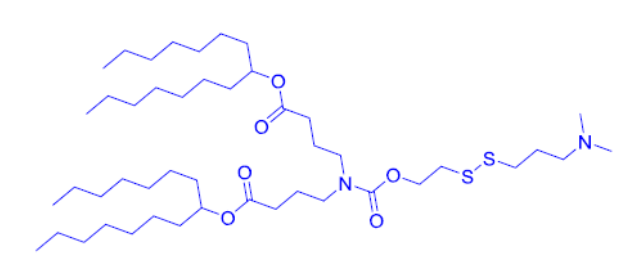
L1 is a biodegradable, branched self-immolative lipid optimized for high-efficiency mRNA delivery. Its disulfide-based architecture enables rapid glutathione-triggered degradation in the cytosol (liver half-life: 4.2 days), promoting rapid clearance while maintaining serum stability. In vivo, L1 achieves exceptional mRNA translation, producing twice the hEPO protein levels of the clinically approved MC3 lipid at 0.1 mg/kg. Its reported apparent pKa is 6.57. Tolerability is dose-dependent: supplementary clinical observations record abnormalities at 5 mg/kg through 48 hours; these findings should be considered alongside body-weight and cytokine measurements. Structural features (C7 alkyl tails, carbamate linker) balance potency and biodegradability, making L1 ideal for mRNA vaccines and protein-replacement therapies.
| CAS No. | Not available |
| Chemical Name | ATX L1 |
| Synonyms | ATX-L1, ATXL1 |
| SMILES | CCCCCCCC(CCCCCCC)OC(=O)CCCN(CCCC(=O)OC(CCCCCCC)CCCCCCC)C(=O)OCCSSCCCN(C)C |
| Formula | C46H90O6N2S2 |
| M.Wt | 831.35 |
| Purity | >95% by ELSD-HPLC |
| Storage | Pure form: −20 °C, 1 year; In solvent: −80 °C, 6 months; −20 °C, 1 month. Sealed and protected from light. |
| Shipping condition | Ships from Shanghai. Pure lipid is stable during ice-pack transport. |
| Publication | Mukthavaram R, Sagi A, Hong H, et al. Design and Evaluation of Biodegradable Self-Immolative Lipids for RNA Delivery. Advanced Healthcare Materials 14 (2025), e2501305. DOI: 10.1002/adhm.202501305. |
| Components | ATX-L1 (study L1), DSPC, cholesterol and DMG-PEG2000 |
| Molar ratio | Not specified in the supplied supporting information |
| N/P; lipid:RNA mass ratio | Not specified in the supplied supporting information |
| RNA aqueous phase | Citrate buffer, pH 3.5 |
| Lipid ethanol phase:aqueous phase | 1:3 (v/v) |
| Post-mixing treatment | Threefold dilution with Tris buffer, pH 7.4; tangential-flow filtration with 10 diavolumes of Tris buffer; concentration adjustment with 100 kDa MWCO centrifugal filters; final 0.2 µm PES filtration |
Source: SI PDF pp. 6–7, “siRNA Formulation into Lipid Nanoparticles.” The 1:3 value is a phase-volume ratio, not a lipid molar ratio or N/P. The reported method is specifically for siRNA and is not substituted for an unverified mRNA formulation.
| Endpoint | L1 result |
|---|---|
| Diameter | 60 nm |
| PDI | 0.16 |
| Encapsulation | 99.1% |
| FVII knockdown at 0.03 mg/kg | 84% |
| FVII knockdown at 0.01 mg/kg | 63% |
| FVII ED50 | <0.01 mg/kg |
Source: SI Table S1, PDF p. 4. These are L1-specific siRNA results, not mRNA expression measurements. Table S1 does not specify the animal strain, administration route, endpoint time, sample size or error estimates. Those details remain unconfirmed for this record.
| Lipid | Diameter / PDI | Encapsulation | FVII KD, 0.03 / 0.01 mg/kg | ED50, mg/kg |
|---|---|---|---|---|
| L1 | 60 nm / 0.16 | 99.1% | 84% / 63% | <0.01 |
| L2 | 67.46 nm / 0.142 | 99.4% | 96% / 83% | <0.01 |
| L5 | 70.21 nm / 0.104 | 97.4% | 81% / 43% | 0.014 |
The stronger knockdown values for L2 must not be attributed to L1. These results do not establish a universal ranking for mRNA delivery.
Figure S2 displays CT26 and A549 eGFP expression and viability at 25, 50 and 100 ng RNA/well. Cells were exposed for 24 hours with 4 µg/mL ApoE; results are means ± SEM, n=2. GFP was measured at 485/535 nm, and viability by CellTiter-Glo. The graph panel labels identify the cell models; no exact fluorescence values or fold improvements are inferred from bar heights. (SI PDF pp. 3, 7–8.)
In CD1 mice, Figure S3 reports spleen weight at 48 hours and RANTES, INFα (source label) and GROα at 6 and 48 hours (n=5). The authors report no significant between-group differences for these displayed endpoints. This does not mean that no clinical signs occurred.
| L1 dose | 2 h | 6 h | 24 h | 48 h |
|---|---|---|---|---|
| 1 mg/kg | RC | N | N | N |
| 3 mg/kg | RC | N | N | N |
| 5 mg/kg | RC3, HP3 | RC2, HP | RC | RC |
Table S2 records the same entries for all five L1 animals at each dose. Codes are reproduced as printed; the supplied SI does not define their expansions or scoring scale. At 5 mg/kg, both L1 and MC3 groups retain RC entries through 48 hours. Dose basis, cargo and injection route are not explicitly provided in Table S2. Source: SI PDF pp. 4–6, Figure S3 and Table S2.
L1 contains a dimethylaminopropyl head group, a disulfide, a carbamate linker and two pentadecan-8-yl ester groups. Formula: C46H90N2O6S2. Molecular weight: 831.35.
The supplied 32-page SI adds product-specific siRNA, cell-assay and tolerability evidence. It does not establish a complete mRNA molar formulation, N/P, nonhuman-primate performance or use in a named clinical program. Existing overview values for apparent pKa, liver half-life and hEPO expression were not independently re-verified from this SI.
Mukthavaram R, Sagi A, Hong H, et al. Design and Evaluation of Biodegradable Self-Immolative Lipids for RNA Delivery. Advanced Healthcare Materials 14 (2025), e2501305. DOI: 10.1002/adhm.202501305. Article · Supporting information. Page numbers above refer to the 32-page supplied PDF, including its cover.
The product molecular weight is prefilled when available and remains editable. Confirm solvent compatibility and solubility before preparation.
Solvent volumes update from the molecular weight above.
| Mass | 1 mM | 5 mM | 10 mM |
|---|---|---|---|
| 10 mg | 12.0286 mL | 2.4057 mL | 1.2029 mL |
| 25 mg | 30.0716 mL | 6.0143 mL | 3.0072 mL |
| 50 mg | 60.1431 mL | 12.0286 mL | 6.0143 mL |
| 100 mg | 120.2863 mL | 24.0573 mL | 12.0286 mL |
| 250 mg | 300.7157 mL | 60.1431 mL | 30.0716 mL |
Contact our team with the catalog number and requested quantity.