Galnac Lipid 83
DC67409
Recommended because it shares a closely related research category or delivery context. Formulation and performance are product- and study-specific.
View product →
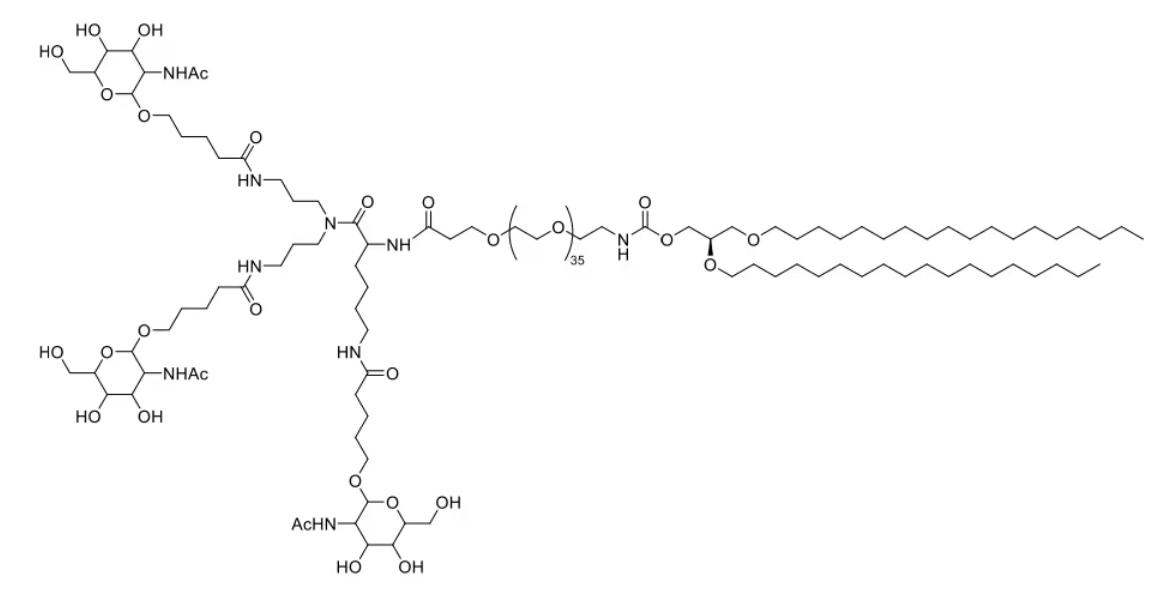
GL6 is a trivalent GalNAc lipid ligand studied as an ASGPR-targeting component of lipid nanoparticles. In mouse and cynomolgus-monkey experiments it enabled hepatic ANGPTL3 base editing despite LDLR deficiency. GL6 is the targeting component of a multi-lipid formulation; the ionizable amino lipid used in the paper was not structurally disclosed.
Open full Formulation & Performance →
Hepatic targeting evidence from the 2023 Nature Communications paper and its complete supporting information.
The paper identifies GL6 as a lysine-scaffold GalNAc ligand with a PEG spacer and a DSG lipid anchor. GalNAc Lipid 1004 is retained as the catalog alias. Commercial molecular-weight and formula values are catalog specifications; the paper describes an average PEG spacer length.
| Component | DC Chemicals product | Molecular weight | Molar ratio | Mass at 1 µmol total lipid (mg) |
|---|---|---|---|---|
| Undisclosed ionizable amino lipid | Not uniquely mapped | Not established | 55 | Not calculable from disclosed data |
| Cholesterol | DCD-041 | 386.65 | 38.15 | 0.147507 |
| DSPC | DC57005 | 790.15 | 4.7 | 0.037137 |
| PEG-lipid, exact identity undisclosed | Not uniquely mapped | Not established | 2.1 | Not calculable from disclosed data |
| GalNAc Lipid GL6 | DC60502 | 3449.38 | 0.05 | 0.001725 |
Methods give the four-base-lipid molar percentages for some mouse studies; the listed 0.05% GL6 condition completes a nominal 100%. These values are not assumed to define every mouse batch or the NHP formulation. The NHP table confirms 0.05% GL6 but does not disclose the full composition. Exact amino-lipid and PEG-lipid MWs are unavailable.
Not all inputs are assigned to a single verified study formulation; unassigned fields are blank. Enter your own values to calculate a research scenario. Molecular weights and ratios are editable. Results are calculated, not measured study data. No N/P or RNA dose is inferred.
| Component | MW | Molar ratio | Mass (mg) | Mass % |
|---|---|---|---|---|
| Undisclosed ionizable amino lipid | ||||
| Cholesterol | ||||
| DSPC | ||||
| PEG-lipid, exact identity undisclosed | ||||
| GalNAc Lipid GL6 |
| Table S1 entry / figure | Cargo target | GL6 mol% | Size nm | PDI | RNA entrapment % |
|---|---|---|---|---|---|
| 1 / 1d | Angptl3 | 0.05 | 98.61 | 0.013 | 94.91 |
| 3 / 1e | Pcsk9; post-insertion | 0.5 | 79.3 | 0.072 | 94.7 |
| 6 / 1f,g | Angptl3 | 0.05 | 100.4 | 0.034 | 93.59 |
| 11 / 2b | Angptl3 | 0.05 | 98.61 | 0.013 | 94.91 |
| 16 / 2c | Angptl3 | 0.05 | 66.73 | 0.018 | 98.36 |
| 17 / 2d | Angptl3 | 0.05 | 77.24 | 0.028 | 99.2 |
SI Table S1, p. 1. These are separate preparations; entry 3 uses post-insertion. Do not merge their particle values.
| Table S2 entry | GL6 mol% | Size nm | PDI | RNA entrapment % | RNA dose |
|---|---|---|---|---|---|
| 1 | 0 | 74.97 | 0.057 | 92.6 | 2 mg/kg |
| 2 | 0 | 72.73 | 0.032 | 94.3 | 2 mg/kg |
| 3 | 0.05 | 72.93 | 0.083 | 93.6 | 2 mg/kg |
| 4 | 0.05 | 71.97 | 0.042 | 93.3 | 2 mg/kg |
SI Table S2, p. 2; two standard and two GL6-containing preparations. No N/P or undisclosed amino-lipid identity is inferred.
| Comparison | Outcome | Model / source |
|---|---|---|
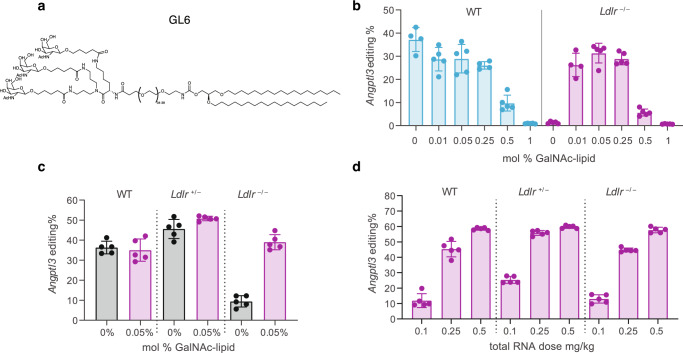
| GL6 vs GL3 | Mean Angptl3 editing 31% vs 23%; p=0.0086. | Ldlr-null mice, 0.1 mg/kg; n=5/group; Fig. 1d. |
| GL6 vs GL3 | Mean Pcsk9 editing 43% vs 33%; p=0.01. | Ldlr-null mice, 0.25 mg/kg; n=5/group; Fig. 1e. |
| GL6 vs shorter-spacer GL5 | Mean Angptl3 editing 56% vs 18%; p<0.0001. | Ldlr-null mice, 0.3 mg/kg; n=4-5/group; Fig. 1f. |
| Addition of 0.05% GL6 | Editing increased from 9% to 39% in Ldlr-null mice; p<0.0001. | 0.25 mg/kg; Fig. 2c. Comparable delivery was retained in WT and heterozygous animals. |
Liver editing was assessed 5-10 days after dosing. Values are reported study means, not a customer performance specification.
| Endpoint | Result | Context |
|---|---|---|
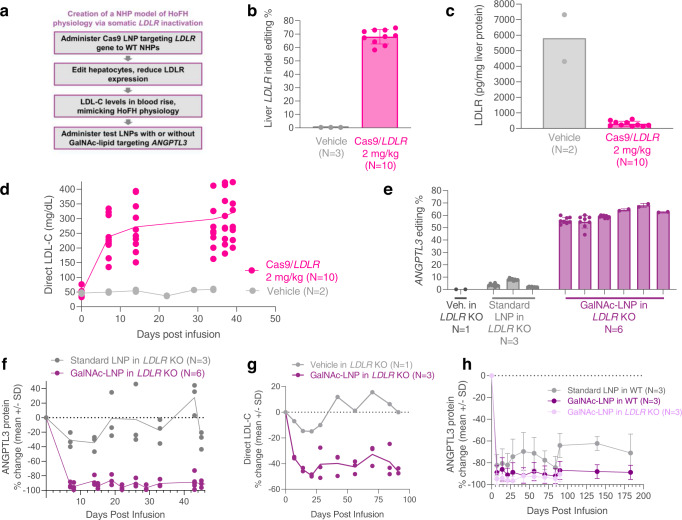
| Liver ANGPTL3 editing | Mean 61% with GalNAc-LNPs vs 5% with standard LNPs. | Somatic LDLR-deficient cynomolgus monkeys, 2 mg/kg RNA; six GL6-treated animals across studies; Fig. 3e. |
| ANGPTL3 protein | 89% reduction in the LDLR-deficient model. | Fig. 3f; distinct from percentage liver DNA editing. |
| LDL cholesterol | Approximately 35% reduction, about 100 mg/dL, maintained for three months. | LDLR-deficient model; Fig. 3g. |
| Longer follow-up | Sustained ANGPTL3 protein reduction assessed through six months. | Wild-type monkeys; Fig. 3h. This does not establish six-month persistence of lipid or RNA. |
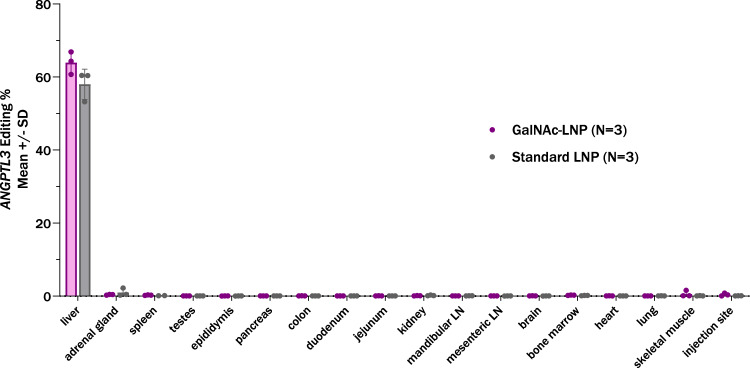
| Extrahepatic editing | Low editing in the assessed non-liver tissues. | Fig. 4; tissue sampling and limits of the study apply. |
| Group | Reported observations | Boundary |
|---|---|---|
| LDLR-deficient NHPs | Maximal mean ALT 480 U/L at 48 h; AST 537 U/L at 6 h; both returned to baseline by day 14. | Main text and SI Fig. S5; AST was not significantly different from vehicle in the cited comparison. |
| Wild-type NHPs | Maximal mean ALT 710 U/L at 48 h; AST 650 U/L at 6 h; both normalized by day 14. | Transient TNF-alpha and MCP-1 increases peaked at 24 h and returned toward baseline within 7 days. |
| Interpretation | Authors describe tolerability with transient biochemical/cytokine changes. | Animals received premedication. The findings are not evidence of no toxicity or clinical safety. |
| CAS No. | Not available |
| Chemical Name | GalNAc Lipid GL6(GalNAc Lipid 1004) |
| Synonyms | GalNAc Lipid-GL6 |
| SMILES | CCCCCCCCCCCCCCCCCCOC[C@H](COC(=O)NCCOCCOCCOCCOCCOCCOCCOCCOCCOCCOCCOCCOCCOCCOCCOCCOCCOCCOCCOCCOCCOCCOCCOCCOCCOCCOCCOCCOCCOCCOCCOCCOCCOCCOCCOCCOCCC(=O)NC(CCCCNC(=O)CCCCOC1OC(CO)C(O)C(O)C1NC(C)=O)C(=O)N(CCCNC(=O)CCCCOC1OC(CO)C(O)C(O)C1NC(C)=O)CCCNC(=O)CCCCOC1OC(CO)C(O)C(O)C1NC(C)=O)OCCCCCCCCCCCCCCCCCC |
| Formula | C166H319O63N9 |
| M.Wt | 3,449.38 |
| Purity | >95% by ELSD-HPLC |
| Storage | Pure form: −20 °C, 1 year; In solvent: −80 °C, 6 months; −20 °C, 1 month. Sealed and protected from light. |
| Shipping condition | Ships from Shanghai. Pure lipid is stable during ice-pack transport. |
| Publication |
The product molecular weight is prefilled when available and remains editable. Confirm solvent compatibility and solubility before preparation.
Solvent volumes update from the molecular weight above.
| Mass | 1 mM | 5 mM | 10 mM |
|---|---|---|---|
| 10 mg | 2.8991 mL | 579.81 μL | 289.91 μL |
| 25 mg | 7.2477 mL | 1.4495 mL | 724.77 μL |
| 50 mg | 14.4954 mL | 2.8991 mL | 1.4495 mL |
| 100 mg | 28.9907 mL | 5.7981 mL | 2.8991 mL |
| 250 mg | 72.4768 mL | 14.4954 mL | 7.2477 mL |
Contact our team with the catalog number and requested quantity.