E10i-494
DC13101
Recommended because it shares a closely related research category or delivery context. Formulation and performance are product- and study-specific.
View product →
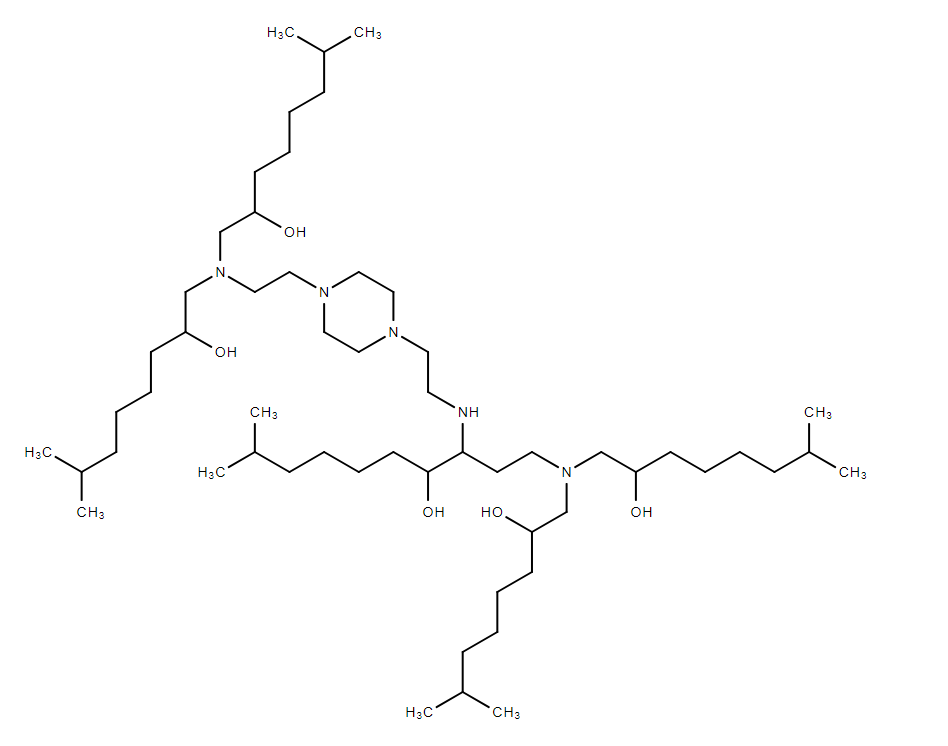
Ionizable lipid for LNP and nucleic-acid delivery research.
E4i-200 is a branched ionizable lipid designed for efficient mRNA and CRISPR-Cas9 delivery. It features a 4-carbon (C4) lipid tail with an isopropyl (i) branch at the terminal position, enhancing its ability to disrupt endosomal membranes. The lipid is built around the 200 core, a polyamine structure (N1-(2-(4-(2-aminoethyl)piperazin-1-yl)ethyl)ethane-1,2-diamine), which facilitates mRNA encapsulation and delivery. E4i-200 excels in liver-targeted delivery, significantly improving mRNA translation and gene editing efficiency in vivo. In experiments, it outperformed linear lipids, achieving 1.5-fold higher liver luminescence compared to the gold standard C12-200. Its isopropyl branch promotes deeper membrane penetration, enhancing endosomal escape and cargo release. This lipid is particularly effective for hepatic gene editing, reducing target gene expression (e.g., TTR) by up to 90% in mouse models. Its modular design and low toxicity make it a promising candidate for mRNA-based therapies and CRISPR applications in the liver.
| CAS No. | Not available |
| Chemical Name | E4i-200 |
| Synonyms | E4i200, E4i 200 |
| SMILES | CC(C)CCCCC(O)CN(CCN1CCN(CCNC(CCN(CC(O)CCCCC(C)C)CC(CCCCC(C)C)N=O)C(O)CCCCC(C)C)CC1)CC(O)CCCCC(C)C |
| Formula | C55H114O5N6 |
| M.Wt | 939.55 |
| Purity | >98% |
| Storage | Pure form: −20 °C, 1 year; In solvent: −80 °C, 6 months; −20 °C, 1 month. Sealed and protected from light. |
| Shipping condition | Ships from Shanghai. Pure lipid is stable during ice-pack transport. |
| Publication | Not available |
The product molecular weight is prefilled when available and remains editable. Confirm solvent compatibility and solubility before preparation.
Solvent volumes update from the molecular weight above.
| Mass | 1 mM | 5 mM | 10 mM |
|---|---|---|---|
| 10 mg | 10.6434 mL | 2.1287 mL | 1.0643 mL |
| 25 mg | 26.6085 mL | 5.3217 mL | 2.6608 mL |
| 50 mg | 53.2170 mL | 10.6434 mL | 5.3217 mL |
| 100 mg | 106.4339 mL | 21.2868 mL | 10.6434 mL |
| 250 mg | 266.0848 mL | 53.2170 mL | 26.6085 mL |
Contact our team with the catalog number and requested quantity.