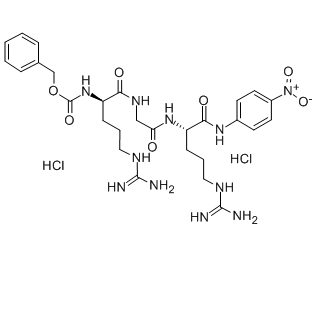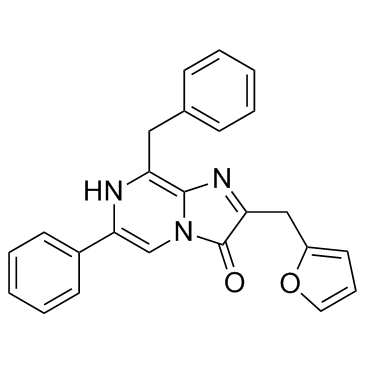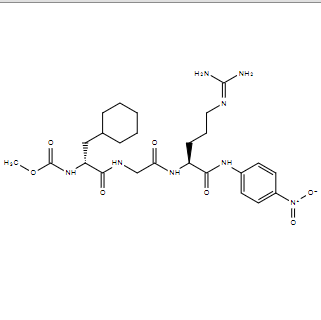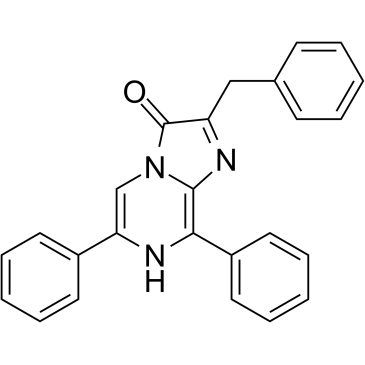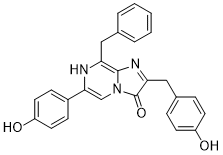
Coelenterazine chemical structure
Chemical structureResearch use only
CAT. NO. DC8863Featured

Coelenterazine

Pack Sizes & Prices

TotalUS$500
We match the best price and quality on market.
Product overview

Description & Application

Coelenterazine is widely distributed among marine organisms which can produce bioluminescence by calcium-dependent oxidation mediated by the photoprotein aequorin.

ParameterValue
Chemical NameCoelenterazine
CAS No.55779-48-1
SynonymsCoelenteramine;2-[(4-Hydroxyphenyl)methyl]-6-(4-hydroxyphenyl)-8-(phenylmethyl)-imdazo[1,2-a]pyrazin-3-(7H)-one;8-Benzyl-2-(4-hydroxybenzyl)-6-(4-hydroxyphenyl)imidazo[1,2-a]pyrazin-3(7H)-one;Coelenterazine;CLZN [Coelenterazine, Native];6-(4-hydroxyphenyl)-2-[(4-hydroxyphenyl)methyl]-8-(phenylmethyl)Imidazo[1,2-a]pyrazin-3(7H)-one;Coelenterazine, native;3,2-Dihydro-2-(p-hydroxybenzyl)-6-(p-hydroxyphenyl)-8-benzylimidazolo[1,2-a]pyrazin-3-one;CLZN;Coelenterazine native;Oplophorus luciferin;coelenterate luciferin;3O1CB88RRD;8-benzyl-6-(4-hydroxyphenyl)-2-[(4-hydroxyphenyl)methyl]-7H-imidazo[1,2-a]pyrazin-3-one;2-(p-Hydroxybenzyl)-6-(p-hydroxyphenyl)-8-benzylimidazo[1,2-a]pyrazin-3-(7H)-one;8-Benzyl-2-(4-hydroxybenzyl)-6-(4-hydroxyphenyl)imidazo-[1,2a]pyrazin-3(7H)-one;3,2-
FormulaC26H21N3O3
M.Wt423.4632
SMILESO([H])C1=C(C([H])([H])C2C([H])=C([H])C(=C([H])C=2[H])O[H])N=C2C(C([H])([H])C3C([H])=C([H])C([H])=C([H])C=3[H])=NC(C3C([H])=C([H])C(=C([H])C=3[H])O[H])=C([H])N21
Purity>98%
Storage2 years -20°C Powder, 2 weeks 4°C in DMSO, 6 months -80°C in DMSO

Biological Activity

Coelenterazine is widely distributed among marine organisms which can produce bioluminescence by calcium-dependent oxidation mediated by the photoprotein aequorin.

In Vitro

On addition of Coelenterazine to the buffer, intact KB 3-1 Rluc cells show high bioluminescence, whereas intact KB 8-5-11 Rluc cells show low bioluminescence. A specific Pgp-mediated reduction in steady-state content of Coelenterazine exists in KB 8-5-11 Rluc cells compare to KB 3-1 Rluc cells. Bioluminescence signals from KB 3-1 Rluc cells, both in the absence and presence of GF120918 (300 nM), are readily detected with as little as 1 nM extracellular Coelenterazine and increase in a concentration-dependent manner to 1 μM extracellular Coelenterazine. In Pgp-expressing cells, there is evidence for a GF120918-reversible concentration-dependent saturation of bioluminescence with an EC50 of 257 nM Coelenterazine. The plateau in bioluminescence signal observed in KB 8-5-11 Rluc cells implies hat the capacity of Pgp to limit delivery of Coelenterazine to cytosolic Rluc is not exceeded within the concentration range test[1].

In Vivo

At baseline, KB 3-1 Rluc tumors show a 4-fold higher bioluminescence signal in vivo than KB 8-5-11 Rluc tumors. Normalized bioluminescence signals arise from KB 3-1 Rluc tumors, signals emits from KB 8-5-11 Rluc tumors in vivo are consistently reduced by ≈75%[1] .

Cell Assay

Cells are plated at a density of 5×10⁴ cells per well into 24-well plates and grown to 80-100% confluency. Just before imaging, media are changed to a colorless solution containing (in mM): 2.7 KCl, 139 NaCl, 8.1 Na2HPO4, 0.7 H2O, 1.5 KH2PO4, 1.8 CaCl2, 1 MgCl2 and 5.5 d-glucose. Cells are preincubated for 15 min in the absence or presence of Pgp modulator, after which Coelenterazine (final concentration of 470 nM) is added directly to the cells[1].

Animal Administration

Mice are anesthetized with metofane or isoflurane before tail vein injection of Coelenterazine (4 μg/g) formulated from an ethanol stock diluted in sodium phosphate buffer (50 mM). Bioluminescence imaging is performed on the in vivo imaging system at 2, 6, 8, and 11 min after injection. Anesthesia is maintained during imaging by nose cone delivery of 2.5% isoflurane. After imaging, animals are killed by cervical dislocation; tumors are then harvested and weighed[1].

References & source

[1]. Andrea Pichler, et al. Imaging reversal of multidrug resistance in living mice with bioluminescence: MDR1 P-glycoprotein transports coelenterazine. Proc Natl Acad Sci U S A. 2004 Feb 10; 101(6): 1702–1707.

DC Chemicals original product information

Published experimental findings depend on the model and assay conditions. They do not guarantee equivalent performance in every application. For laboratory research use only.
Product documentation

Refer to the certificate supplied with your lot for batch-specific release results.

Handling guide

2 years -20°C Powder, 2 weeks 4°C in DMSO, 6 months -80°C in DMSO

Solution calculator

Related research products

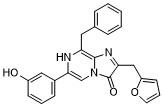
Furimazine chemical structureDC42623

Furimazine

Furimazine is an imidazopyrazinone substrate. NanoLuc (Nluc) paired with Furimazine produced 2.5 million-fold brighter luminescence in mammalian cells relative to Oluc-19 with Coelenterazine.

View activity & prices
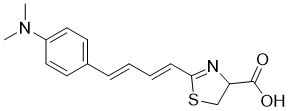
AkaLumine chemical structureDC34025

AkaLumine

AkaLumine is a luciferin analogue. The bioluminescence produced by AkaLumine in reactions with native firefly luciferase is in the near-infrared wavelength ranges (λmax=677?nm), and yields significantly increased…

View activity & prices
Hydrofurimazine chemical structureDC45184

Hydrofurimazine

Hydrofurimazine is a NanoLuc substrate whose enhanced aqueous solubility allows delivery of higher doses to mice. Hydrofurimazine enables sensitive bioluminescence imaging for either prolonged light production of high…

View activity & prices
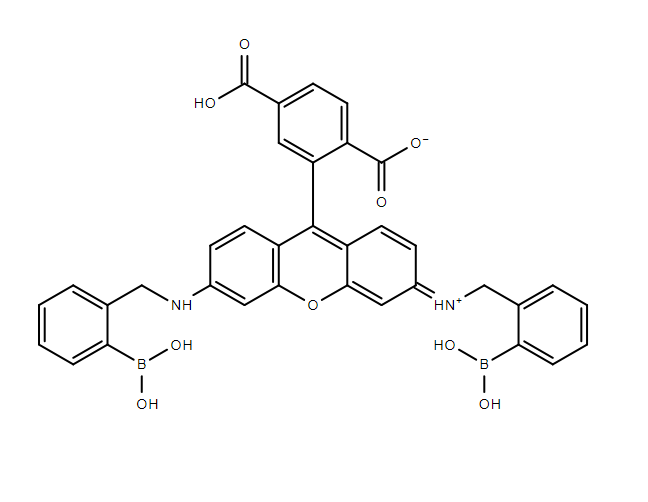
Rhobo6 chemical structureDC67279

Rhobo6

Rhobo6 is a fluorescent glycan-binding probe optimized for live-cell imaging and in vivo tracking of glycoconjugates. It exhibits pH-dependent binding (pKa ~5-7), high photostability, and minimal cytotoxicity.…

View activity & prices
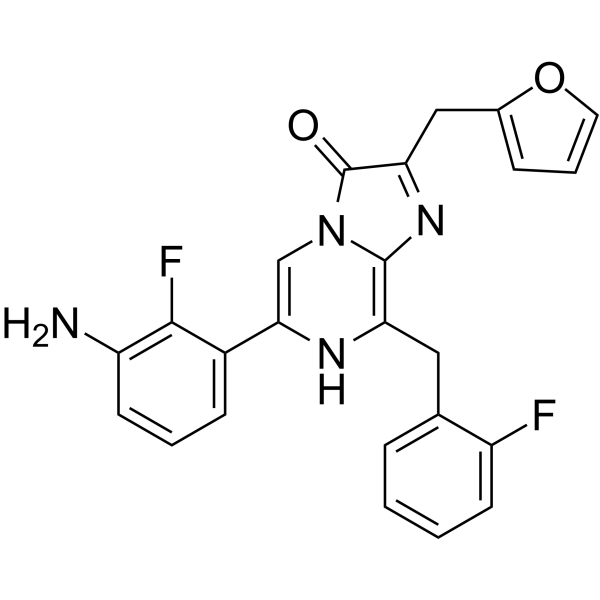
Fluorofurimazine chemical structureDC74576

Fluorofurimazine

Fluorofurimazine is an advanced furimazine derivative with enhanced aqueous solubility, allowing for greater signal output compared to furimazine in bioluminescence imaging. This compound supports higher substrate…

View activity & prices

Cart

Request quotation