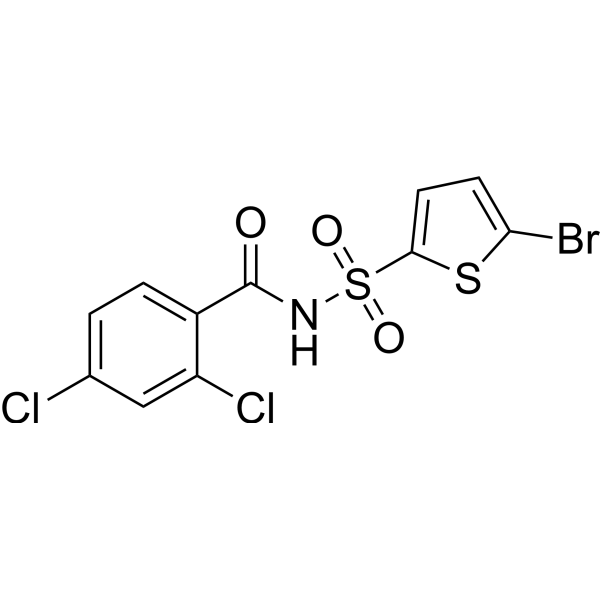
Tasisulam(LY573636) chemical structure
Chemical structureResearch use only
CAT. NO. DC7312Featured

Tasisulam(LY573636)

Pack Sizes & Prices

TotalUS$350
We match the best price and quality on market.
Product overview

Description & Application

Tasisulam is a small molecule antitumor agent that inhibits mitotic progression and induces vascular normalization. Tasisulam induces apoptosis via the intrinsic pathway[1].

ParameterValue
Chemical NameTasisulam
CAS No.519055-62-0
SynonymsTasisulam;N-(2,4-Dichlorobenzoyl)-5-bromothiophene-2-sulfonamide;LY573636;N-(5-bromothiophen-2-yl)sulfonyl-2,4-dichlorobenzamide;N-(5-Bromothiophen-2-ylsulfonyl)-2,4-dichlorobenzamide;UNII-1YC4W9MSLJ;1YC4W9MSLJ;519055-62-0;DTXSID20199869;FT-0763021;AS-38576;HY-14804;AC-32975;P7M;Tasisulam(LY573636);Tasisulam [INN];J-522818;EX-A1367;Q27253184;SW219181-1;CCG-268827;HMS3653O12;BCP05154;s7326;NCGC00386305-05;LY 573636 (sodium);Benzamide, N-((5-bromo-2-thienyl)sulfonyl)-2,4-dichloro-;BCP9000890;NS00069285;519055-63-1;SB19401;CHEMBL2110587;Z442229142;Tasisulam (sodium);AKOS027250790;N-((5-BROMOTHIOPHEN-2-YL)SULFONYL)-2,4-DICHLOROBENZAMIDE;N-[(5-bromothiophen-2-yl)sulfonyl]-2,4-dichlorobenzamide;TASISULAM [WHO-DD];SCHEMBL1581371;Tasisulam (LY573636);LY-573636;DB11941;CS-0003569;LY 573636;MFCD11973637;EN300-6492968;Tasisulam(LY573636)?;CHEBI:231621;tasisulamum;DB-071449;LY573636 sodium;DTXCID30122360;BRD-K42495768-001-01-7;n-((5-bromo-2-thienyl)sulfonyl)-2,4-dichlorobenzamide
FormulaC11H6NO3S2Cl2Br
M.Wt415.11024
SMILESO=C(NS(=O)(C1=CC=C(Br)S1)=O)C2=CC=C(Cl)C=C2Cl
Purity>98%
Storage2 years -20°C Powder, 2 weeks 4°C in DMSO, 6 months -80°C in DMSO

Biological Activity

Tasisulam is a small molecule antitumor agent that inhibits mitotic progression and induces vascular normalization. Tasisulam induces apoptosis via the intrinsic pathway[1].

In Vitro

Tasisulam (200 μM-200 nM; 48 hours) induces an antiproliferative response across a wide range of tumor histologies with EC50s is 10 μM and 25 μM for Calu-6 and A-375 cell lines, respectively[1]. Tasisulam (25, 50 μM; 72 hours) induces a concentration-dependent increase in 4N DNA and G2-M accumulation[1]. Tasisulam (200 μM-200 nM; 48 hours) induces apoptosis in a broad range of in vitro cancer cell models[1]. Cell Proliferation Assay[1] Cell Line: Calu-6 non-small cell lung carcinoma and A-375 melanoma models Concentration: 200 μM-200 nM Incubation Time: 48 hours Result: Induced an antiproliferative response across a wide range of tumor histologies with EC50s are 10 μM and 25 μM, respectively. Cell Cycle Analysis[1] Cell Line: Calu-6 and A-375 cell lines Concentration: 25, 50 μM Incubation Time: 72 hours Result: Induced a concentration-dependent increase in 4N DNA and G2-M accumulation. Apoptosis Analysis[1] Cell Line: Calu-6 non-small cell lung carcinoma and A-375 melanoma models Concentration: 200 μM-200 nM Incubation Time: 48 hours Result: Induced apoptosis in a broad range of in vitro cancer cell models.

In Vivo

No in vivo data are provided in the current product source. Contact us for further information.

References & source

DC Chemicals original product information

Published experimental findings depend on the model and assay conditions. They do not guarantee equivalent performance in every application. For laboratory research use only.
Product documentation

Refer to the certificate supplied with your lot for batch-specific release results.

Handling guide

2 years -20°C Powder, 2 weeks 4°C in DMSO, 6 months -80°C in DMSO

Solution calculator

Related research products

D927 chemical structureDC60864

D927

D927 is a molecular glue and promotes glucose uptake in the absence of insulin. D927 also increases the affinity of RAS binding to PI3Kα by ~500-fold. In vivo, D927 mimicks the effects of insulin and rapidly lowers…

View activity & prices
Lenalidomide chemical structureDCAPI1502

Lenalidomide

Lenalidomide is a potent inhibitor of TNF-α used as a immunomodulatory drug. It has also been shown to have anti-angiogenic properties.

View activity & prices
SJ3149 chemical structureDC60460

SJ3149

SJ3149 is a uniquely potent and selective CK1α degrader with DC50 of 3.7 nM. SJ3149 shows high activity across a range of acute leukemia (AL) cell lines derived from different hematologic neoplasms, such as B-cell and…

View activity & prices
PT-179 chemical structureDC60559

PT-179

PT-179 is a new orthogonal immunomodulatory drug (IMiD) derivative that binds CRBN but does not induce degradation of off-target proteins. PT-179 potently degrades proteins fused to SD40 at either the N or C terminus.

View activity & prices
(R)-CR8 chemical structureDC70109

(R)-CR8

(R)-CR8 (CR8), a second-generation derivative of Roscovitine, is a highly effective inhibitor of CDK1/2/5/7/9. It exhibits inhibitory activity against CDK1/cyclin B (IC50=0.09 μM), CDK2/cyclin A (0.072 μM), CDK2/cyclin…

View activity & prices
MRT6160 chemical structureDC60676

MRT6160

MRT-6160 represents a groundbreaking molecular glue degrader designed to selectively target VAV1, achieving its proteasomal degradation with a DC50 value of 7 nM. This innovative compound showcases its unique mechanism…

View activity & prices
SKPer1 (XMU-MP-8) chemical structureDC60874

SKPer1 (XMU-MP-8)

SKPer1 (XMU-MP-8) is a small-molecule degrader of SKP2 that triggers degradation of the oncoprotein SKP2 and specifically kills SKP2-expressing cancer cells.

View activity & prices
SJ6986 chemical structureDC55050

SJ6986

SJ6986 is a highly potent, selective, and orally bioavailable degrader of GSPT1/2, with a DC50 of 2.1 nM. It exhibits strong antiproliferative effects in MV4-11 and MHH-CALL-4 cell lines, showing IC50 values of 1.5 nM…

View activity & prices
Cyclosporin A chemical structureDC4115

Cyclosporin A

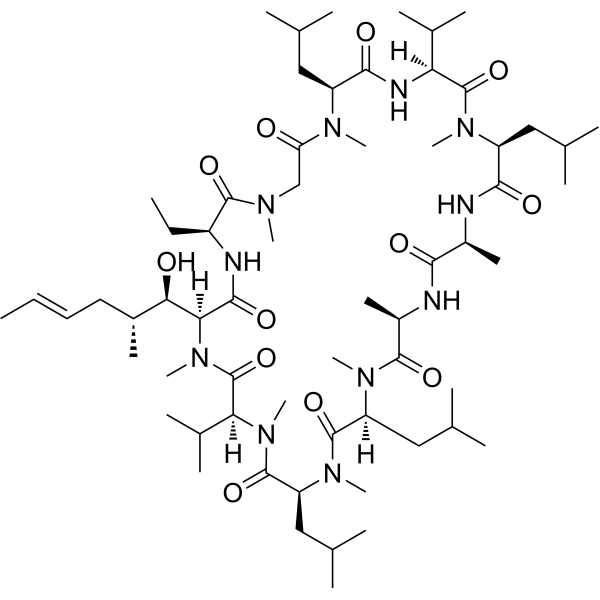
Cyclosporin A is an immunosuppressant which binds to the cyclophilin and inhibits phosphatase activity of calcineurin with an IC50 of 5 nM.

View activity & prices

Cart

Request quotation