5A2-SC8
DC49907
Recommended because it shares a closely related research category or delivery context. Formulation and performance are product- and study-specific.
View product →
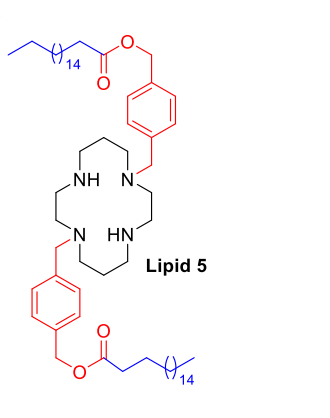
Ionizable lipid for LNP and nucleic-acid delivery research.
Lipid 5 is an ionizable lipid based on a macrocyclic cyclam headgroup. Its structure incorporates a benzylmethyl carbonate (BMC) linker, which contains an aromatic benzene ring, and a saturated C18 hydrophobic tail. Lipid 5 was mixed with helper lipids at a fixed molar ratio and formulated into mRNA-loaded lipid nanoparticles (LNPs) using microfluidic technology. Characterization data show that these LNPs have a hydrodynamic diameter of approximately 50-80 nanometers and a polydispersity index (PDI) below 0.2, indicating a small particle size with a uniform distribution. Their zeta potential at physiological pH is near neutral (ranging from -3 to +3 mV). The mRNA encapsulation efficiency, as determined by the Ribogreen assay, exceeds 95%. Cryo-transmission electron microscopy images reveal that the LNPs exhibit a typical spherical bilayer structure. In in vitro experiments, Lipid 5 LNPs mediated a higher level of luciferase protein expression in HEK293FT cells compared to the benchmark lipid DLin-MC3-DMA. In Balb/c mice, intravenous injection of LNPs encapsulating luciferase mRNA resulted in in vivo imaging signals predominantly concentrated in the lungs. Quantitative analysis indicated that the signal intensity in the lungs was over 100 times greater than that in the liver, with more than 95% of the total signal distributed in the lungs. In Ai9 reporter gene mice, two intravenous injections of Lipid 5 LNPs encapsulating Cre mRNA led to quantitative analysis of lung tissue sections showing that approximately 30% of lung cells were positive for tdTomato signal.
| CAS No. | Not available |
| Chemical Name | Macrocyclic Lipid 5 |
| Synonyms | Macrocyclic Lipid-5 |
| SMILES | CCCCCCCCCCCCCCCCCC(=O)OCC1=CC=C(N2CCCNCCN(C3=CC=C(COC(=O)CCCCCCCCCCCCCCCCC)C=C3)CCCNCC2)C=C1 |
| Formula | C60H104O4N4 |
| M.Wt | 945.52 |
| Purity | >98% |
| Storage | Pure form: −20 °C, 1 year; In solvent: −80 °C, 6 months; −20 °C, 1 month. Sealed and protected from light. |
| Shipping condition | Ships from Shanghai. Pure lipid is stable during ice-pack transport. |
| Publication | Not available |
The product molecular weight is prefilled when available and remains editable. Confirm solvent compatibility and solubility before preparation.
Solvent volumes update from the molecular weight above.
| Mass | 1 mM | 5 mM | 10 mM |
|---|---|---|---|
| 10 mg | 10.5762 mL | 2.1152 mL | 1.0576 mL |
| 25 mg | 26.4405 mL | 5.2881 mL | 2.6440 mL |
| 50 mg | 52.8810 mL | 10.5762 mL | 5.2881 mL |
| 100 mg | 105.7619 mL | 21.1524 mL | 10.5762 mL |
| 250 mg | 264.4048 mL | 52.8810 mL | 26.4405 mL |
Contact our team with the catalog number and requested quantity.