SM-86(Lipid 5)
DC31024
Recommended because it shares a closely related research category or delivery context. Formulation and performance are product- and study-specific.
View product →
Ionizable lipid for LNP and nucleic-acid delivery research.
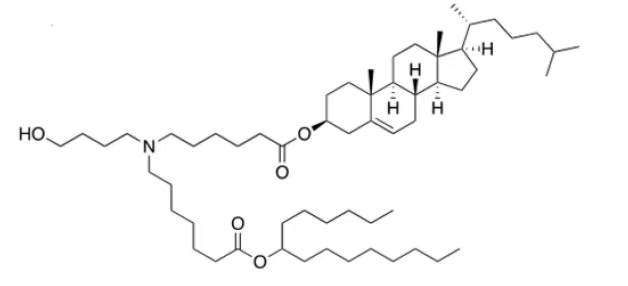
ARV-T1 is a novel ionizable lipid featuring a cholesterol moiety incorporated in its tail, designed to enhance mRNA delivery efficiency. With a pKa of 6.73, it exhibits optimal pH-dependent ionization for endosomal escape and mRNA release. Structurally, ARV-T1 contains a tertiary amine head group and ester-linked lipid tails, enabling rapid in vivo metabolism and improved biocompatibility.Compared to SM-102 (used in Moderna's vaccine), LNPs formulated with ARV-T1 demonstrate superior physicochemical properties: smaller particle size (~80 nm vs. 90 nm), lower polydispersity index (0.09 vs. 0.10), and higher absolute zeta potential (-10 mV vs. -5 mV). These characteristics correlate with >90% mRNA encapsulation efficiency and enhanced stability, maintaining performance for 12 weeks at -20°C.In vitro, ARV-T1 LNPs showed 7-fold higher protein expression than SM-102 LNPs. In vivo, they prolonged luciferase expression (>72 hours vs. <48 hours for SM-102) and induced 10-fold higher neutralizing antibodies against SARS-CoV-2 spike protein at low doses. The cholesterol tail promotes endosomal membrane fusion, while ester linkages facilitate metabolic clearance, yielding an excellent safety profile in toxicity studies. This combination of efficacy and safety positions ARV-T1 as a promising platform for mRNA vaccines and therapeutics.
| CAS No. | Not available |
| Chemical Name | ARV-T1 |
| Synonyms | ARVT1, ARV T1 |
| SMILES | CCCCCCCCC(CCCCCC)OC(=O)CCCCCCN(CCCCO)CCCCCC(=O)O[C@H]1CC[C@@]2(C)C(=CC[C@@H]3[C@@H]2CC[C@@]2(C)[C@H]3CC[C@@H]2[C@H](C)CCCC(C)C)C1 |
| Formula | CsgH107NO5 |
| M.Wt | 910.51 |
| Purity | ELSD-HPLC>95% |
| Storage | Pure form: −20 °C, 1 year; In solvent: −80 °C, 6 months; −20 °C, 1 month. Sealed and protected from light. |
| Shipping condition | Ships from Shanghai. Pure lipid is stable during ice-pack transport. |
| Publication | Lipid Nanoparticles Formulated with a Novel Cholesterol-Tailed Ionizable Lipid Markedly Increase mRNA Delivery Both in vitro and in vivo-Int J Nanomedicine. 2025 Jul 28:20:9389-9405. doi: 10.2147/IJN.S527822. eCollection 2025. |
The product molecular weight is prefilled when available and remains editable. Confirm solvent compatibility and solubility before preparation.
Solvent volumes update from the molecular weight above.
| Mass | 1 mM | 5 mM | 10 mM |
|---|---|---|---|
| 10 mg | 10.9829 mL | 2.1966 mL | 1.0983 mL |
| 25 mg | 27.4571 mL | 5.4914 mL | 2.7457 mL |
| 50 mg | 54.9143 mL | 10.9829 mL | 5.4914 mL |
| 100 mg | 109.8286 mL | 21.9657 mL | 10.9829 mL |
| 250 mg | 274.5714 mL | 54.9143 mL | 27.4571 mL |
Contact our team with the catalog number and requested quantity.