SM-86(Lipid 5)
DC31024
Recommended because it shares a closely related research category or delivery context. Formulation and performance are product- and study-specific.
View product →
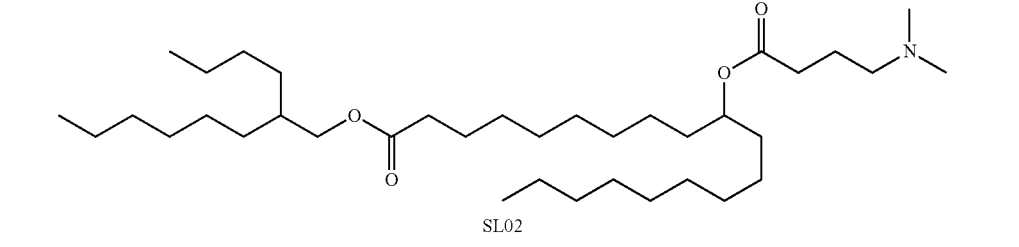
Ionizable lipid for LNP and nucleic-acid delivery research.
SL02 is a next-generation ionizable lipid featuring a unique branched hydrophobic domain and a pH-sensitive dimethylaminoethyl headgroup(pKa 6.25)developed by Seqirus. Its asymmetric lipid tails, combining unsaturated and saturated chains, enhance LNP fusogenicity and endosomal membrane disruption. With a slightly lower pKa than SL01, SL02 achieves efficient mRNA binding at acidic pH while maintaining neutral charge in circulation, reducing nonspecific interactions. In vitro, SL02-LNPs show superior transfection potency in BHK-V cells, attributed to improved cellular uptake and endosomal escape kinetics. In vivo, it elicits high neutralizing antibody titers (comparable to MF59-adjuvanted vaccines) and robust CD8+ T-cell activation. The lipid’s ester-based design ensures biodegradability, while PEGylation compatibility enhances colloidal stability. SL02’s tailored balance of hydrophobicity and ionization enables precise control over nanoparticle size (70–120 nm) and low polydispersity, positioning it as a leading candidate for saRNA-based vaccines and gene therapies.
| CAS No. | Not available |
| Chemical Name | Lipid SL02 |
| Synonyms | Lipid-SL02 |
| SMILES | CCCCCCCCCC(CCCCCCCCC(=O)OCC(CCCC)CCCCCC)OC(=O)CCCN(C)C |
| Formula | C37H73O4N |
| M.Wt | 595.99 |
| Purity | >98% |
| Storage | Pure form: −20 °C, 1 year; In solvent: −80 °C, 6 months; −20 °C, 1 month. Sealed and protected from light. |
| Shipping condition | Ships from Shanghai. Pure lipid is stable during ice-pack transport. |
| Publication | Not available |
The product molecular weight is prefilled when available and remains editable. Confirm solvent compatibility and solubility before preparation.
Solvent volumes update from the molecular weight above.
| Mass | 1 mM | 5 mM | 10 mM |
|---|---|---|---|
| 10 mg | 16.7788 mL | 3.3558 mL | 1.6779 mL |
| 25 mg | 41.9470 mL | 8.3894 mL | 4.1947 mL |
| 50 mg | 83.8940 mL | 16.7788 mL | 8.3894 mL |
| 100 mg | 167.7881 mL | 33.5576 mL | 16.7788 mL |
| 250 mg | 419.4701 mL | 83.8940 mL | 41.9470 mL |
Contact our team with the catalog number and requested quantity.