For research use only. We do not sell to patients.
Ionizable lipids / AA-T3A-C12
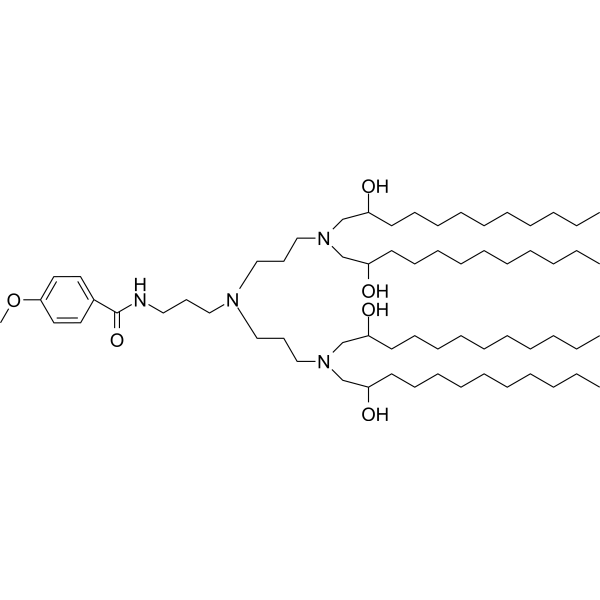
AA-T3A-C12 chemical structure
Product imageResearch use only
CAT. NO. DC65328Featured

AA-T3A-C12

Ionizable lipid for LNP and nucleic-acid delivery research.

Research highlights
Activated-fibroblast targetingHSP47 siRNA deliveryCCl4 liver-fibrosis modelFour-component microfluidic LNP
Derived from the cited study; not a product specification or performance guarantee.

Pack size & price

USD
Total$400
We match the best price and quality on market.
Ships from ShanghaiIce-pack transportPure lipid recommended
Product overview

Description & Application

AA-T3A-C12 is a leading anisamide-tethered lipidoid (AA-lipidoid) identified through a combinatorial library screening for targeted RNA delivery to activated fibroblasts, offering a promising approach to treat liver fibrosis.AA-T3A-C12 is a leading anisamide-tethered lipidoid (AA-lipidoid) identified through a combinatorial library screening for targeted RNA delivery to activated fibroblasts, offering a promising approach to treat liver fibrosis. It is synthesized via a one-pot, two-step modular method that combines anisamide—a ligand for sigma receptors overexpressed on activated hepatic stellate cells (HSCs)—with a T3A polyamine core and C12 epoxide tails, enabling efficient siRNA encapsulation in lipid nanoparticles (LNPs). In vitro, AA-T3A-C12 LNPs exhibit enhanced cellular uptake and gene silencing in activated fibroblasts, dependent on sigma receptor binding, as confirmed by haloperidol blockade studies, and outperform non-targeted analogs and the FDA-approved MC3 LNPs in fibroblast selectivity.In a mouse model of CCl4-induced liver fibrosis, AA-T3A-C12/siHSP47 LNP achieves approximately 65% knockdown of heat shock protein 47 (HSP47), a key fibrotic target, leading to significant reduction in collagen deposition and fibrosis alleviation, with a good safety profile and no exacerbation of liver injury.

CAS No.Not available
Chemical NameAA-T3A-C12
SynonymsAAT3AC12, AA T3A C12
SMILESOC(CCCCCCCCCC)CN(CC(O)CCCCCCCCCC)CCCN(CCCNC(C1=CC=C(OC)C=C1)=O)CCCN(CC(O)CCCCCCCCCC)CC(O)CCCCCCCCCC
FormulaC65H126N4O6
M.Wt1,059.72
PurityELSD-HPLC>95%
StoragePure form: −20 °C, 1 year; In solvent: −80 °C, 6 months; −20 °C, 1 month. Sealed and protected from light.
Shipping conditionShips from Shanghai. Pure lipid is stable during ice-pack transport.
PublicationHan X, Gong N, Xue L, et al. Ligand-tethered lipid nanoparticles for targeted RNA delivery to treat liver fibrosis. Nature Communications. 2023;14:75.

Literature-reported formulation composition

Componentmol%Role
AA-T3A-C1250Ionizable lipid
DSPC10Helper phospholipid
Cholesterol38.5Sterol
C14-PEG20001.5PEG lipid
Reported total100Source values retained
Formulation calculator unavailable. The reported four-component ratio is complete, but the exact chemical identity and average molecular weight of C14-PEG2000 (Avanti #880150) have not been reconciled. The formulation weight calculator and supporting-component bundle remain unavailable. Obtain and verify the complete composition and component molecular weights before planning component quantities.
Not reported in the cited article
10:1 (w/w)
RNA in 10 mM citrate buffer, pH 3; lipid phase in ethanol; final dialysis against 1× PBS.
siRNA (GFP, HSP47 or Cy5-labelled siRNA) and luciferase mRNA in separate experiments
Cell-culture treatment for in vitro endpoints; intravenous tail-vein injection for biodistribution and therapeutic studies
Therapeutic study: 5 micrograms siRNA/mouse (0.2 mg/kg) twice weekly for 2 weeks; other endpoint-specific doses are retained with each result
Activated murine 3T3 fibroblasts and primary HSCs in vitro; male BALB/c mice, 6-8 weeks, with CCl4-induced liver fibrosis in vivo
Ethanolic lipid phase and acidic aqueous RNA phase mixed in a PDMS staggered-herringbone microfluidic device with a 4 cm mixing channel. Aqueous flow 1.8 mL/min; organic flow 0.6 mL/min (3:1 aqueous:organic). Dialysis against 1× PBS for 2 h in a 20 kDa MWCO cassette, 0.22 micrometer filtration, then storage at 4°C. Initial in vitro screening used pipette mixing without dialysis.

Literature-reported performance for the cited formulation

Calculated from published source data82.31 ± 1.15%50 nM siGFP; 48 h; n=3 · With 30 micromolar haloperidol pretreatment: 49.80 ± 6.87% from raw values [44.66512323, 57.60886545322, 47.124865451]Main PDF p.3, Fig. 2d-e; Source Data 'Fig 2d'!C10:H10
Calculated from published source data65.48 ± 4.98%50 nM siHSP47; 48 h; n=3 · MC3/siHSP47 LNP mean 33.77% from raw values [29.6, 38.5, 33.2]Main PDF pp.5-6, Fig. 4e; Source Data 'Fig 4e'!D7:E9
Calculated from published source data65.2% knockdown versus PBS disease controlMale BALB/c mice, 6-8 weeks, CCl4 0.7 microliter/g intraperitoneally twice weekly for 4 weeks; LNP 5 micrograms siRNA/mouse (0.2 mg/kg) intravenously twice weekly during weeks 3-4; tissue collected 2 days after the last treatment. · PBS disease control and MC3/siHSP47 LNP; paper reports MC3 knockdown 31%.Calculated from mean normalized Western-blot values: PBS 18.3, AA-T3A-C12/siHSP47 6.3667; consistent with the paper-reported approximately 65%.Main PDF pp.6 and 8, Fig. 5b/f; pp.10-11, Methods; Source Data 'Fig 5f'!D5:G7
Calculated from published source data3.745 ± 0.898% collagen-positive areaSame therapeutic regimen; n=5 · PBS disease control raw [9.39, 7.67, 9.26, 8.18, 10.1]; MC3/siHSP47 LNP was less effective in the authors' analysis.Mean/sample SD of five AA-T3A-C12/siHSP47 animals. Derived reduction versus the PBS disease-control mean (8.92%) is 58.0%.Main PDF pp.7-8, Fig. 6a-b; Source Data 'Fig 6b'!D6:G10

Reported LNP particle properties

ParameterReported resultSource
Size (DLS)65.6 ± 1.2 nmSupplementary Table S1
PDI0.018Supplementary Table S1
Encapsulation efficiency87.4 ± 3.8%Supplementary Table S1
Zeta potential−1.1 ± 1.5 mVSupplementary Table S1
Apparent pKa (TNS)5.72Main article, characterization

Main PDF p.2, Fig. 1a; p.4, Characterization; pp.9-10, LNP formulation and characterization; SI p.27, Table S1

Additional reported findings

Biodistribution in fibrotic mice

Predominant liver localization, with no significant difference in total liver accumulation versus MC3 (p=0.443). Confocal microscopy showed more AA-T3A-C12 signal colocalized with or near alpha-SMA-positive activated HSCs than MC3.

5 micrograms/mouse IV; fibrotic male BALB/c mice; organs at 1 h; n=3 · Main PDF p.6, Fig. 5a and p.8 caption; SI p.20, Fig. S20; Source Data 'Fig 5a'!B7:K12
Study-specific tolerability

In fibrotic mice, AA-T3A-C12/siGFP LNP did not significantly increase ALT, AST or TBIL versus the PBS disease control; cytokines were not increased by LNP regimens and no histological damage was observed in heart, spleen, lung or kidney.

This is tolerability in a CCl4 injury model under one repeated-dose regimen, not a general toxicology package. · Main PDF pp.6-8, Fig. 6c-e; SI pp.23-24, Figs. S22-S23; Source Data 'Fig 6c'!B4:F9, 'Fig 6d'!B6:F11, 'Fig 6e'!B6:F11, 'Fig S22'!B3:M9
Literature Data DisclaimerAll formulation parameters and performance values shown in this section are derived from the cited publication and are provided for reference only. These results were obtained using the specific materials, formulation process, cargo, dose, analytical method, model and administration route described in that study. Unless otherwise stated, the data were not generated or independently verified by DC Chemicals. DC Chemicals supplies the lipid compound only and does not guarantee that customers will reproduce the reported LNP properties or biological performance.

The administration route shown above was used in the cited study and is not a clinical-use instruction or recommendation by DC Chemicals.
Cited literature for this formulation and performance datasetHan X, Gong N, Xue L, et al. Ligand-tethered lipid nanoparticles for targeted RNA delivery to treat liver fibrosis. Nature Communications. 2023;14:75. DOI: 10.1038/s41467-022-35637-z
Composition, particle properties and study methods come from the main article and SI. Results labelled calculated were computed from the cited published source-data cells; their assay conditions and comparators are retained. No product-specific human efficacy is established.
Laboratory planning

Solution Calculators

The product molecular weight is prefilled when available and remains editable. Confirm solvent compatibility and solubility before preparation.

Mass = concentration × volume × molecular weight
Enter any three values to calculate the fourth.
C₁V₁ = C₂V₂
Enter any three values to calculate the fourth.
Preparing stock solutions

Quick preparation table

Solvent volumes update from the molecular weight above.

Mass1 mM5 mM10 mM
10 mg9.4365 mL1.8873 mL943.65 μL
25 mg23.5911 mL4.7182 mL2.3591 mL
50 mg47.1823 mL9.4365 mL4.7182 mL
100 mg94.3645 mL18.8729 mL9.4365 mL
250 mg235.9114 mL47.1823 mL23.5911 mL

Need a different pack size or technical document?

Contact our team with the catalog number and requested quantity.

Contact us
Handling guidance

Shipping, storage and sampling

How is the lipid shipped, and how should I store it?
We generally ship the neat (undissolved) lipid compound rather than an ethanol solution. The neat lipid is stable during transport with ice packs, and shipments originate from Shanghai. Pure form: store at −20 °C for up to 1 year. In solvent: store at −80 °C for up to 6 months or at −20 °C for up to 1 month. Keep sealed and protected from light. Avoid repeated thaw cycles for best results.
Pure lipid or solution — which should I choose?
Pure lipid is generally more stable during shipping and storage, so we usually recommend the pure form. A solution in ethanol or chloroform can be supplied when required by your workflow. Tell us the intended application, solvent and target concentration so the most suitable format can be confirmed.
How should I measure a small amount of oily or viscous lipid?
Ionizable lipids are often oily liquids or viscous semisolids, so material can be lost during repeated weighing or transfer. For a small pack, dissolve the entire quantity and aliquot it volumetrically. For example, add 1 mL ethanol to 25 mg lipid to prepare a 25 mg/mL stock, then use a pipette to withdraw the required amount. For quantities above 100 mg, direct weighing with an analytical balance may be more practical. Always confirm solvent compatibility and solubility first.
Can you support formulation optimization and scale-up?
Yes. Share the RNA cargo, target tissue, administration route, formulation method and assay plan. Our team can discuss starting molar ratios, N/P ratio and scale-up requirements for research workflows.