E10i-494
DC13101
Recommended because it shares a closely related research category or delivery context. Formulation and performance are product- and study-specific.
View product →
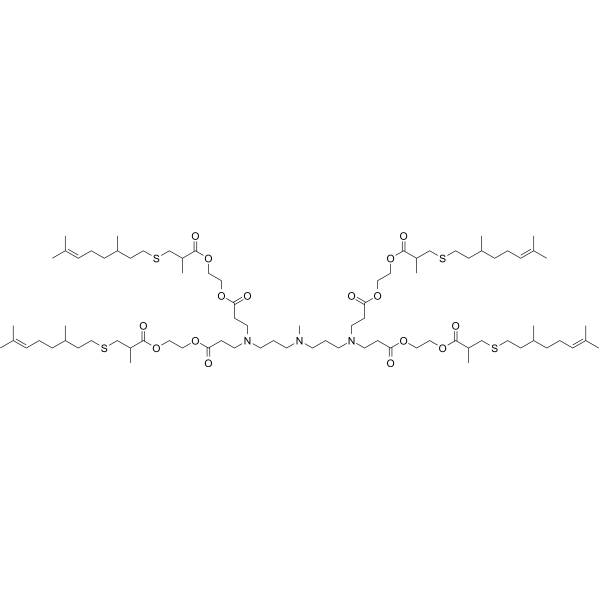
Ionizable lipid for LNP and nucleic-acid delivery research.
4A3-Cit is an ionizable lipid used for the generation of lipid nanoparticles (LNPs). To investigate the role of unsaturated lipid tails in iLNPs, the nucleophilic amines were added to ester-based linkers, followed by Michael’s addition to the thiols to construct a library of 91 amino ionizable lipids. Such ionizable lipids were composed of an ionizable tertiary amine core, an ester-based degradable linker, and an alkylthiol tail periphery. Through in vitro and in vivo screening, the iLNPs with 4A3 core and citronellolbased (Cit) periphery can significantly increase endosome escape and delivery efficiency of mRNA, leading to 18-fold increase in protein expression compared with iLNPs without Cit periphery. Furthermore, the delivery efficiency of mRNA may be associated with the location/configuration of the unsaturated bond(s) in lipids. Although lipids with Cit periphery showed excellent membrane fusion ability to facilitate endosome escape, the fusion mechanism needs to be further clarified.
| CAS No. | Not available |
| Chemical Name | 4A3-Cit |
| Synonyms | 4A3Cit, 4A3 Cit |
| SMILES | O=C(CCN(CCCN(CCCN(CCC(OCCOC(C(CSCCC(CC/C=C(C)/C)C)C)=O)=O)CCC(OCCOC(C(CSCCC(CC/C=C(C)/C)C)C)=O)=O)C)CCC(OCCOC(C(CSCCC(CC/C=C(C)/C)C)C)=O)=O)OCCOC(C(CSCCC(CC/C=C(C)\C)C)C)=O |
| Formula | C83H147N3O16S4 |
| M.Wt | 1,571.33 |
| Purity | 98% |
| Storage | Pure form: −20 °C, 1 year; In solvent: −80 °C, 6 months; −20 °C, 1 month. Sealed and protected from light. |
| Shipping condition | Ships from Shanghai. Pure lipid is stable during ice-pack transport. |
| Publication | S. M. Lee, Q. Cheng, X. L. Yu, S. Liu, L. T. Johnson, D. J. Siegwart, Angew. Chem. Int. Ed. 2021, 60, 5848. |
The product molecular weight is prefilled when available and remains editable. Confirm solvent compatibility and solubility before preparation.
Solvent volumes update from the molecular weight above.
| Mass | 1 mM | 5 mM | 10 mM |
|---|---|---|---|
| 10 mg | 6.3640 mL | 1.2728 mL | 636.40 μL |
| 25 mg | 15.9101 mL | 3.1820 mL | 1.5910 mL |
| 50 mg | 31.8202 mL | 6.3640 mL | 3.1820 mL |
| 100 mg | 63.6404 mL | 12.7281 mL | 6.3640 mL |
| 250 mg | 159.1009 mL | 31.8202 mL | 15.9101 mL |
Contact our team with the catalog number and requested quantity.