TCL053
DC60211
Recommended because it shares a closely related research category or delivery context. Formulation and performance are product- and study-specific.
View product →
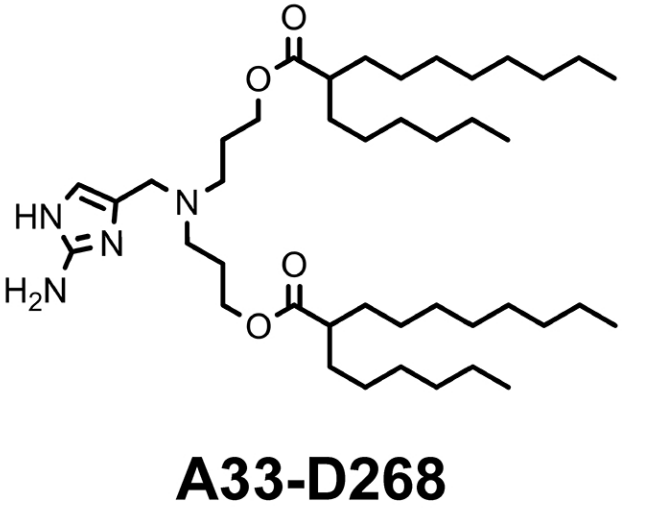
Ionizable lipid for LNP and nucleic-acid delivery research.
A33-D268 is an ionizable lipid derived from a 2-aminoimidazole (AM) core, featuring an asymmetric hydrophobic tail structure designed to optimize mRNA interactions. Selected as the top candidate from a 21-lipid library through molecular dynamics (MD) simulations, it demonstrated superior performance: low root mean square deviation (RMSD) and the smallest radius of gyration (Rg), indicating tight mRNA compaction, alongside moderate electrostatic energy and above-average hydrogen bonding for stable encapsulation. Formulated into LNPs, it achieves efficient muscle-specific transfection post-intramuscular injection, rivaling commercial ALC-0315 LNPs. Crucially, it exhibits 29-fold lower hepatic off-target expression, attributed to its inability to leverage serum protein coronas for liver tropism.
| CAS No. | Not available |
| Chemical Name | Lipid A33-D268 |
| Synonyms | Lipid A33 D268 |
| SMILES | CCCCCCCCC(CCCCCC)C(=O)OCCCN(CCCOC(=O)C(CCCCCC)CCCCCCCC)CC1=CNC(N)=N1 |
| Formula | C42H80O4N4 |
| M.Wt | 705.13 |
| Purity | 98% |
| Storage | Pure form: −20 °C, 1 year; In solvent: −80 °C, 6 months; −20 °C, 1 month. Sealed and protected from light. |
| Shipping condition | Ships from Shanghai. Pure lipid is stable during ice-pack transport. |
| Publication | Not available |
The product molecular weight is prefilled when available and remains editable. Confirm solvent compatibility and solubility before preparation.
Solvent volumes update from the molecular weight above.
| Mass | 1 mM | 5 mM | 10 mM |
|---|---|---|---|
| 10 mg | 14.1818 mL | 2.8364 mL | 1.4182 mL |
| 25 mg | 35.4545 mL | 7.0909 mL | 3.5454 mL |
| 50 mg | 70.9089 mL | 14.1818 mL | 7.0909 mL |
| 100 mg | 141.8178 mL | 28.3636 mL | 14.1818 mL |
| 250 mg | 354.5446 mL | 70.9089 mL | 35.4545 mL |
Contact our team with the catalog number and requested quantity.