5A2-SC8
DC49907
Recommended because it shares a closely related research category or delivery context. Formulation and performance are product- and study-specific.
View product →
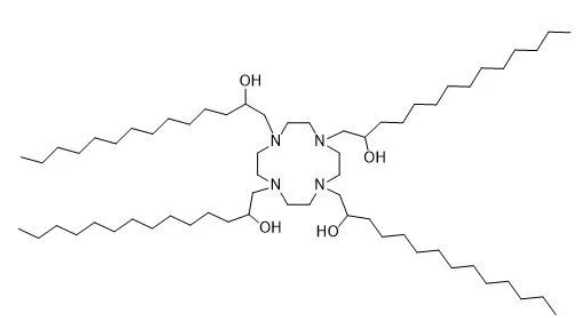
Ionizable lipid for LNP and nucleic-acid delivery research.
H7T4-4 is an ionizable lipid designed for mRNA delivery via lipid nanoparticles (LNPs). It features a cyclic amine headgroup (derived from cyclen tetrahydrochloride) and four C14 hydrophobic alkyl tails, synthesized through a Michael addition reaction between cyclen and 1,2-epoxytetradecane. With a high transition temperature (Tm = 58.6°C) due to strong intermolecular interactions from its cyclic headgroup and multi-tail structure, H7T4-4 alone forms rigid aggregates incompatible with mRNA encapsulation. However, when blended with low-Tm helper lipids (e.g., DOPE, Tm = -16°C), the system’s overall Tm decreases, enabling stable LNP formation. Optimized formulations (20% H7T4-4, 41% DOPE, 38% cholesterol, 1% DMG-PEG) exhibit efficient mRNA encapsulation (>90%) and transfection. Structural analyses (SAXS, cryo-TEM) confirm monodisperse LNPs with lamellar/hexagonal phases. In vivo, H7T4-4 LNPs show tumor-targeted and intranasal mRNA delivery with reduced off-target accumulation compared to SM-102-based LNPs. This rational design highlights Tm-guided helper lipid selection to overcome rigidity challenges in ionizable lipids.
| CAS No. | Not available |
| Chemical Name | Lipid H7T4-4 |
| Synonyms | Lipid H7T4 4 |
| SMILES | CCCCCCCCCCCCC(O)CN1CCN(CC(O)CCCCCCCCCCCC)CCN(CC(O)CCCCCCCCCCCC)CCN(CC(O)CCCCCCCCCCCC)CC1 |
| Formula | C64H132N4O4 |
| M.Wt | 1,021.78 |
| Purity | ELSD-HPLC>95% |
| Storage | Pure form: −20 °C, 1 year; In solvent: −80 °C, 6 months; −20 °C, 1 month. Sealed and protected from light. |
| Shipping condition | Ships from Shanghai. Pure lipid is stable during ice-pack transport. |
| Publication | Transition Temperature-Guided Design of Lipid Nanoparticles for Effective mRNA Delivery-ACS Applied Materials & InterfacesVol 17-Jeong Eun ShinEun-jeong WonJunchao XuJong Cheol LeeJeong Kyu Bang*Michael J. Mitchell*Hyunjoo Cha-Molstad* |
The product molecular weight is prefilled when available and remains editable. Confirm solvent compatibility and solubility before preparation.
Solvent volumes update from the molecular weight above.
| Mass | 1 mM | 5 mM | 10 mM |
|---|---|---|---|
| 10 mg | 9.7868 mL | 1.9574 mL | 978.68 μL |
| 25 mg | 24.4671 mL | 4.8934 mL | 2.4467 mL |
| 50 mg | 48.9342 mL | 9.7868 mL | 4.8934 mL |
| 100 mg | 97.8684 mL | 19.5737 mL | 9.7868 mL |
| 250 mg | 244.6711 mL | 48.9342 mL | 24.4671 mL |
Contact our team with the catalog number and requested quantity.