Lipid A10
DC68150
Recommended because it shares a closely related research category or delivery context. Formulation and performance are product- and study-specific.
View product →
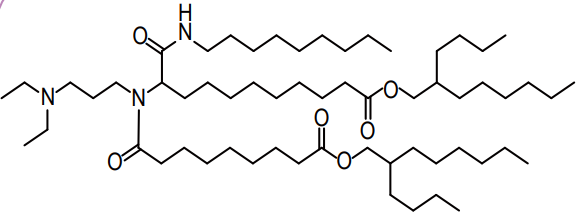
Lipid-168 is an ionizable lipid investigated in an antibody-free LNP platform for bone-marrow delivery and in vivo base editing.
Open full Formulation & Performance →
The peer-reviewed study evaluates reporter delivery in mice and HBG promoter editing in mice engrafted with β-thalassaemia patient-derived cells. Cargo design and lipid composition are distinct contributors to the measured performance.
Lipid-168 was studied by Xu et al. in Nature Biomedical Engineering (published online in 2025; volume 10, 2026). The structure in final Figure 4 matches the catalog connectivity. The tables below separate the earlier preprint formulation record from the final publication’s particle measurements and biological source data.
| Component | DC Chemicals product | Molecular weight | Molar ratio | Mass at 1 µmol total lipid (mg) |
|---|---|---|---|---|
| Lipid-168 | DC60683 | 976.611 | 50 | 0.488306 |
| Cholesterol | DCD-041 | 386.65 | 38.5 | 0.148860 |
| DSPC | DC57005 | 790.15 | 10 | 0.079015 |
| DMG-PEG2000 | DC40169 | 2507 | 1.5 | 0.037605 |
The 2024 preprint reports a 50:38.5:10:1.5 molar ratio, N/P 4.5, ABE mRNA:sgRNA 1:1 mass ratio and citrate pH 5. These preparation details have not been independently reverified against the subscription-only final Methods. Particle and biological results below use the final publication. Mass conversion uses molecular weight 976.611; DMG-PEG2000 uses the catalog convention 2507.
Prefilled proportions follow the source specified above. Molecular weights and ratios are editable. Results are calculated, not measured study data. No N/P or RNA dose is inferred.
| Component | MW | Molar ratio | Mass (mg) | Mass % |
|---|---|---|---|---|
| Lipid-168 | ||||
| Cholesterol | ||||
| DSPC | ||||
| DMG-PEG2000 |
| LNP-168 cargo | Diameter (nm) | PDI | EE (%) | Apparent pKa | Source |
|---|---|---|---|---|---|
| ABE8e / sgRNA-PCSK9 | 75.8 | 0.02 | 93.4 | Not listed | Supplementary Table 8 |
| Luc mRNA | 71.6 | 0.02 | 94.7 | 7.36 | Supplementary Table 9 |
| Luc-miR-122 mRNA | 76.7 | 0.03 | 95.1 | 7.41 | Supplementary Table 9 |
| Cre mRNA | 75.8 | 0.02 | 93.4 | 7.39 | Supplementary Table 9 |
| Cre-miR-122 mRNA | 69.1 | 0.02 | 89.9 | 7.43 | Supplementary Table 9 |
| ABE8e / sgRNA-25(HBG) | 73.6 | 0.04 | 92.6 | 7.32 | Supplementary Table 9 |
The final published SI separates each cargo formulation; these particle values are not neat-lipid specifications.
| Endpoint | Context | Calculated mean ± SD | Source |
|---|---|---|---|
| Mouse BM cells / PCSK9 editing | In vitro; 3 days; n=5 LNP-168, n=3 LNP-028 | LNP-168 57.00 ± 6.44%; LNP-028 28.00 ± 1.00% | Fig. 4c |
| Mouse BM / PCSK9 editing | Two IV 2 mg/kg doses,14 days apart; n=4 | ABE8e 44.75 ± 8.06%; ABE8e-miR-122T 46.00 ± 5.48% | Fig. 4d |
| Mouse liver / PCSK9 editing | Same two-dose study; n=4 | ABE8e 71.25 ± 2.87%; ABE8e-miR-122T 19.00 ± 2.58% | Fig. 4d |
| Ai14 total BM / tdTomato-positive cells | Cre-miR-122T; IV 1 mg/kg once; day 4; n=5 | LNP-168 60.60 ± 7.36%; MC3 11.80 ± 2.89% | Fig. 4g |
| Ai14 HSC / tdTomato-positive cells | Same single-dose Cre-miR-122T study; n=5 | LNP-168 45.68 ± 4.04%; MC3 8.08 ± 2.46% | Fig. 4h |
| Patient-derived human BM / HBG editing | Humanized mice;IV 1 mg/kg twice, 14 days apart;14 days after dose 2; n=3 | A5 43.11 ± 2.81%; A6 41.33 ± 5.50% | Fig. 5b |
| Erythroid cells differentiated from treated BM / HBG editing | Same animals; n=3 | A5 42.24 ± 1.68%; A6 37.76 ± 0.90% | Fig. 5b |
Means and sample SD calculated from individual values in publisher Source Data, Figure 4 and Figure 5 worksheets. Reporter-positive fraction and base-editing percentage are different endpoints. The reduction in liver editing in the miR-122T arm depends on engineered RNA cargo, not simply on the lipid.
| Study | Finding |
|---|---|
| C57 mice;two IV 1 mg/kg doses, 14 days apart;follow-up to day 29;Fig. 6 | Acute ALT/AST and inflammatory-marker elevations were observed, followed by declines over time. |
| Late sampling | The caption reports nonsignificant enzyme differences at days 7/22 and cytokine differences at day 2/day 22 versus control. |
| Scope | No clinical safety or nonhuman-primate efficacy was established. |
Source: final Figure 6 caption and Source Data. Numerical enzyme and cytokine concentrations are not transcribed because their units were not independently reconciled. The observed acute response precludes a blanket “no toxicity” claim.
| CAS No. | Not available |
| Chemical Name | Lipid-168 |
| Synonyms | Lipid 168, Lipid168 |
| SMILES | CCCCCCCCCNC(=O)C(CCCCCCCCC(=O)OCC(CCCC)CCCCCC)N(CCCN(CC)CC)C(=O)CCCCCCCC(=O)OCC(CCCC)CCCCCC |
| Formula | C60H117O6N3 |
| M.Wt | 976.611 |
| Purity | >95% by ELSD-HPLC |
| Storage | Pure form: −20 °C, 1 year; In solvent: −80 °C, 6 months; −20 °C, 1 month. Sealed and protected from light. |
| Shipping condition | Ships from Shanghai. Pure lipid is stable during ice-pack transport. |
| Publication |
|
The product molecular weight is prefilled when available and remains editable. Confirm solvent compatibility and solubility before preparation.
Solvent volumes update from the molecular weight above.
| Mass | 1 mM | 5 mM | 10 mM |
|---|---|---|---|
| 10 mg | 10.2395 mL | 2.0479 mL | 1.0239 mL |
| 25 mg | 25.5987 mL | 5.1197 mL | 2.5599 mL |
| 50 mg | 51.1975 mL | 10.2395 mL | 5.1197 mL |
| 100 mg | 102.3949 mL | 20.4790 mL | 10.2395 mL |
| 250 mg | 255.9873 mL | 51.1975 mL | 25.5987 mL |
Contact our team with the catalog number and requested quantity.