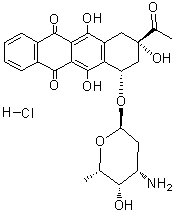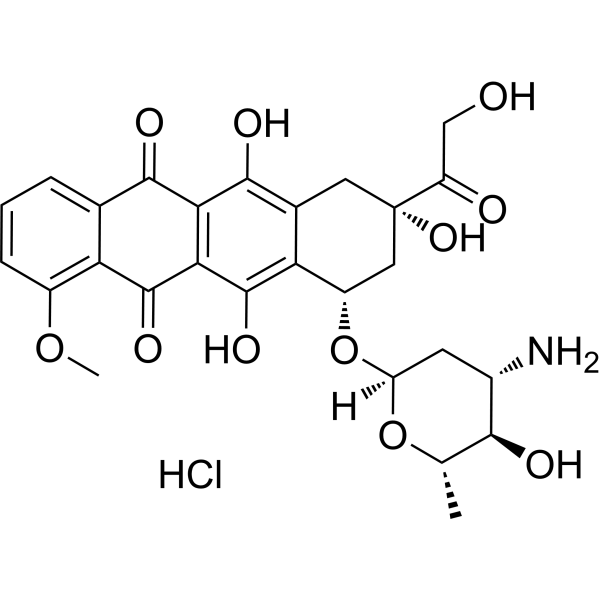
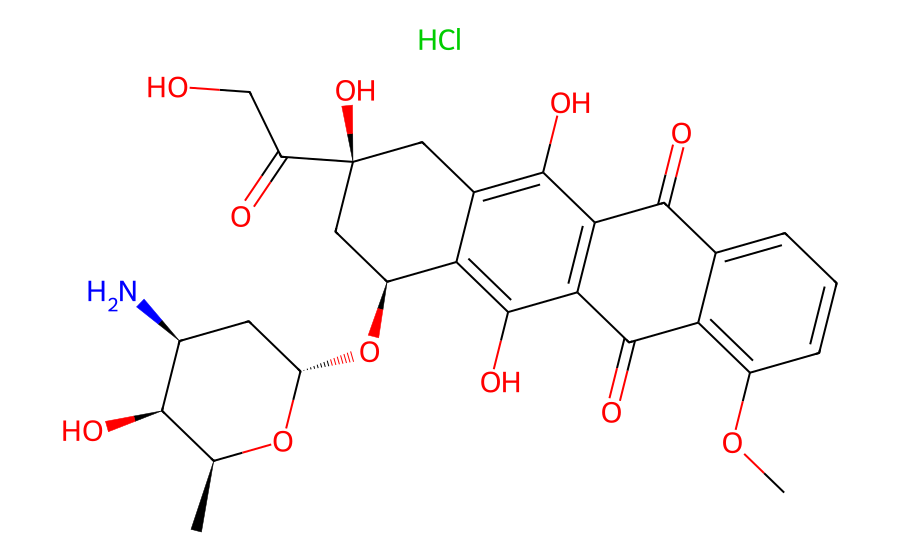
Epirubicin HCl (4'-epidoxorubicin) chemical structure
Chemical structureResearch use only
CAT. NO. DC5184Featured

Epirubicin HCl (4'-epidoxorubicin)

Pack Sizes & Prices

TotalUS$450
We match the best price and quality on market.
Product overview

Description & Application

Epirubicin (hydrochloride) is a semisynthetic L-arabino derivative of doxorubicin, and an antineoplastic agent by inhibiting Topoisomerase.

ParameterValue
Chemical NameEpirubicin hydrochloride
CAS No.56390-09-1
SynonymsEpirubicin HCl;epirubicin hydrochloride;l-erythro-dihydrosphingosine;4'-Epidoxorubicin hydrochloride;5,12-Naphthacenedione, 10-[(3-amino-2,3,6-trideoxy-.α.-L-arabino-hexopyranosyl)oxy]-7,8,9,10-tetrahydro-6,8,11-trihydroxy-8-(hydroxyacetyl)-1-methoxy-, hydrochloride;Epirubicin (hydrochloride);Epirubicin, Hydrochloride Salt (4'-Epidoxorubicin,Pharmorubicin®, Ellence®, Epirubicin Ebewe®, Pharmorubicin,Ridorubicin);(8S-cis)-10-[(3-Amino-2,3,6-trideoxy-alpha-L-arabino-hexopyranosyl)oxy]-7,8,9,10-tetrahydro-6,8,11-trihydroxy-8-(hydroxyacetyl)-1-methoxynaphthacene-5,12-dione hydrochloride;(7S,9S)-7-[(2R,4R,5R)-4-Amino-5-hydroxy-6-methyloxan-2-yl]oxy-6,9,11-trihydroxy-9-(2-hydroxyacetyl)-;Adriamycin;DOXORUBICIN;14-hydroxydaunomycin;4'-Epiadriamycin Pidorubicin hydrochloride 4'-epi-Adriamycin hydrochloride Epirubicin 5,12-Naphthacenedione, 10-[(3-amino-2,3,6-trideoxy-.alpha.-L-arabino-hexopyranosyl)oxy]-7,8,9,10-tetrahydro-6,8,11-trihydroxy-8-(hydroxyacetyl)-1-methoxy-, hydrochloride 5,12-Naphthacenedione, 10-[(3-amino-2,3,6-trideoxy-.alpha.-L-arabino-hexopyranosyl)oxy]-7,8,9,10-tetrahydro-6,8,11-trihydroxy-8-(hydroxyacetyl)-1-methoxy-, hydrochloride, (8S-cis)-;14-hydroxydaunorubicine;Epirubicin;doxorubicin;(1S,3S)-3-glycoloyl-3,5,12-trihydroxy-10-methoxy-6,11-dioxo-1,2,3,4,6,11-hexahydrotetracen-1-yl 3-amino-2,3,6-trideoxy-alpha-L-lyxo-hexopyranoside;(8S-cis)-10-((3-amino-2,3,6-trideoxy-alpha-L-lyxo-hexopyranosyl)oxy)-7,8,9,10-tetrahydro-6,8,11-trihydroxy-8-(hydroxyacetyl)-1-methoxy-5,12-naphthacenedione;CCRIS 4477;E-ADM;(8S-cis)-10-((3-Amino-2,3,6-trideoxy-beta-L-arabino-hexopyranosyl)oxy)-7,8,9,10-tetrahydro-6,8,11-trihydroxy-8-(hydroxyacetyl)-1-methoxy-5,12-naphthacenedione Hydrochloride;Hydrochloride, Epirubicin;3-Glycoloyl-1,2,3,4,6,11-hexahydro-3,5,12-trihydroxy-10-methoxy-6,11-dioxo-1-naphthacenyl-3-amino-2,3,6-trideoxy-alpha-L-arabino-hexopyranoside Hydrochloride;5,12-Naphthacenedione, 10-((3-amino-2,3,6-trideoxy-alpha-L-arabinohexopyranosyl)oxy)-7,8,9,10-tetrahydro-6,8,11-trihydroxy-8-(hydroxyacetyl)-1-methoxy-, hydrochloride, (8S,10S)-;Farmorubicina;CPD000466308;CHEMBL1200981;Farmorubicin;EPIRUBICIN HYDROCHLORIDE (EP MONOGRAPH);NS00087126;EINECS 260-145-2;(8S-cis)-10-((3-Amino-2,3,6-trideoxy-alpha-L-arabino-hexopyranosyl)oxy)-7,8,9,10-tetrahydro-6,8,11-trihydroxy-8-(hydroxyacetyl)-1-methoxynaphthacene-5,12-dione hydrochloride;(2S,4S)-4-(3-Amino-2,3,6-trideoxy-alpha-L-arabino-hexopyranosyloxy)-2,5,12-trihydroxy-2-hydroxyacetyl-7-methoxy-1,2,3,4-tetrahydrotetracene-6,11-dione monohydrochloride;5,12-NAPHTHACENEDIONE, 10-((3-AMINO-2,3,6-TRIDEOXY-.ALPHA.-L-ARABINO-HEXOPYRANOSYL)OXY)-7,8,9,10-TETRAHYDRO-6,8,11-TRIHYDROXY-8-(HYDROXYACETYL)-1-METHOXY-, HYDROCHLORIDE, (8S-CIS)-;Epirubicin hydrochloride;4'-epi-Adriamycin;EPIRUBICIN HYDROCHLORIDE (USP MONOGRAPH);Q27253634;4'-epi-Doxorubicin;EPIRUBICIN HYDROCHLORIDE [ORANGE BOOK];SCHEMB...
FormulaC27H30ClNO11
M.Wt579.98
SMILESCl[H].O([C@@]1([H])C([H])([H])[C@]([H])([C@]([H])(C([H])(C([H])([H])[H])O1)O[H])N([H])[H])[C@]1([H])C2C(=C3C(C4C(=C([H])C([H])=C([H])C=4C(C3=C(C=2C([H])([H])[C@@](C(C([H])([H])O[H])=O)(C1([H])[H])O[H])O[H])=O)OC([H])([H])[H])=O)O[H]
Purity>98%
Storage2 years -20°C Powder, 2 weeks4°C in DMSO,6 months-80°C in DMSO

Biological Activity

Epirubicin (hydrochloride) is a semisynthetic L-arabino derivative of doxorubicin, and an antineoplastic agent by inhibiting Topoisomerase.

In Vitro

Epirubicin, like doxorubicin, exerts its antitumor effects by complex with DNA, resulting in damage to DNA and interference with the synthesis of DNA, RNA, and proteins. Epirubicin may also affect the integrity and activity of cellular membranes. Maximal cell kill caused by Epirubicin occurs during the S phase of the cell cycle. With higher concentrations effects are also seen in early G2 as well as G1 and M phases[1]. Epirubicin display antineoplastic activity against most cancer cells. Epirubicin is cytotoxic to Hepatoma G2 cells with IC50 of 1.6 μg/mL at 24 hr. 1.6 μg/mL Epirubicin induces apoptosis of Hep G2 cells, and higher activity of catalase by 50%, Se-dependent glutathione peroxidase by 110%, Cu, Zn-superoxide dismutase by 172% and Mn-superoxide dismutase by 135%. Epirbicin increases the cellular expression of NADPH-CYP 450 reductase, and reduces GST-π expression[2].

In Vivo

Epirubicin are clinically active against a broad range of tumor types, including breast cancer, malignant lymphomas, soft tissue sarcomas, lung cancer, pleural mesothelioma, gastrointestinal cancer, head and neck cancer, ovarian cancer, prostatic carcinoma, transitional bladder carcinoma and so on[3]. Epirubicin at a dose of 3.5 mg/kg suppresses tumor mass of human breast tumor xenograft R-27 by 74.4 %[4].

References & source

DC Chemicals original product information

Published experimental findings depend on the model and assay conditions. They do not guarantee equivalent performance in every application. For laboratory research use only.
Product documentation

Refer to the certificate supplied with your lot for batch-specific release results.

Handling guide

2 years -20°C Powder, 2 weeks4°C in DMSO,6 months-80°C in DMSO

Solution calculator

Related research products

Doxorubicin hydrochloride chemical structureDC4188

Doxorubicin hydrochloride

Doxorubicin hydrochloride is a cytotoxic anthracycline antibiotic for the treatment of multiple cancers. The possible mechanisms by which doxorubicin acts in the cancer cell are intercalation into DNA and disruption of…

View activity & prices
beta-Lapachone (ARQ-501, CO-501) chemical structureDC7905

beta-Lapachone (ARQ-501, CO-501)

Beta-Lapachone inhibits DNA relaxation induced by DNA topoisomerase I in a dose-dependent manner. Treatment of beta-lapachone (100 nM or greater) results in >95% inhibition of Topo I DNA unwinding activity compared to…

View activity & prices
SW-044248 chemical structureDC8852

SW-044248

SW044248 is a non-canonical topoisomerase I inhibitor, and selectively toxic for certain non-small cell lung cancer (NSCLC) cell lines.

View activity & prices
SN-38(NK-012) chemical structureDC5905

SN-38(NK-012)

SN-38 is an active metabolite of the Topoisomerase I inhibitor Irinotecan. SN-38 inhibits DNA and RNA synthesis with IC50s of 0.077 and 1.3 μM, respectively.

View activity & prices
Voreloxin chemical structureDC7530

Voreloxin

Voreloxin is a first-in-class topoisomerase II inhibitor that intercalates DNA and induces site-selective DNA DSB, G2 arrest, and apoptosis.

View activity & prices
Cytarabine hydrochloride chemical structureDCAPI1566

Cytarabine hydrochloride

For the detailed information of Cytarabine hydrochloride, the solubility of Cytarabine hydrochloride in water, the solubility of Cytarabine hydrochloride in DMSO, the solubility of Cytarabine hydrochloride in PBS…

View activity & prices

Cart

Request quotation