Biological Activity
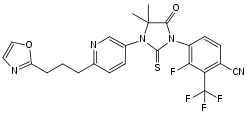
Proxalutamide (GT0918) is a potent androgen receptor (AR) antagonist.
In Vitro
In biochemical assay, Proxalutamide (GT0918) more potently inhibits androgen binding with AR's ligand binding domain than Bicalutamide (11.4x) and MDV3100 (3.5x). In both hormone-sensitive (LNCaP) and CRPC (C4-2) cancer cells, Proxalutamide demonstrates stronger potency to block AR function of gene transcription than Bicalutamide (~5-10) and MDV3100 (2-5x) while maintaining full antagonism in CRPC cells. Proxalutamide impairs androgen stimulates AR translocation to cell nuclei hence blocks its binding DNA and shuts down the downstream oncogenic signaling. Moreover, Proxalutamide induces AR down regulation in prostate cancer cells. Proxalutamide not only inhibits proliferation of hormone-sensitive CaP cells, but also more potently inhibits proliferation of CRPC cells. In addition, Proxalutamide inhibits the growth of AR positive breast cancer cells. In contrast, Proxalutamide has minimum effects on the growth of AR-negative CaP cells (PC-3 and DU145), indicating it is a selective AR pathway inhibitor[1].
In Vivo
The major pharmacokinetic parameters and statistical moment parameters are summarized. The tmax for the pHM-SD and conventional tablets are 0.9±0.4 h and 2.5±1.1 h, respectively, meaning that the pHM-SD tablets dissolve more quickly than the conventional tablets. Moreover, the difference between the tmax of the two treatments is statistically significant (p<0.05). The mean Cmaxand the AUC0-36 are 5.1±2.4 μg/mL and 38.3±8.2 μgh/mL for the pHM-SD tablets versus 3.1±1.5 μg/mL and 42.1±22.3 μgh/mL for conventional tablets, respectively. The relative bioavailability (frel) of the pHM-SD tablets is 125.6% of that for the conventional tablets on average, revealing that the bioavailability of the former is higher. The mean Proxalutamide (GT0918) half-life estimate from the pHM-SD tablets (7.9±2.2 h) was similar to that of the conventional tablets (8.4±0.5 h), remaining consistent with the following pharmacoki-netic theory: the extent and rate of absorption should not affect elimination[2].
Target
Androgen Receptor[1].
Animal Administration
Beagle Dogs[2] A single dose (25 mg Proxalutamide), randomized study with a two period crossover design is carried out to assess the pharmacoki-netics. Six healthy beagle dogs (9.3±0.7 kg) are randomly divided into two groups and fasted with free access to water overnight. Each group is orally administered with pHM-SDs tablet (Test) or a conventional tablet followed by 50 mL of water, respectively. The dogs obtain free access to water and food 6 h after drug administration. After a 1-week washout period, the groups are inverted and the administrations are repeated. A series of blood samples (1 mL) is collected in heparinized tubes using an indwelling cannula at pre-dose (-0.5 h) and post-dose (0.5, 1, 1.5, 2, 2.5 4, 6, 12, 24, 30, 36 and 48 h); these samples are gently mixed and centrifuged at 4000 rpm for 10 min within 1 h of collection[2].
References & source
[1]. Youzhi Tong, et al. Abstract 614: Proxalutamide (GT0918), a potent androgen receptor pathway inhibitor. Cancer Research. AACR Annual Meeting 2014; April 5-9, 2014; San Diego, CA.
[2]. Yang M, et al. Microenvironmental pH-modified solid dispersions to enhance the dissolution and bioavailability of poorly water-soluble weakly basic GT0918, a developing anti-prostate cancer drug: preparation, characterization and evaluation in vivo. Int J Pharm. 2014 Nov 20;475(1-2):97-109.
Published experimental findings depend on the model and assay conditions. They do not guarantee equivalent performance in every application. For laboratory research use only.