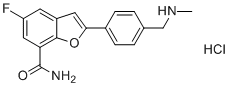
Biological Activity
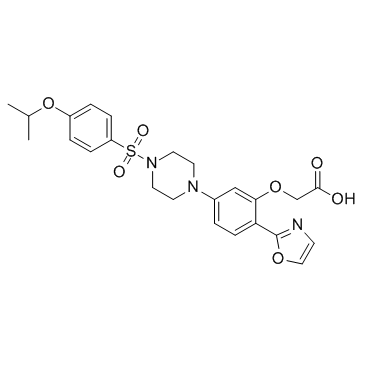
Asapiprant is a potent and selective DP1 receptor antagonist with a Ki of 0.44 nM..
In Vitro
Oral administration of Asapiprant to sheep at 1 and 3 mg/kg significantly (P<0.01) suppresses the increase in nasal resistance by 82% and 92%, respectively. Oral administration of Asapiprant to sheep at 5 mg/kg suppresses Prostaglandin (PG) D2 (PGD)2-induced nasal resistance by 86%. When orally administered 1 h before the antigen challenge in pigs, Asapiprant (3, 10, and 30 mg/kg) suppresses immediate airway response (IAR) by 52%, 57%, and 96%, and late airway response (LAR) by 67%, 50%, and 79%, respectively. Orally administered with Asapiprant (5 mg/kg) for 4 days, the Asapiprant significantly (P<0.01) suppresses antigen-induced nasal resistance by 73% in sheep. Treatment with 3 and 30 mg/kg of Asapiprant in pigs significantly (P<0.01) suppresses nasal secretion by 53% and 72%, respectively. Treatment with Asapiprant in rats at 10 mg/kg significantly (P<0.05) reduces airway hyper-responsiveness (AHR), infiltration of inflammatory cells, and mucin production in bronchoalveolar lavage fluid (BALF), although treatment with Asapiprant at 0.1 mg/kg does not have a significant effect on any responses[1].
In Vivo
No in vivo data are provided in the current product source. Contact us for further information.
References & source
https://www.nature.com/articles/s41586-022-04630-3
Published experimental findings depend on the model and assay conditions. They do not guarantee equivalent performance in every application. For laboratory research use only.