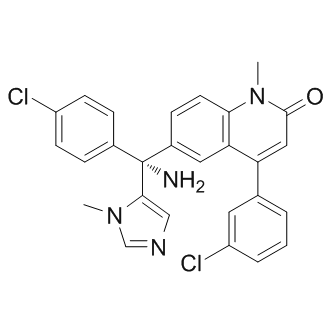
Tipifarnib chemical structure
Chemical structureResearch use only
CAT. NO. DC9701Featured

Tipifarnib

Pack Sizes & Prices

TotalUS$850
We match the best price and quality on market.
Product overview

Description & Application

Tipifarnib is a potent and specific farnesyltransferase (FTase) inhibitor with IC50 of 0.6 nM, and the anti-proliferative effects are most prominent in H-ras or N-ras mutant cells.

ParameterValue
Chemical NameZarnestra; IND 58359; R115777; IND-58359; IND58359; R-115777; R 115777
CAS No.192185-72-1
SynonymsZarnestra; IND 58359; R115777; IND-58359; IND58359; R-115777; R 115777
FormulaC27H22Cl2N4O
M.Wt489.4
SMILESCN1C=NC=C1[C@@](C2=CC=C(C=C2)Cl)(C3=CC4=C(C=C3)N(C(=O)C=C4C5=CC(=CC=C5)Cl)C)N
Purity>98%
Storage2 years -20°C Powder, 2 weeks 4°C in DMSO, 6 months -80°C in DMSO

Biological Activity

Tipifarnib is a potent and specific farnesyltransferase (FTase) inhibitor with IC50 of 0.6 nM, and the anti-proliferative effects are most prominent in H-ras or N-ras mutant cells.

In Vitro

Tipifarnib (5 μM) leads the percentage of apoptotic cells significantly higher in drug-treated compared to DMSO-treated LGL T-cells. Using T-cells from healthy donors, tipifarnib reduces the percentage of IFNγ-positive cells in a time-dependent manner. Tipifarnib reduces the amount of activated Ras in precipitates compared to DMSO[2]. Tipifarnib exerts selective in vitro toxicity against clonal MDS hematopoiesis at concentrations less than 10 nM the effect being more prominent in white cell progenitors. This action is not due to apoptosis induction as both normal and MDS progenitors displays equivalent DiOC3 and annexin V expression up to 72 hours after exposure to Tipifarnib[3]. Combining Tipifarnib with 10 nM 4-OH-tamoxifen in the presence of E2 reduces the IC50 8-fold from 400 to 50 nM[4]. Tipifarnib induces apoptosis in U937 cells[5]. In addition, Tipifarnib inhibits isolated human farnesyltransferase for a lamin B peptide and for the K-RasB peptide with IC50 of 0.86 nM and 7.9 nM, respectively[6].

In Vivo

Tipifarnib has the light of the modest toxicity in patients and the potent reduction of graft-versus-host disease in mice, and it could help to reduce graft-versus-host disease significantly without having a negative impact on immune reconstitution[1]. Combined therapy with tamoxifen and Tipifarnib (50 mg/kg, p.o.) produces greater tumor growth inhibition when compared with either drug alone. E2 deprivation and Tipifarnib in combination results in greater growth inhibition than either E2 deprivation or Tipifarnib alone. The combination of tamoxifen and Tipifarnib results in significantly lower Ki-67 compared with either tamoxifen or Tipifarnib alone. Tipifarnib alone also reduces the CTI compared with control. The combination of tamoxifen and Tipifarnib or Tipifarnib coupled with E2 withdrawal is most effective at lowering the CTI (0.8 and 0.7, respectively), which may account for the decrease in tumor volume[4].

References & source

DC Chemicals original product information

Published experimental findings depend on the model and assay conditions. They do not guarantee equivalent performance in every application. For laboratory research use only.
Product documentation

Refer to the certificate supplied with your lot for batch-specific release results.

Handling guide

2 years -20°C Powder, 2 weeks 4°C in DMSO, 6 months -80°C in DMSO

Solution calculator

Related research products

AZD1152 chemical structureDC7060

AZD1152

AZD1152 is a pro-drug of Barasertib-hQPA, which is a highly selective Aurora B inhibitor with IC50 of 0.37 nM in a cell-free assay.

View activity & prices
AT7519 HCL chemical structureDC1025

AT7519 HCL

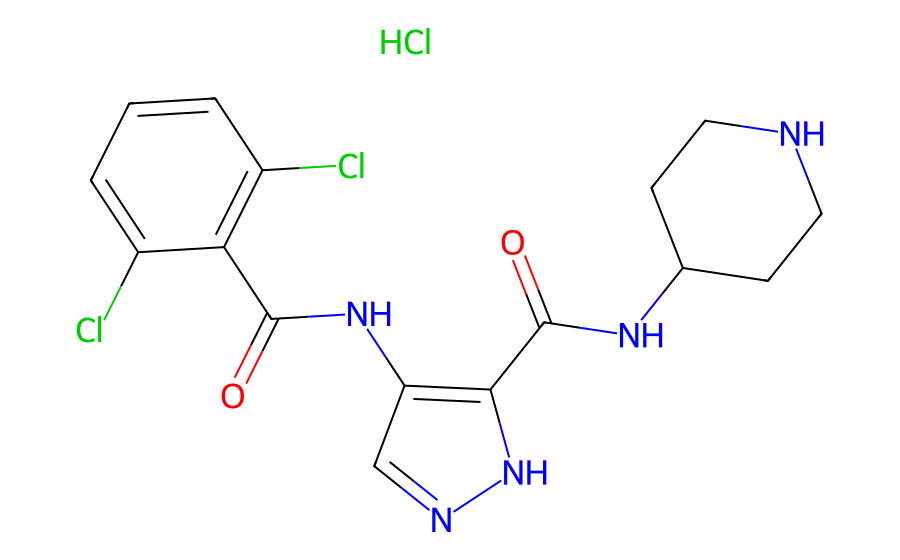
AT7519 Hydrochloride is a potent inhibitor of CDKs, with IC50s of 210, 47, 100, 13, 170, and <10 nM for CDK1, CDK2, CDK4 to CDK6, and CDK9, respectively.

View activity & prices
NVP-TAE684 chemical structureDC7303

NVP-TAE684

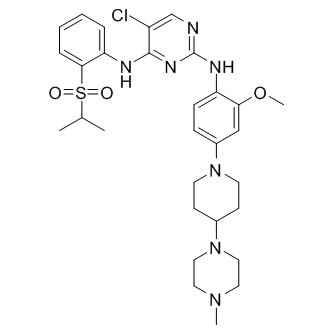
NVP-TAE 684 is a highly potent and selective ALK inhibitor, which blocks the growth of ALCL-derived and ALK-dependent cell lines with IC50 values between 2 and 10 nM.

View activity & prices
Volasertib(BI6727) chemical structureDC7187

Volasertib(BI6727)

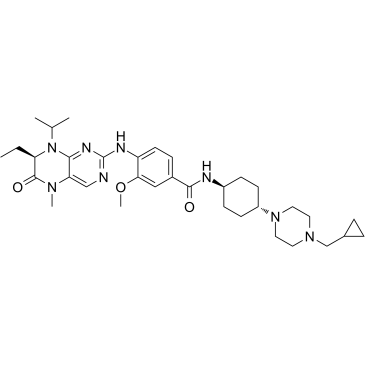
Volasertib is a highly potent Polo-like kinase 1 (PLK1) inhibitor with an IC50 of 0.87 nM, as well as the two closely related kinases PLK2 and PLK3 with IC50s of 5 and 56 nM, respectively.

View activity & prices
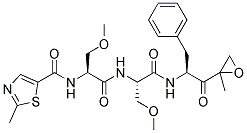
Oprozomib (ONX-0912) chemical structureDC2010

Oprozomib (ONX-0912)

Oprozomib (ONX 0912; PR047) is an orally bioavailable inhibitor for CT-L activity of 20S proteasome β5/LMP7 with IC50 of 36 nM/82 nM.The anti-MM activity of Oprozomib is associated with activation of caspase-8,…

View activity & prices
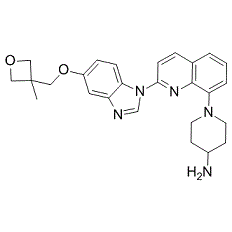
CP-868596 (Crenolanib) chemical structureDC5159

CP-868596 (Crenolanib)

Crenolanib is a potent and selective inhibitor of wild-type and mutant isoforms of the class III receptor tyrosine kinases FLT3 and PDGFRα/β with Kds of 2.1 nM/3.2 nM, 0.74 nM, respectively.

View activity & prices

Cart

Request quotation