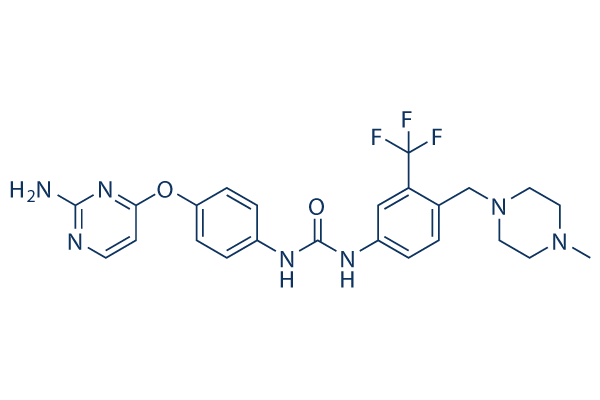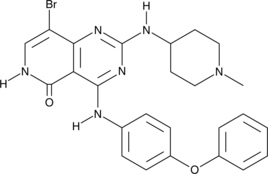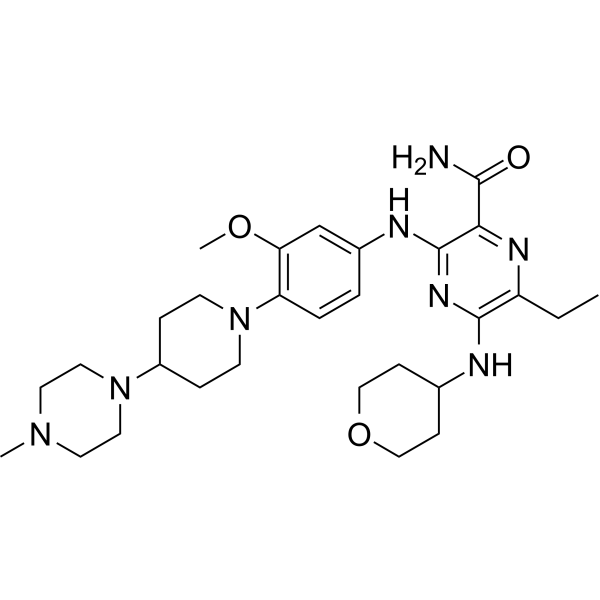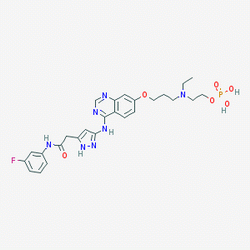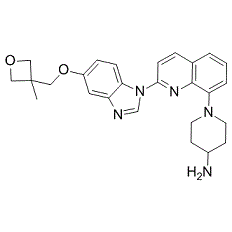
CP-868596 (Crenolanib) chemical structure
Chemical structureResearch use only
CAT. NO. DC5159Featured

CP-868596 (Crenolanib)

Pack Sizes & Prices

TotalUS$400
We match the best price and quality on market.
Product overview

Description & Application

Crenolanib is a potent and selective inhibitor of wild-type and mutant isoforms of the class III receptor tyrosine kinases FLT3 and PDGFRα/β with Kds of 2.1 nM/3.2 nM, 0.74 nM, respectively.

ParameterValue
Chemical Name1-(2-(5-((3-methyloxetan-3-yl)methoxy)-1H-benzo[d]imidazol-1-yl)quinolin-8-yl)piperidin-4-amine.
CAS No.670220-88-9
SynonymsCP-868,596; CP-868596; ARO 002;CP868596
FormulaC26H29N5O2
M.Wt443.54
SMILESNC1CCN(C2=CC=CC3=C2N=C(N4C5=CC=C(C=C5N=C4)OCC6(COC6)C)C=C3)CC1
Purity>98%
Storage2 years -20°C Powder, 2 weeks 4°C in DMSO, 6 months -80°C in DMSO

Biological Activity

Crenolanib is a potent and selective inhibitor of wild-type and mutant isoforms of the class III receptor tyrosine kinases FLT3 and PDGFRα/β with Kds of 2.1 nM/3.2 nM, 0.74 nM, respectively.

In Vitro

Crenolanib has 25-fold more affinity for PDGFRA/B compared with KIT, and is approximately 135-fold more potent than imatinib for inhibiting the PDGFRA D842V mutation. The IC50 for crenolanib for a KIT exon 11 deletion mutant kinase is greater than 1,000 versus 8 nM for imatinib. Crenolanib has low nanomolar potency against the V561D + D842V-mutant kinase that is similar to its potency against the isolated D842V mutation. Both imatinib and crenolanib potently inhibit the kinase activity of the fusion oncogene with IC50 values of 1 and 21 nM, respectively, and inhibits PDGFRA activation in this cell line with IC50 values of 93 and 26 nM, respectively[1]. HL60/VCR and K562/ABCB1 cells, overexpressing ABCB1, are 6.9- and 3.6-fold resistant to crenolanib, respectively, in relation to parental HL60 and K562 cells. PSC-833 fully reverses resistance to crenolanib in both HL60/VCR and K562/ABCB1 cells. Crenolanib (1 nM-10 μM) stimulates ABCB1 ATPase activity in a concentration-dependent manner. Crenolanib treatment does not increase the cell surface expression of ABCB1. Crenolanib inhibits [125I]-IAAP photocrosslinking of ABCB1 at high concentrations, with 50 % inhibition at 10 μM, but has little effect at lower concentrations, below 1 μM[2]. Crenolanib decreases NSCLC cell viability, induces apoptosis in NSCLC cells, and inhibits cell migration in NSCLC cells[3].

In Vivo

Crenolanib (10 mg/kg and 20 mg/kg) suppresses non-small-cell lung cancer tumor growth in vivo and induces tumor cell apoptosis, and the dosage of crenolanib applied is well tolerated by recipient mice[3].

References & source

DC Chemicals original product information

Published experimental findings depend on the model and assay conditions. They do not guarantee equivalent performance in every application. For laboratory research use only.
Product documentation

Refer to the certificate supplied with your lot for batch-specific release results.

Handling guide

2 years -20°C Powder, 2 weeks 4°C in DMSO, 6 months -80°C in DMSO

Solution calculator

Related research products

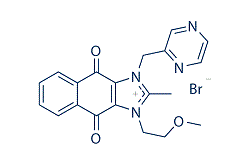
KW-2449 chemical structureDC8522

KW-2449

KW-2449 is a multi-targeted kinase inhibitor of FLT3, ABL, ABLT315I and Aurora kinase with IC50s of 6.6, 14, 4 and 48 nM, respectively.

View activity & prices
K03861 chemical structureDC9286

K03861

K03861 is a type II CDK2 inhibitor with Kd of 8.2 nM.K03861 inhibits CDK2 activity by competing with binding of activating cyclins.

View activity & prices
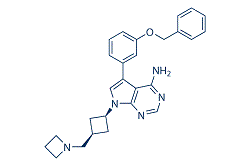
G-749 chemical structureDC7792

G-749

G-749 is a novel FLT3 inhibitor that showed potent and sustained inhibition of the FLT3 wild type and mutants with IC50s of 0.4/0.6/3.5/7.5 nM for Wt Flt3/D835Y/MV4-11/Molm-14 respectively.G-749 showed potent and…

View activity & prices
AZD1152 chemical structureDC7060

AZD1152

AZD1152 is a pro-drug of Barasertib-hQPA, which is a highly selective Aurora B inhibitor with IC50 of 0.37 nM in a cell-free assay.

View activity & prices
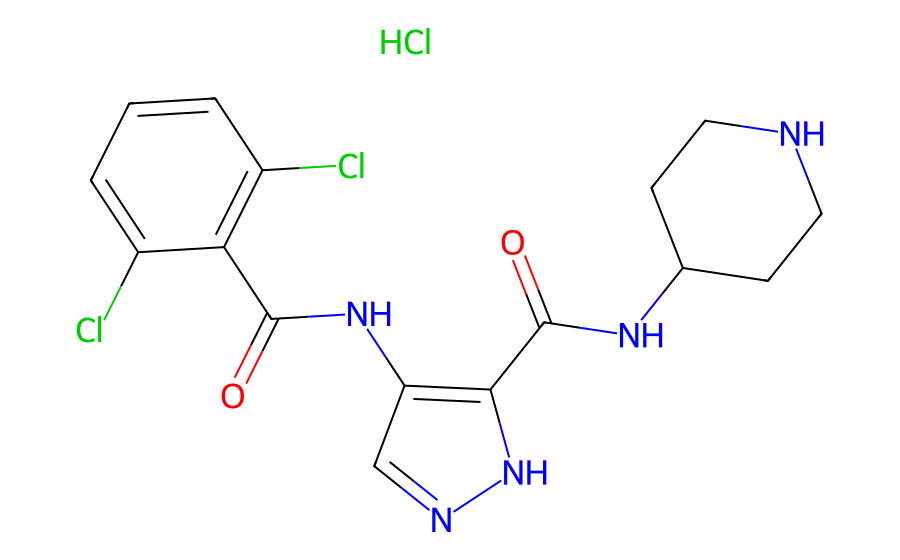
AT7519 HCL chemical structureDC1025

AT7519 HCL

AT7519 Hydrochloride is a potent inhibitor of CDKs, with IC50s of 210, 47, 100, 13, 170, and <10 nM for CDK1, CDK2, CDK4 to CDK6, and CDK9, respectively.

View activity & prices
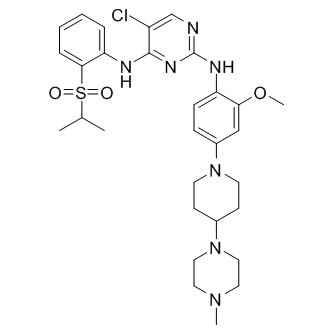
NVP-TAE684 chemical structureDC7303

NVP-TAE684

NVP-TAE 684 is a highly potent and selective ALK inhibitor, which blocks the growth of ALCL-derived and ALK-dependent cell lines with IC50 values between 2 and 10 nM.

View activity & prices

Cart

Request quotation