Biological Activity
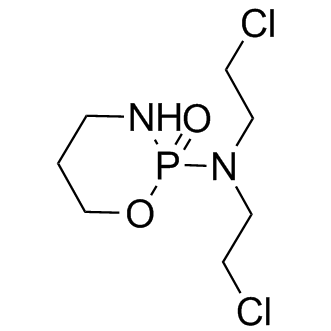
Cyclophosphamide is a synthetic alkylating agent chemically related to the nitrogen mustards with antineoplastic and immunosuppressive activities.
In Vitro
Cyclophosphamide induces outer membrane blebbing, leads to DNA fragmentation, as revealed by TUNEL staining of free 3'-OH DNA ends, and induces cleavage of the caspase 3 and caspase 7 substrate PARP in 9L/P450 cells. Bcl-2 expression fully blocks the activation of both initiator caspases as well as the effector caspase 3 in cells treated with activated Cyclophosphamide. Bcl-2 inhibits the cytotoxic effects but not the cytostatic effects of activated Cyclophosphamide[1]. Cyclophosphamide inhibits the AChE reversibly with an IC50 of 511 μM[2]. Carbon tetrachloride does not affect the direct cytotoxicity of cyclophosphamide or 4-hydroxycyclophosphamide to cells in culture[3].
In Vivo
No in vivo data are provided in the current product source. Contact us for further information.
References & source
Published experimental findings depend on the model and assay conditions. They do not guarantee equivalent performance in every application. For laboratory research use only.