Biological Activity
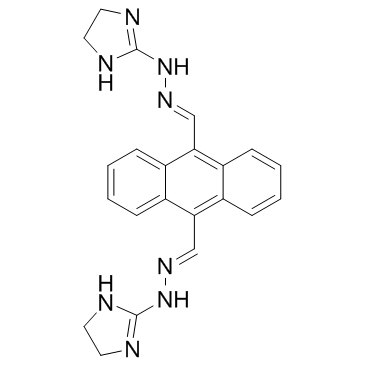
Bisantrene is a highly effective antitumor drug, targets eukaryotic type II topoisomerases.
In Vitro
No in vitro data are provided in the current product source. Contact us for further information.
In Vivo
Bisantrene shows an outstanding ability to form a complex with DNA. Bisantrene exhibits the most effective binding (even neglecting electrostatic contacts), followed by the 9-substituted compounds and finally by 1-IHA. Bisantrene congeners retained a remarkable capacity for binding to the single-stranded structure. In comparison with the Ki values found for double-stranded DNA, 9-IHA shows a 2-fold increase, 1-IHA maintains the same values, and aza-9-IHA exhibits a modest reduction. On the other hand, Bisantrene, although undergoing a 6-fold reduction in Ki, still exhibits an affinity constant of the order of 106 M-1. Bisantrene promots DNase I cleavage at oligopurine-oligopyrimidine tracts; conversely, it slightly reduces the cleavage activity at alternating purine-pyrimidine sequences[1]. Bisantrene is an active new drug in the treatment of metastatic breast cancer. Bisantrene is an inhibitor of [3H]uridine incorporation into RNA and [3H]thymidine incorporation into DNA[2].
References & source
[1]. Sissi C, et al. DNA-binding preferences of Bisantrene analogues: relevance to the sequence specificity of drug-mediated topoisomerase II poisoning. Mol Pharmacol. 1998 Dec;54(6):1036-45.
[2]. Yap HY, et al. Bisantrene, an active new drug in the trea
Published experimental findings depend on the model and assay conditions. They do not guarantee equivalent performance in every application. For laboratory research use only.