Biological Activity
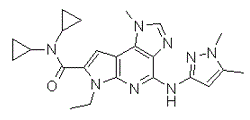
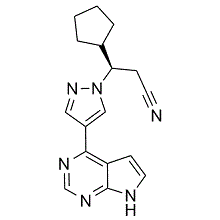
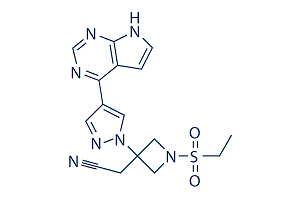
Gandotinib (LY2784544) is a potent JAK2 inhibitor with IC50 of 3 nM. Gandotinib (LY2784544) also inhibits FLT3, FLT4, FGFR2, TYK2, and TRKB with IC50 of 4, 25, 32, 44, and 95 nM.
In Vitro
Gandotinib (LY2784544), a potent, selective and ATP-competitive inhibitor of janus kinase 2 (JAK2) tyrosine kinase. LY2784544 effectively inhibits JAK2V617F-driven signaling and cell proliferation in Ba/F3 cells (IC50=20 and 55 nM, respectively). In comparison, Gandotinib (LY2784544) is much less potent at inhibiting interleukin-3-stimulated wild-type JAK2-mediated signaling and cell proliferation (IC50=1183 and 1309 nM, respectively). Gandotinib (LY2784544) potently inhibits the JAK2V617F signaling (IC50=20 nM) but, remarkably, shows very minimal activity against the IL-3-activated wild-type JAK2 signaling with an IC50 of 1183 nM. LY2784544 inhibits the proliferation of JAK2V617F-expressing cells (IC50=55 nM) and is markedly less potent as an inhibitor of the proliferation of IL-3-stimulated wild-type JAK2 expressing Ba/F3 cells (IC50=1309 nM). Gandotinib (LY2784544) is potent in the cell-based TF-1 JAK2 assay (IC50=45 nM) and had the desired threshold selectivity in the NK-92 JAK3/JAK1 heterodimer assay (942 nM)[1].
In Vivo
Gandotinib (LY2784544) effectively inhibits STAT5 phosphorylation in Ba/F3-JAK2V617F-GFP (green fluorescent protein) ascitic tumor cells (TED50=12.7 mg/kg) and significantly reduces (P<0.05) Ba/F3-JAK2V617F-GFP tumor burden in the JAK2V617F-induced MPN model (TED50=13.7 mg/kg, twice daily)[1].
Target
JAK2:3 nM (IC50)
FGFR2:32 nM (IC50)
Flt-4:25 nM (IC50)
Tyk2:44 nM (IC50)
JAK3:48 nM (IC50)
FGFR3:106 nM (IC50)
KDR:109 nM (IC50)
FLT3:4 nM (IC50)
TRKB:95 nM (IC50)
ALK:138 nM (IC50)
MUSK:147 nM (IC50)
AURKA:168 nM (IC50)
MAP3K9:299 nM (IC50)
Cell Assay
Ba/F3 cells expressing JAK2V617F are placed in RPMI-1640-containing vehicle (DMSO) or Gandotinib (LY2784544) (concentration range, 0.001-20 μM) (1×10⁴ cells/96-well). Ba/F3 cells expressing wild-type JAK2 are treated similarly except IL-3 (2 ng/mL) is added. After a 72-hour incubation, cell proliferation is assessed by adding Cell Titer 96 Aqueous One Solution Reagent (20 μL/well). The IC50 for inhibition of cell proliferation is calculated using the GraphPad Prism 4 software[1].
Animal Administration
Mice[1] Dose- and time-dependent in vivo inhibition of JAK2V617F signaling is assessed by measuring inhibition of STAT5 phosphorylation in a mouse ascitic tumor model. Ba/F3-JAK2V617F-GFP cells (1×10⁷) are implanted in the intraperitoneal cavity of severe combined immunodeficiency mice (SCID mice) and allowed to develop into ascitic tumors for 7 days. For dose-response studies (six animals/group), Gandotinib (LY2784544) is administered once by oral gavage (2.5, 5, 10, 20, 40, or 80 mg/kg), then 30 min later, ascitic tumor cells are collected, fixed, incubated for 2 h with Mouse-anti-pSTAT5 (pY694) Alexa Fluor 647 (1:10 dilution), and analyzed by flow cytometry. Time course studies are performed similarly, except the animals are treated with Gandotinib (LY2784544) at 20, 40 or 80 mg/kg and ascitic tumor cells collected at prespecified intervals of 0.25-6 h after dosing. Data are analyzed by the one-way analysis of variance, and Dunnett's test (α=0.05). Dose response data are analyzed with a four-parameter logistic curve-fitting program.
References & source
[1]. Ma L, et al. Discovery and characterization of LY2784544, a small-molecule tyrosine kinase inhibitor of JAK2V617F. Blood Cancer J. 2013, 3, e109.
Published experimental findings depend on the model and assay conditions. They do not guarantee equivalent performance in every application. For laboratory research use only.