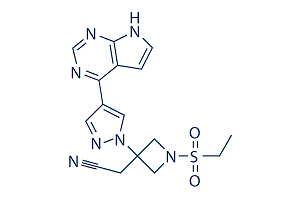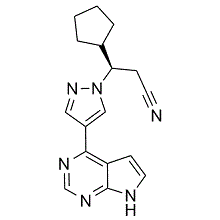
Ruxolitinib (INCB018424) chemical structure
Chemical structureResearch use only
CAT. NO. DC4230Featured

Ruxolitinib (INCB018424)

Pack Sizes & Prices

TotalUS$300
We match the best price and quality on market.
Product overview

Description & Application

Ruxolitinib is a potent and selective JAK1/2 inhibitor with IC50s of 3.3 nM and 2.8 nM in cell-free assays, and has 130-fold selectivity for JAK1/2 over JAK3.

ParameterValue
Chemical NameRuxolitinib free base
CAS No.941678-49-5
SynonymsINCB018424; INCB 018424; INCB-018424; INC424; INC424; INC-424; INCB18424; INCB 18424; INCB-18424; trade name:J akafi and Jakavi
FormulaC17H18N6
M.Wt306.37
SMILESC1CCC(C1)[C@@H](CC#N)N2C=C(C=N2)C3=C4C=CNC4=NC=N3
Purity99%
Storage2 years -20°C Powder, 2 weeks 4°C in DMSO, 6 months -80°C in DMSO

Biological Activity

Ruxolitinib is a potent and selective JAK1/2 inhibitor with IC50s of 3.3 nM and 2.8 nM in cell-free assays, and has 130-fold selectivity for JAK1/2 over JAK3.

In Vitro

Ruxolitinib potently and selectively inhibits JAK2V617F-mediated signaling and proliferation, markedly increases apoptosis in a dose dependent manner, and at 64 nM results in a doubling of cells with depolarized mitochondria in Ba/F3 cells. Ruxolitinib demonstrates remarkable potency against erythroid colony formation with IC50 of 67 nM, and inhibits proliferating of erythroid progenitors from normal donors and polycythemia vera patients with IC50 values of 407 nM and 223 nM, respectively[1].

In Vivo

Ruxolitinib (180 mg/kg, orally, twice a day) results in survive rate of greater than 90% by day 22 and markedly reduces splenomegaly and circulating levels of inflammatory cytokines, and preferentially eliminated neoplastic cells, resulting in significantly prolonged survival without myelosuppressive or immunosuppressive effects in a JAK2V617F-driven mouse model[1]. In the Ruxolitinib group, the primary end point is reached in 41.9% of patients, as compared with 0.7% in the placebo group in the double-blind trial of myelofibrosis. Ruxolitinib results in maintaining of reduction in spleen volume and improvement of 50% or more in the total symptom score[2]. Ruxolitinib (15 mg twice daily) treatment leads a total of 28% of the patients to have at least a 35% reduction in spleen volume at week 48 in patients with myelofibrosis, as compared with 0% in the group receiving the best available therapy. The mean palpable spleen length has decreased by 56% with Ruxolitinib but has increased by 4% with the best available therapy at week 48. Patients in the ruxolitinib group has an improvement in overall quality-of-life measures and a reduction in symptoms associated with myelofibrosis[3].

References & source

DC Chemicals original product information

Published experimental findings depend on the model and assay conditions. They do not guarantee equivalent performance in every application. For laboratory research use only.
Product documentation

Refer to the certificate supplied with your lot for batch-specific release results.

Handling guide

2 years -20°C Powder, 2 weeks 4°C in DMSO, 6 months -80°C in DMSO

Solution calculator

Related research products

AZD1480 chemical structureDC5032

AZD1480

AZD1480 is a novel ATP-competitive JAK2 inhibitor with IC50 of 0.26 nM, selectivity against JAK3 and Tyk2, and to a smaller extent against JAK1. IC50 value: 0.26 nM Target: JAK2 in vitro: AZD1480 demonstrated…

View activity & prices
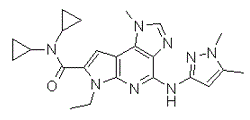
BMS-911543 chemical structureDC4175

BMS-911543

BMS-911543 is a selective JAK2 inhibitor, with IC50s of 1.1 nM, less selective at JAK1, JAK3 and TYK2 (IC50, 75, 360, 66 nM, respectively).

View activity & prices
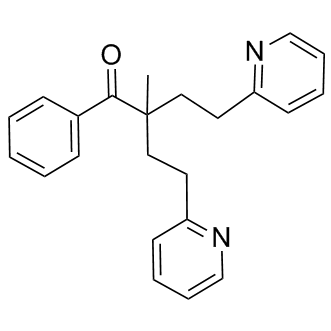
JAK2 Inhibitor V,Z3 chemical structureDC7436

JAK2 Inhibitor V,Z3

JAK2 Inhibitor V, Z3 is a cell-permeable pyridinylbutanone compound that inhibits both JAK2 and the active V167F mutant cellular autophosphorylation. JAK2 Inhibitor V, Z3 displays no effect against cellular Tyk 2…

View activity & prices
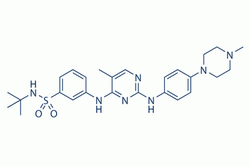
TG101209 chemical structureDC7317

TG101209

TG101209 is a selective JAK2 inhibitor with IC50 of 6 nM, less potent to Flt3 and RET with IC50 of 25 nM and 17 nM, appr 30-fold selective for JAK2 than JAK3, and sensitive to JAK2V617F and MPLW515L/K mutations.

View activity & prices

Cart

Request quotation