Lipid H5T5
DC60925
Recommended because it shares a closely related research category or delivery context. Formulation and performance are product- and study-specific.
View product →
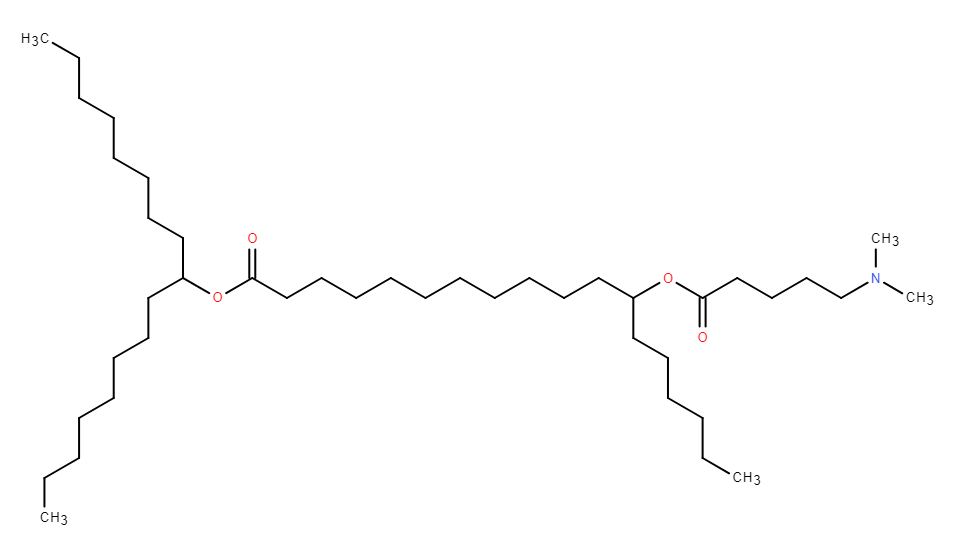
Ionizable lipid for LNP and nucleic-acid delivery research.
Lipid 87 is a proprietary ionizable lipid developed by Generation Bio. Used as a key ingredient in stealth LNPs, it greatly prolongs blood circulation time, maintains high nucleic acid encapsulation efficiency and low cytotoxicity, and enables effective liver targeting. Its relevant applications are documented in PCT patent WO2026/080826A1. As a core component (47.5–57.5 mol%) of stealth lipid nanoparticles (LNPs), it works synergistically with steric-stabilizing polymers like DSG-PEG₂₀₀₀-OMe to extend the in vivo blood half-life of LNPs to over 24 hours (compared to merely 30 minutes of conventional LNPs). It achieves an encapsulation efficiency above 95% for mRNA and closed-ended DNA (ceDNA), exhibits low cytotoxicity with an IC₅ value greater than 100 μM, and delivers robust liver-targeting performance, obtaining over 80% hepatocyte transfection at a dosage of 0.5 mpk. In preclinical models of hemophilia B, LNPs formulated with Lipid 87 can restore around 40% of clotting factor IX (FIX) activity for more than seven days.
| CAS No. | Not available |
| Chemical Name | Generation Lipid 87 |
| Synonyms | Generation Lipid-87 |
| SMILES | CCCCCCCCC(CCCCCCCC)OC(=O)CCCCCCCC(CCCCCCC)OC(=O)CCCN(C)C |
| Formula | C39H77O4N |
| M.Wt | 624.05 |
| Purity | >98% |
| Storage | Pure form: −20 °C, 1 year; In solvent: −80 °C, 6 months; −20 °C, 1 month. Sealed and protected from light. |
| Shipping condition | Ships from Shanghai. Pure lipid is stable during ice-pack transport. |
| Publication | WO2026/080826A1 |
The product molecular weight is prefilled when available and remains editable. Confirm solvent compatibility and solubility before preparation.
Solvent volumes update from the molecular weight above.
| Mass | 1 mM | 5 mM | 10 mM |
|---|---|---|---|
| 10 mg | 16.0244 mL | 3.2049 mL | 1.6024 mL |
| 25 mg | 40.0609 mL | 8.0122 mL | 4.0061 mL |
| 50 mg | 80.1218 mL | 16.0244 mL | 8.0122 mL |
| 100 mg | 160.2436 mL | 32.0487 mL | 16.0244 mL |
| 250 mg | 400.6089 mL | 80.1218 mL | 40.0609 mL |
Contact our team with the catalog number and requested quantity.