Antioxidant lipid AO12
DC60941
Recommended because it shares a closely related research category or delivery context. Formulation and performance are product- and study-specific.
View product →
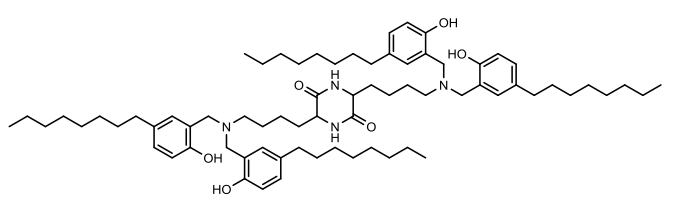
Ionizable lipid for LNP and nucleic-acid delivery research.
C-a16 is an ionizable lipid engineered through Mannich reaction chemistry, designed to revolutionize mRNA delivery by synergizing high efficiency with minimized immune activation. Synthesized by reacting a phenolic tail derivative, formaldehyde, and a branched tertiary amine core under optimized ethanol conditions, this lipid integrates antioxidant phenol groups directly into its structure. These phenol moieties serve as intrinsic radical scavengers, effectively neutralizing intracellular reactive oxygen species that typically degrade mRNA and trigger inflammation.In lipid nanoparticle formulations, C-a16 constitutes the functional backbone, enabling superior mRNA encapsulation efficiency while maintaining a stable nanoparticle size of approximately 80–100 nm. Critically, it outperforms conventional lipids like DLin-MC3-DMA by achieving significantly higher target-protein expression in vivo alongside markedly reduced pro-inflammatory cytokine secretion. The antioxidant capability is not incidental but fundamental—quenching the phenol groups drastically diminishes both ROS suppression and delivery efficacy, confirming the design's mechanistic elegance.C-a16 represents a paradigm shift: its biomimetic antioxidant architecture addresses the chronic trade-off between delivery potency and immunogenicity, unlocking safer therapeutic applications for vaccines and gene therapies.
| CAS No. | Not available |
| Chemical Name | C-a16 |
| Synonyms | Ca16, C a16 |
| SMILES | CCCCCCCCC1=CC=C(O)C(CN(CC2=C(O)C=CC(CCCCCCCC)=C2)CCCCC2NC(=O)C(CCCCN(CC3=CC(CCCCCCCC)=CC=C3O)CC3=C(O)C=CC(CCCCCCCC)=C3)NC2=O)=C1 |
| Formula | C72H112O6N4 |
| M.Wt | 1,129.71 |
| Purity | >98% |
| Storage | Pure form: −20 °C, 1 year; In solvent: −80 °C, 6 months; −20 °C, 1 month. Sealed and protected from light. |
| Shipping condition | Ships from Shanghai. Pure lipid is stable during ice-pack transport. |
| Publication | Mannich reaction-based combinatorial libraries identify antioxidant ionizable lipids for mRNA delivery with reduced immunogenicity-N Gong, D Kim, MG Alameh, R El-Mayta, EL Han- Nature Biomedical …, 2025 |
The product molecular weight is prefilled when available and remains editable. Confirm solvent compatibility and solubility before preparation.
Solvent volumes update from the molecular weight above.
| Mass | 1 mM | 5 mM | 10 mM |
|---|---|---|---|
| 10 mg | 8.8518 mL | 1.7704 mL | 885.18 μL |
| 25 mg | 22.1296 mL | 4.4259 mL | 2.2130 mL |
| 50 mg | 44.2591 mL | 8.8518 mL | 4.4259 mL |
| 100 mg | 88.5183 mL | 17.7037 mL | 8.8518 mL |
| 250 mg | 221.2957 mL | 44.2591 mL | 22.1296 mL |
Contact our team with the catalog number and requested quantity.