5A2-SC8
DC49907
Recommended because it shares a closely related research category or delivery context. Formulation and performance are product- and study-specific.
View product →
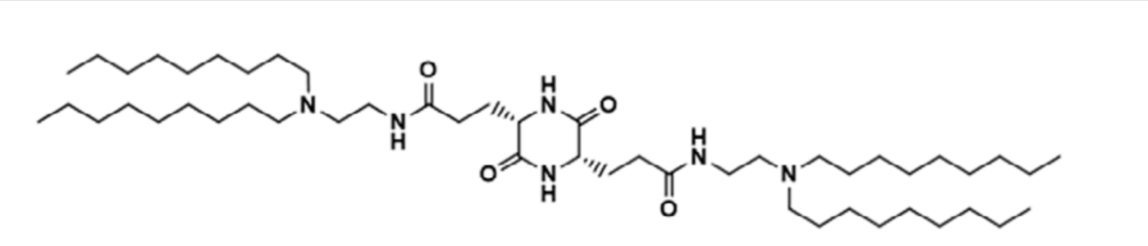
Ionizable lipid for LNP and nucleic-acid delivery research.
D-2 is a novel, custom-synthesized ionizable cationic lipid that serves as the core functional component of the targeted lipid nanoparticle (LNP) delivery system. Its key function is to enable the efficient in vivo delivery of therapeutic mRNAs. Under acidic conditions, it ionizes to a positive charge, allowing it to complex with and encapsulate the negatively charged mRNAs encoding the anti-FAP CAR and Lgmn protease. At physiological pH, it returns to a neutral state, which helps reduce systemic toxicity and is crucial for promoting the release of the mRNA payload inside the target macrophages within the infarcted heart. As part of the optimized LNP formulation, D-2 is fundamental for achieving high transfection efficiency, thereby enabling the in situ generation of efferocytosis-boosted CAR-Ms to treat cardiac fibrosis.
| CAS No. | Not available |
| Chemical Name | Lipid D-2 |
| Synonyms | Not available |
| SMILES | Not available |
| Formula | Not available |
| M.Wt | Not available |
| Purity | 98% |
| Storage | Pure form: −20 °C, 1 year; In solvent: −80 °C, 6 months; −20 °C, 1 month. Sealed and protected from light. |
| Shipping condition | Ships from Shanghai. Pure lipid is stable during ice-pack transport. |
| Publication | Not available |
The product molecular weight is prefilled when available and remains editable. Confirm solvent compatibility and solubility before preparation.
Solvent volumes update from the molecular weight above.
| Mass | 1 mM | 5 mM | 10 mM |
|---|---|---|---|
| 10 mg | Enter molecular weight | Enter molecular weight | Enter molecular weight |
| 25 mg | Enter molecular weight | Enter molecular weight | Enter molecular weight |
| 50 mg | Enter molecular weight | Enter molecular weight | Enter molecular weight |
| 100 mg | Enter molecular weight | Enter molecular weight | Enter molecular weight |
| 250 mg | Enter molecular weight | Enter molecular weight | Enter molecular weight |
Contact our team with the catalog number and requested quantity.