Lipid H5T5
DC60925
Recommended because it shares a closely related research category or delivery context. Formulation and performance are product- and study-specific.
View product →
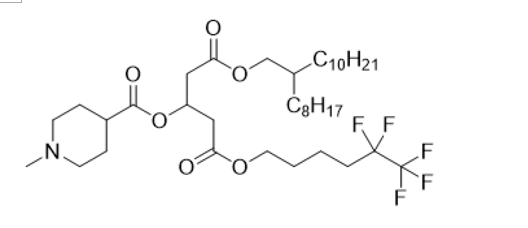
Ionizable lipid for LNP and nucleic-acid delivery research.
A1F5C5 is a core fluorinated ionizable lipid that forms the basis of the F5-LNP platform. Its key biological functions are multifaceted. Primarily, it enables efficient, targeted mRNA delivery in vivo. Following intravenous administration, F5-LNPs exhibit a strong tropism for the spleen and tumor sites, successfully transfecting over 70% of splenic macrophages and more than 20% of tumor-infiltrating macrophages. This allows for in situ cell engineering. Beyond delivery, A1F5C5 possesses intrinsic immunostimulatory activity. It promotes the maturation and activation of antigen-presenting cells (e.g., upregulating CD80/86 on dendritic cells) and enriches immune-related pathways like "cytokine-cytokine receptor interaction." Mechanistically, its unique 5-fluorine (F5) configuration confers superior membrane fusion capability, which is critical for efficient endosomal escape and cytosolic mRNA release. Therapeutically, when loaded with CAR mRNA, it serves as a platform for in vivo generation of CAR-macrophages (CAR-M). These CAR-M cells phagocytose tumors, reprogram the tumor microenvironment by shifting macrophages to an M1 phenotype, and activate CD8+ T cells. Notably, this approach synergizes powerfully with anti-PD-L1 therapy, achieving complete tumor regression in preclinical models.
| CAS No. | Not available |
| Chemical Name | Lipid A1F5C5 |
| Synonyms | Not available |
| SMILES | Not available |
| Formula | Not available |
| M.Wt | Not available |
| Purity | >98% |
| Storage | Pure form: −20 °C, 1 year; In solvent: −80 °C, 6 months; −20 °C, 1 month. Sealed and protected from light. |
| Shipping condition | Ships from Shanghai. Pure lipid is stable during ice-pack transport. |
| Publication | Not available |
The product molecular weight is prefilled when available and remains editable. Confirm solvent compatibility and solubility before preparation.
Solvent volumes update from the molecular weight above.
| Mass | 1 mM | 5 mM | 10 mM |
|---|---|---|---|
| 10 mg | Enter molecular weight | Enter molecular weight | Enter molecular weight |
| 25 mg | Enter molecular weight | Enter molecular weight | Enter molecular weight |
| 50 mg | Enter molecular weight | Enter molecular weight | Enter molecular weight |
| 100 mg | Enter molecular weight | Enter molecular weight | Enter molecular weight |
| 250 mg | Enter molecular weight | Enter molecular weight | Enter molecular weight |
Contact our team with the catalog number and requested quantity.