For research use only. We do not sell to patients.
Ionizable lipids / Lipid GVS-18-B6
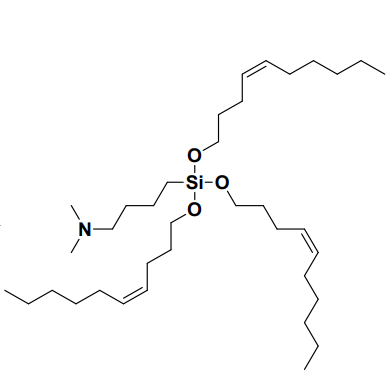
Lipid GVS-18-B6 chemical structure
Product imageResearch use only
CAT. NO. DC60564Featured

Lipid GVS-18-B6

Ionizable lipid for LNP and nucleic-acid delivery research.

Research highlights
Biodegradable silicon-ether lipidLiver-directed mRNA deliveryRapid tissue clearanceMouse and nonhuman-primate studies
Derived from the cited study; not a product specification or performance guarantee.

Pack size & price

USD
TotalUS$950
We match the best price and quality on market.
Ships from ShanghaiIce-pack transportPure lipid recommended
Product overview

Description & Application

GVS-18-B6 is a biodegradable silicon-ether ionizable lipid reported for liver-directed mRNA delivery. The literature-verified structure contains a dimethylamino headgroup connected through a four-carbon linker to a silicon center bearing three cis-4-decenyl ether chains. In the cited study, GVS-18-B6 LNPs showed high mRNA encapsulation, an apparent LNP pKa of 6.15, preferential hepatic expression after intravenous administration, rapid tissue clearance, and favorable tolerability in the reported mouse and nonhuman-primate experiments. All formulation and performance values shown below are literature-reported study results, not specifications or guaranteed performance of the supplied lipid.

CAS No.Not available
Chemical NameLipid GVS-18-B6
SynonymsLipid GVS 18 B6, GVS-18-B6
SMILESCCCCC/C=C\CCCO[Si](CCCCN(C)C)(OCCC/C=C\CCCCC)OCCC/C=C\CCCCC
FormulaC36H71NO3Si
M.Wt594.05
PurityELSD-HPLC>95%
StoragePure form: −20 °C, 1 year; In solvent: −80 °C, 6 months; −20 °C, 1 month. Sealed and protected from light.
Shipping conditionShips from Shanghai. Pure lipid is stable during ice-pack transport.
PublicationHolland R, Lam K, Jeng S, et al. Silicon Ether Ionizable Lipids Enable Potent mRNA Lipid Nanoparticles with Rapid Tissue Clearance. ACS Nano. 2024;18:10374-10387.

Literature-reported formulation composition

Componentmol%Role
GVS-18-B654.6Ionizable lipid
DSPC10.9Helper phospholipid
Cholesterol32.8Sterol
PEG-conjugated lipid (identity not specified in article)1.6PEG lipid
Reported total99.9Source values retained
Formulation calculator unavailable. The reported values total 99.9 mol% because of source rounding; the calculator normalizes them only for weight calculation. Obtain and verify the complete composition and component molecular weights before planning component quantities.
Not reported in the cited article
Nucleic acid in acetate buffer, pH 5; final LNP in Tris-sucrose buffer, pH 8.0
EGFP mRNA
Intravenous injection (IV)
0.5 mg mRNA/kg, single dose
Female BALB/c mice, 7-8 weeks old
Controlled mixing of the aqueous nucleic-acid phase with an ethanolic four-lipid solution, followed by tangential-flow ultrafiltration, buffer exchange, concentration and 0.2 µm sterile filtration

Literature-reported performance for the cited formulation

Literature-reported89 nmPost-formulation characterizationTable 1, p. 10376
Literature-reported0.06Post-formulation characterizationTable 1, p. 10376
Literature-reported90%Post-formulation characterizationTable 1, p. 10376
Literature-reported6.15TNS binding assayTable 1, p. 10376; TNS method, p. 10382
Literature-reported+2.69 mVPost-formulation characterizationTable 1, p. 10376
Literature-reported+0.98 mVPost-formulation characterizationTable 1, p. 10376
Literature-reported5.30 × 10^7 pg EGFP/g liver24 h after IV administration · 2.56-fold the MC3 value in the same tableTable 1, p. 10376
Literature-reported0.58 × 10^6 pg EGFP/g spleen24 h after IV administrationTable 1, p. 10376
Calculated from literatureApproximately 92:124 h after IV administration · Benchmarks reported at approximately 10:1 to 20:1Calculated from Table 1 values; ratio also stated in text, p. 10377
Literature-reported81 pg/mL6 h after IV administration · MC3: 159 pg/mL in the same tableTable 1 and Figure 2 caption, p. 10376

Additional reported findings

Rapid mouse liver clearance

The parent GVS-18-B6 lipid was reported as almost completely cleared from mouse liver within 6 hours after IV dosing.

EGFP mRNA LNP; IV; mouse; LC-MS · Figure 2 and text, pp. 10376-10377
Mouse tolerability

GVS-18-B6 LNPs were reported as well tolerated at doses up to 6 mg/kg, with little elevation in the measured ALT, AST, MCP-1 or IL-6 biomarkers.

Nonstimulatory siRNA LNP; IV; female BALB/c mice · Figure 3 and text, pp. 10377-10378
NHP single-dose expression and clearance

After a 1 mg/kg IV infusion of hOTC mRNA LNP, strong hOTC expression was reported in liver, with substantially lower expression in spleen; the vast majority of GVS-18-B6 was degraded in liver within 24 hours.

hOTC mRNA LNP; 1 mg/kg; 60-minute IV infusion; cynomolgus monkeys · Figure 5A-C and text, pp. 10378-10379
NHP repeat dosing

Weekly 0.25 mg/kg IV doses for five weeks produced comparable plasma hEPO profiles after doses 1 and 5, with no efficacy pattern indicative of accelerated blood clearance in the reported experiment.

hEPO mRNA LNP; 0.25 mg/kg; IV every 7 days × 5; cynomolgus monkeys · Figure 5D and text, pp. 10378-10379
Literature Data DisclaimerAll formulation parameters and performance values shown in this section are derived from the cited publication and are provided for reference only. These results were obtained using the specific materials, formulation process, cargo, dose, analytical method, model and administration route described in that study. Unless otherwise stated, the data were not generated or independently verified by DC Chemicals. DC Chemicals supplies the lipid compound only and does not guarantee that customers will reproduce the reported LNP properties or biological performance.

The administration route shown above was used in the cited study and is not a clinical-use instruction or recommendation by DC Chemicals.
Cited literature for this formulation and performance datasetHolland R, Lam K, Jeng S, et al. Silicon Ether Ionizable Lipids Enable Potent mRNA Lipid Nanoparticles with Rapid Tissue Clearance. ACS Nano. 2024;18:10374-10387. DOI: 10.1021/acsnano.3c09028
Formulation: p. 10375 and Materials & Methods; performance: Table 1 and Figures 2-6.
Laboratory planning

Solution Calculators

The product molecular weight is prefilled when available and remains editable. Confirm solvent compatibility and solubility before preparation.

Mass = concentration × volume × molecular weight
Enter any three values to calculate the fourth.
C₁V₁ = C₂V₂
Enter any three values to calculate the fourth.
Preparing stock solutions

Quick preparation table

Solvent volumes update from the molecular weight above.

Mass1 mM5 mM10 mM
10 mg16.8336 mL3.3667 mL1.6834 mL
25 mg42.0840 mL8.4168 mL4.2084 mL
50 mg84.1680 mL16.8336 mL8.4168 mL
100 mg168.3360 mL33.6672 mL16.8336 mL
250 mg420.8400 mL84.1680 mL42.0840 mL

Need a different pack size or technical document?

Contact our team with the catalog number and requested quantity.

Contact us
Handling guidance

Shipping, storage and sampling

How is the lipid shipped, and how should I store it?
We generally ship the neat (undissolved) lipid compound rather than an ethanol solution. The neat lipid is stable during transport with ice packs, and shipments originate from Shanghai. Pure form: store at −20 °C for up to 1 year. In solvent: store at −80 °C for up to 6 months or at −20 °C for up to 1 month. Keep sealed and protected from light. Avoid repeated thaw cycles for best results.
Pure lipid or solution — which should I choose?
Pure lipid is generally more stable during shipping and storage, so we usually recommend the pure form. A solution in ethanol or chloroform can be supplied when required by your workflow. Tell us the intended application, solvent and target concentration so the most suitable format can be confirmed.
How should I measure a small amount of oily or viscous lipid?
Ionizable lipids are often oily liquids or viscous semisolids, so material can be lost during repeated weighing or transfer. For a small pack, dissolve the entire quantity and aliquot it volumetrically. For example, add 1 mL ethanol to 25 mg lipid to prepare a 25 mg/mL stock, then use a pipette to withdraw the required amount. For quantities above 100 mg, direct weighing with an analytical balance may be more practical. Always confirm solvent compatibility and solubility first.
Can you support formulation optimization and scale-up?
Yes. Share the RNA cargo, target tissue, administration route, formulation method and assay plan. Our team can discuss starting molar ratios, N/P ratio and scale-up requirements for research workflows.