Biological Activity
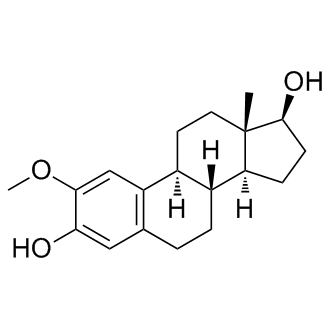
2-Methoxyestradiol is an angiogenesis inhibitor and apoptosis inducer with potent antineoplastic activity. 2-Methoxyestradiol also destablize microtubules.
In Vitro
2-Methoxyestradiol (5-100 μM) inhibits assembly of purified tubulin in a concentration-dependent manner, with maximal inhibition (60%) at 200 μM 2-Methoxyestradiol (2ME2). However, with microtubule-associated protein-containing microtubules, significantly higher 2-Methoxyestradiol concentrations are required to depolymerize microtubules, and polymer mass is reduced by only 13% at 500 μM 2-Methoxyestradiol. 4 μM 2-Methoxyestradiol reduces the mean growth rate by 17% and dynamicity by 27%. In living interphase MCF7 cells at the IC50 for mitotic arrest (1.2 μM), 2-Methoxyestradiol significantly suppresses the mean microtubule growth rate, duration and length, and the overall dynamicity, consistent with its effects in vitro, and without any observable depolymerization of microtubules. 2-Methoxyestradiol induces G2-M arrest and apoptosis in many actively dividing cell types while sparing quiescent cells. 2-Methoxyestradiol binds to tubulin at or near the colchicine site, it inhibits microtubule assembly, and high concentrations have been shown to depolymerize microtubules in cells. 2-Methoxyestradiol induces G2-M arrest and apoptosis in many actively dividing also blocks mitosis and inhibits endothelial cell migration[1]. 2-Methoxyestradiol (2-ME) decreases the HIF-1α and HIF-2α nuclear staining in cells cultured under hypoxia. The HIF-1α and HIF-2α mRNA levels are significantly lower when cells are exposed to 2-Methoxyestradiol under normoxia and hypoxia. 2-Methoxyestradiol is an anti-angiogenic, anti-proliferative and pro-apoptotic agent that suppresses HIF-1α protein levels and its transcriptional activity. A significant decrease in the growth rate is found in the 10 µM 2-Methoxyestradiol-treated A549 cells in comparison with the DMSO-treated cells (66.2±7.2 and 101.2±2.3%, respectively; p=0.04) at 96 h. 2-Methoxyestradiol at a concentration of 10 µM is used for the apoptosis and HIF-1α and HIF-2α expression assays, due to the significance found for this concentration when cells are incubated under normoxic conditions at 72 h. A significant increase in apoptosis is observed in cells treated with 10 µM 2-Methoxyestradiol in a normoxic condition in comparison with cells under lower O2 concentration (5.8±0.2%; p=0.003)[2].
In Vivo
To investigate the effect of 2ME2 on uveitis development, C57BL/6 mice are randomly assigned into two groups and immunized with IRBP peptide. 2ME2 group starts 2-Methoxyestradiol (15 mg/kg) intraperitoneally from day 0 to day 13 while control group is given with vehicle. The disease score of 2-Methoxyestradiol (2ME2) group is 0.30±0.30, significantly lower than that of control group 2.09±0.28 (p<0.05), each group containing 5 mice[3]. Treatment with 2-Methoxyestradiol (60-600 mg/kg/d) results in a dose-dependent inhibition of tumor growth. The percentage of cells with strong pimonidazole-positive staining (+++) is significantly decreased in the 2-Methoxyestradiol-treated group (36.0% for 60 mg/kg/d and 0% for 200 and 600 mg/kg/d) compare with the vehicle-treated group (86.5%). This may be attributed to the dramatic inhibition of tumor growth in a dose-dependent manner following 2-Methoxyestradiol treatment[4].
References & source
Published experimental findings depend on the model and assay conditions. They do not guarantee equivalent performance in every application. For laboratory research use only.