Biological Activity
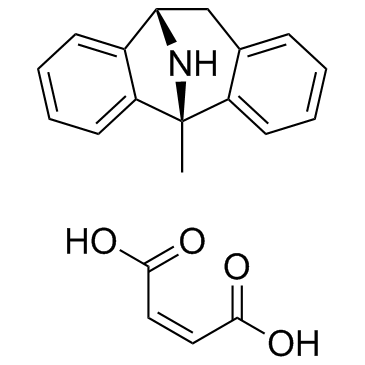
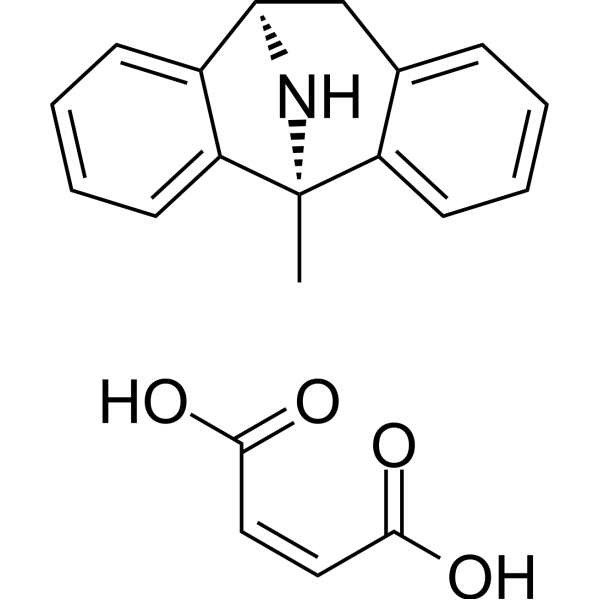
(+)-MK 801 Maleate is a potent, selective and non-competitive NMDA receptor antagonist with Kd of 37.2 nM in rat brain membranes.
In Vitro
[3H]MK-801 binds with NMDA receptor with a Kd of 37.2 ±2.7 nM in rat cerebral cortical membranes[1]. MK-801 shows an inhibitory activity against N-methyl-D-aspartate-induced [3H]norepinephrine (NE) release and [3H]TCP binding in the hippocampus with IC50s of 20 nM and 9 nM, respectively[2]. MK-801 progressively suppresses of current induced by NMDA. Mg2+ (10 mM) prevents MK-801 from blocking the N-Me-D-Asp-induced current, even when MK-801 is applied for a long time in the presence of NMDA. MK-801 blocks NMDA-activated single-channel activity in outside-out patches[3]. MK-801 (< 500 μM) inhibits activation of microglia induced by LPS with increased Cox-2 protein expression in BV-2 cells. MK-801 (< 500 μM) reduces microglial TNF-α output with an EC50 of 400 μM in BV-2 cells[4].
In Vivo
MK-801 (1 mg/kg) treatment before each METH injection reduces the extent of DA depletion by 55% in striatal of mice. MK-801 (1 mg/kg) also attenuates the effects of METH on microglial activation in striatal of mice[4]. MK-801 (0.05, 0.2 mg/kg, i.p.) attenuates subsequent cocaine-primed reinstatement without disruption in rats. MK-801 (0.2 mg/kg, i.p.) prior to two reactivation sessions in the home cage shows no suppression on subsequent cocaine-primed reinstatement[5].
References & source
Published experimental findings depend on the model and assay conditions. They do not guarantee equivalent performance in every application. For laboratory research use only.