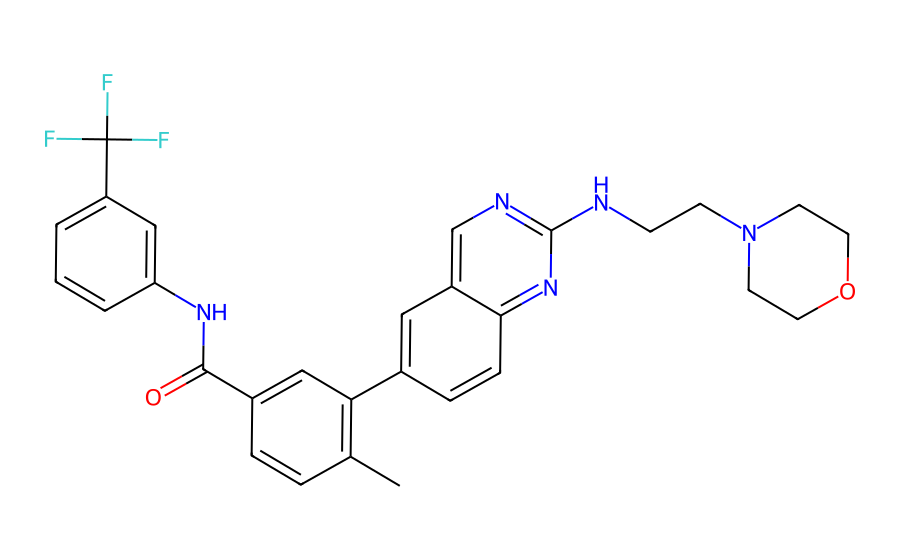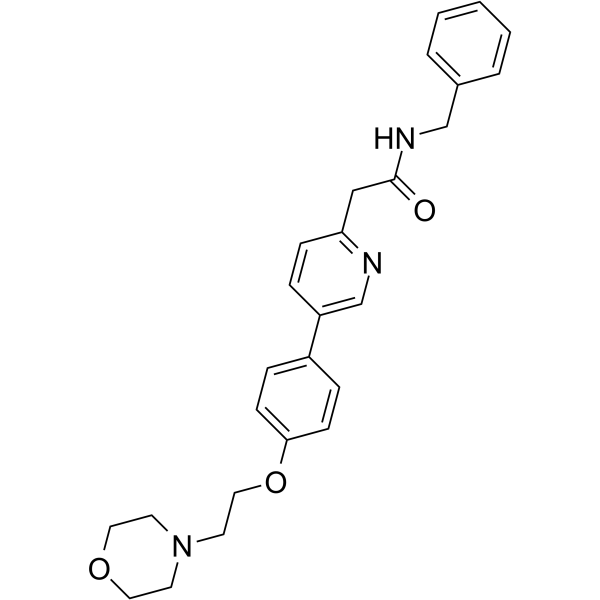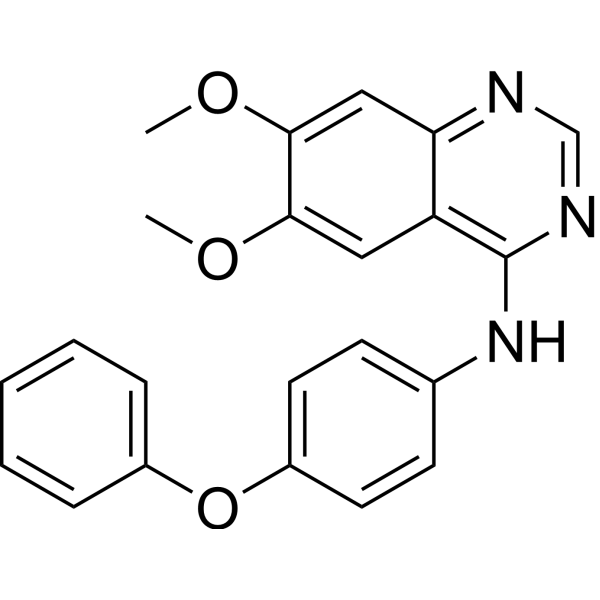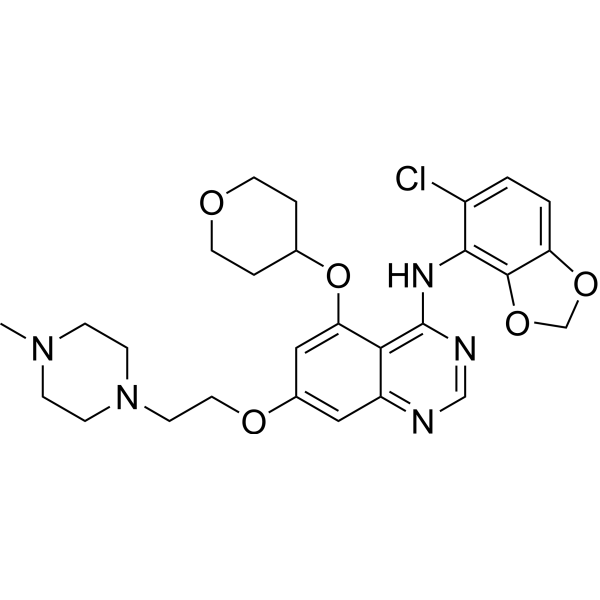
Saracatinib (AZD0530) chemical structure
Chemical structureResearch use only
CAT. NO. DC7276Featured

Saracatinib (AZD0530)

Pack Sizes & Prices

TotalUS$350
We match the best price and quality on market.
Product overview

Description & Application

Saracatinib (AZD0530) is a potent Src family inhibitor with IC50s of 2.7 to 11 nM for c-Src, Lck, c-YES, Lyn, Fyn, Fgr, and Blk and shows high selectivity over other tyrosine kinases.

ParameterValue
Chemical NameSaracatinib free base
CAS No.379231-04-6
SynonymsSaracatinib;N-(5-Chloro-1,3-benzodioxol-4-yl)-7-[2-(4-methyl-1-piperazinyl)ethoxy]-5-[(tetrahydro-2H-pyran-4-yl)oxy]-4-quinazolinamine;Saracatinib (AZD0530);(S)-2-[4-(4-chlorophenyl)-2,3,9-trimethyl-6H-thieno[3,2-f][1,2,4]triazolo[4,3-a][1,4]diazepin-6-yl]-N-(4-hydroxyphenyl)acetamide;4-Quinazolinamine, N-(5-chloro-1,3-benzodioxol-4-yl)-7-[2-(4-methyl-1-piperazinyl)ethoxy]-5-[(...;4-Quinazolinamine, N-(5-chloro-1,3-benzodioxol-4-yl)-7-[2-(4-methyl-1-piperazinyl)ethoxy]-5-[(tetrahydro-2H-pyran-4-yl)oxy]-;AZD0530;N-(5-Chlorobenzo[d][1,3]dioxol-4-yl)-7-(2-(4-methylpiperazin-1-yl)ethoxy)-5-(tetrahydro-2H-pyran-4-yloxy)quinazolin-4-amine;Saracatinib (AZD0530, AZD-0530 );Saracatinib-AZD0530; AZD-0530;AZD0530 difuMarate;AZD 0530;SARACATINIB, FREE BASE;9KD24QGH76;N-(5-chloro-1,3-benzodioxol-4-yl)-7-[2-(4-methylpiperazin-1-yl)ethoxy]-5-(oxan-4-yloxy)quinazolin-4-amine;4-(6-Chloro-;4-(6-Chloro-2,3-methylenedioxyanili;HMS3265E21;N-(5-chloro-2H-1,3-benzodioxol-4-yl)-7-[2-(4-methylpiperazin-1-yl)ethoxy]-5-[(oxan-4-yl)oxy]quinazolin-4-amine;HMS3265E22;379231-04-6;Saracatinib [USAN:INN];nchembio866-comp19;UNII-9KD24QGH76;NSC758872;DTXSID90191355;HMS3884A03;GTPL7731;NCGC00241099-01;CHEMBL217092;saracatinibum;CCG-264773;SB16503;Q-201699;HMS3654K03;BCP0726000126;N-(5-chloro-1,3-benzodioxol-4-yl)-7-[2-(4-methylpiperazin-1-yl)ethoxy]-5-(tetrahydro-2H-pyran-4-yloxy)quinazolin-4-amine;OUKYUETWWIPKQR-UHFFFAOYSA-N;4-(6-chloro-2,3-methylenedioxyanilino)-7-[2-(4-methylpiperazin-1-yl)ethoxy]-5-tetrahydropyran-4-yloxyquinazoline;N-(5-chloro-2H-1,3-benzodioxol-4-yl)-7-[2-(4-methylpiperazin-1-yl)ethoxy]-5-(oxan-4-yloxy)quinazolin-4-amine;N-(5-CHLORO-1,3-BENZODIOXOL-4-YL)-7-(2-(4-METHYLPIPERAZIN-1-YL)ETHOXY)-5-((OXAN-4-YL)OXY)QUINAZOLIN-4-AMINE;CS-0101;2h8h;AZD0350;NS00071732;NSC-800878;HMS3265F22;A823939;FT-0657225;SMR004702935;s1006;SARACATINIB [WHO-DD];4-(6-Chloro-2,3-methylenedioxyanilino)-7-(2-(4-methylpiperazin-1-yl)ethoxy)-5-tetrahydropyran-4-yloxyquinazoline;NSC800878;AC-5249;Q21098957;NCGC00241099-06;SW218134-2;D09664;SCHEMBL41547;HMS3265F21;HMS3747A05;AS-16692;MLS006011166;Saracatinib [USAN];N-(5-chloro-1,3-benzodioxol-4-yl)-7-[2-(4-methylpiperazin-1-yl)ethoxy]-5-tetrahydropyran-4-yloxy-quinazolin-4-amine;SARACATINIB [INN];N-(5-Chloro-1,3-benzodioxol-4-yl)-7-(2-(4-methylpiperazin-1-yl)ethoxy)-5-(tetrahydro-2H-pyran-4-yloxy)quinazolin-4-amine;NCGC00241099-03;DB11805;EX-A1576;BCPP000364;N-(5-chlorobenzo[d][1,3]dioxol-4-yl)-7-(2-(4-methylpiperazin-1-yl)ethoxy)-5-((tetrahydro-2H-pyran-4-yl)oxy)quinazolin-4-amine;BCP9000358;HY-10234;CHEBI:47458;BRD-K19540840-001-05-2;NSC-758872;AZD-0530;N-(5-chloro-1,3-benzodioxol-4-yl)-7-[2-(4-methylpiperazin-1-yl)ethoxy]-5-tetrahydropyran-4-yloxy-quinazolin-4-amine;Saracatinib,AZD0530;AZ-10353926;AKOS005145757;MFCD09832698;N-(5-chlorobenzo[d][1,3]dioxol-4-yl)-7-(((4-methylpiperazin-1-yl)methoxy)methyl)-5-(tetrahyd...
FormulaC27H32ClN5O5
M.Wt542.03
SMILESClC1C([H])=C([H])C2=C(C=1N([H])C1C3=C(C([H])=C(C([H])=C3OC3([H])C([H])([H])C([H])([H])OC([H])([H])C3([H])[H])OC([H])([H])C([H])([H])N3C([H])([H])C([H])([H])N(C([H])([H])[H])C([H])([H])C3([H])[H])N=C([H])N=1)OC([H])([H])O2
Purity>98%
Storage2 years -20°C Powder, 2 weeks 4°C in DMSO, 6 months -80°C in DMSO

Biological Activity

Saracatinib (AZD0530) is a potent Src family inhibitor with IC50s of 2.7 to 11 nM for c-Src, Lck, c-YES, Lyn, Fyn, Fgr, and Blk and shows high selectivity over other tyrosine kinases.

In Vitro

Saracatinib (AZD0530), an orally available Src inhibitor, demonstrates potent antimigratory and anti-invasive effects in vitro, and inhibits metastasis in a murine model of bladder cancer. Antiproliferative activity of Saracatinib varies between cell lines (IC50 0.2-10 μM). Saracatinib potently inhibits the proliferation of Src3T3 mouse fibroblasts and demonstrates variable antiproliferative activity in a range of human cancer cell lines containing endogenous Src. Sub micromolar growth inhibition of five of the human cancer cell lines tested with Saracatinib (tumor types: colon, prostate, lung, and leukemia) is observed with IC50 values of 0.2-0.7 μM. In 3-day MTS cell proliferation assays, Saracatinib inhibits proliferation of the Bcr-Abl-driven human leukemia cell line K562 with an IC50 of 0.22 μM. In the microdroplet migration assay, Saracatinib reduces the migration of human lung cancer A549 cells in a concentration-dependent manner (IC50 0.14 μM)[1].

In Vivo

Saracatinib (AZD0530) treatment potently inhibits the proliferation of subcutaneously transplanted Src3T3 fibroblasts in mice and rats in a dose-dependent manner. In both models, significant inhibition of tumor growth is seen at doses ≥6 mg/kg/day (60% inhibition in mice and 98% inhibition in rats versus animals treated with vehicle) and, at the maximum doses investigated, complete tumor growth inhibition is observed (100% inhibition at 25 mg/kg/day in mice and 10 mg/kg/day in rats)[1].

Target

IC50: 2.7 nM (Src), 30 nM (v-Abl), 66 nM (EGFR), 200 nM (c-Kit)[1]

Kinase Assay

Investigation of the reversibility and the mechanism of Saracatinib inhibition is conducted using a full-length activated human Src in a continuous, coupled assay. ATP and peptide substrate (Src II peptide) concentrations are varied in turn (ATP 40-1280 μM; Src II peptide 100-800 μM), in conjunction with Saracatinib (0-30 nM), at saturating concentrations of the non-varied substrate (ATP 1.6 mM; Src II peptide 1.0 mM). The binding affinity of Saracatinib for inactivated Src (phosphorylated at tyrosine 527, not tyrosine 416) is measured using a BIAcore inhibition-in-solution assay. The assay followed competition binding between Saracatinib and an immobilized ureidoquinazoline for binding to Src. Data analysis is performed by unweighted nonlinear regression using GraFit, version 5 and an F-test is used to identify the most suitable equation[1].

Cell Assay

Cell proliferation is assessed using a colorimetric 5-bromo-2′-deoxyuridine (BrdU) Cell Proliferation ELISA kit. Briefly, cells are plated onto 96-well plates (1.5×10⁴ cells/well), the following day 0.039-20 μM Saracatinib in DMSO (at a final concentration of 0.5%) is added and the cells are incubated for 24 h. The cells are pulse labeled with BrdU for 2 h and fixed. Cellular DNA is then denatured with the provided solution and incubated with antiBrdU peroxidase for 90 min. Following three washes with phosphate-buffered saline, tetramethylbenzidine substrate solution is added and the plates are incubated on a plate shaker for 10-30 min until the positive control absorbance at 690 nm is approximately 1.5 absorbance units[1].

Animal Administration

Mice and Rats[1] Female athymic mice (nu/nu) and rats (RH-rnu/rnu) are used. Animals are treated once daily by oral gavage with either vehicle alone or Saracatinib 6.25-50 mg/kg for 10-91 days. Tumor growth inhibition is calculated. For pharmacokinetic and pharmacodynamic analysis animals are humanely sacrificed and samples (plasma and tumor) are collected. Tumor samples are homogenized with 5 volumes of water and extracted with chloroform. Plasma and tumor samples are analyzed for Saracatinib concentration using high-performance liquid chromatography with tandem mass spectrometric detection after solid-phase extraction.

References & source

[1]. Green TP, et al. Preclinical anticancer activity of the potent, oral Src inhibitor AZD0530. Mol Oncol, 2009, 3(3), 248-261.

[2]. Fuse MA, et al. Combination Therapy With c-Met and Src Inhibitors Induces Caspase-Dependent Apoptosis of Merlin-Deficient Schwann Cells and Suppresses Growth of Schwannoma Cells. Mol Cancer Ther. Mol Cancer Ther. 2017 Nov;16(11):2387-2398.

DC Chemicals original product information

Published experimental findings depend on the model and assay conditions. They do not guarantee equivalent performance in every application. For laboratory research use only.
Product documentation

Refer to the certificate supplied with your lot for batch-specific release results.

Handling guide

2 years -20°C Powder, 2 weeks 4°C in DMSO, 6 months -80°C in DMSO

Solution calculator

Related research products

WH-4-023 chemical structureDC7657

WH-4-023

WH-4-023 is a potent and selective dual Lck/Src inhibitor with IC50 of 2 nM/6 nM for Lck and Src kinase respectively; little inhibition on p38α and KDR.

View activity & prices
KX1-004 chemical structureDC7582

KX1-004

KX1-004 is a potent small molecule inhibitor of Src-PTK as a potential protective drug for NIHL.IC50 value:Target: Src-PTK inhibitorKX1-004, KX1-005 and KX1-174 as potential protective drugs for NIHL. Chinchillas were…

View activity & prices
AMG-47a chemical structureDC7001

AMG-47a

AMG-47a is a potent inhibitor of Lck and T cell proliferation; exhibits anti-inflammatory activity (ED50 = 11 mg/kg) in the anti-CD3 induced production of IL-2 in mice.

View activity & prices
KX2-391 chemical structureDC8023

KX2-391

KX2-391 is an inhibitor of Src that targets the peptide substrate site of Src, with GI50 of 9-60 nM in cancer cell lines.

View activity & prices
1-NA-PP1 chemical structureDC9281

1-NA-PP1

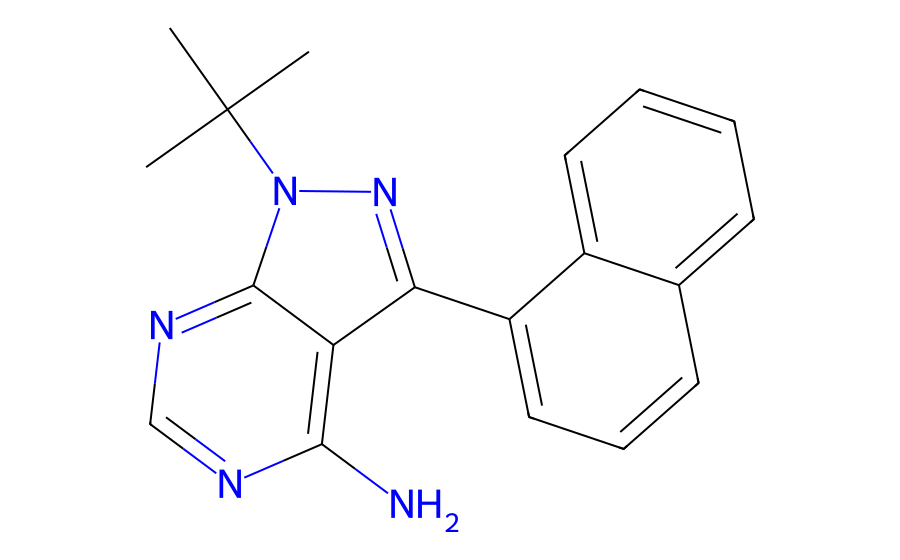
1-Naphthyl PP1(1-NA-PP 1) is a selective inhibitor of src family kinases v-Src and c-Fyn as well as the tyrosine kinase c-Abl (IC50 values are 1.0, 0.6, 0.6, 18 and 22 μM for v-Src, c-Fyn, c-Abl, CDK2 and CAMK II…

View activity & prices
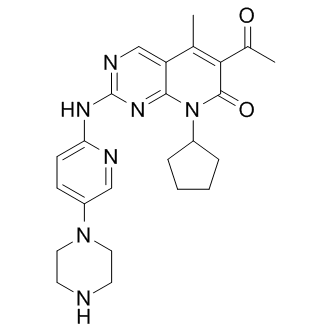
Palbociclib chemical structureDC8469

Palbociclib

Palbociclib (PD 0332991) is a selective CDK4 and CDK6 inhibitor with IC50s of 11 and 16 nM, respectively. Palbociclib is a drug for the treatment of ER-positive and HER2-negative breast cancer.

View activity & prices

Cart

Request quotation