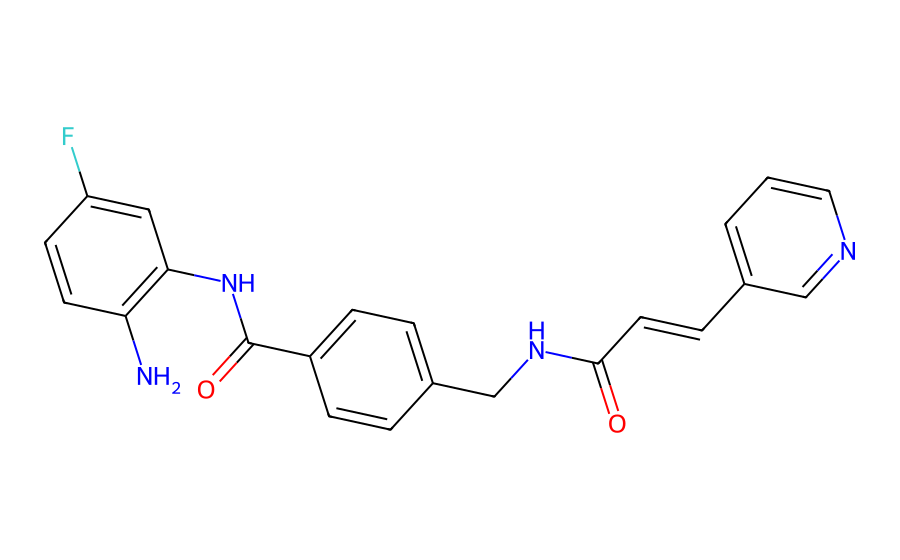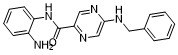
HDAC3 inhibitor PT3 chemical structure
Chemical structureResearch use only
CAT. NO. DC70478Featured

HDAC3 inhibitor PT3

Pack Sizes & Prices

TotalUS$450
We match the best price and quality on market.
Product overview

Description & Application

HDAC3 inhibitor PT3 is a novel potent, selective, BBB-permeable HDAC3 inhibitor.PT3 exhibited higher selectivity for HDAC3 over HDAC1, HDAC6, and HDAC8 compared to the reference compound CI994.PT3 upregulated H3K9 acetylation, CREB 1, BDNF, TRKB, Nr4a2, c-fos, PKA, GAP 43 and MMP9 expression in mouse neuronal (N2A) cells.PT3 significantly improved the discrimination index in C57/BL6 mice in the novel object recognition (NOR) model, significant increased in H3K9 acetylation in hippocampus.PT3 upregulated CREB 1, BDNF, TRKB, Nr4a2, c-fos, PKA, GAP 43, PSD 95 and MMP9 expression in mice treated with PT3.

ParameterValue
Chemical NameN-(2-Aminophenyl)-5-[(phenylmethyl)amino]-2-pyrazinecarboxamide
CAS No.2710273-81-5
SynonymsHDAC3 inhibitor PT3
FormulaC18H17N5O
M.Wt319.360482931137
SMILESC1(C(NC2=CC=CC=C2N)=O)=NC=C(NCC2=CC=CC=C2)N=C1
Purity>98%
Storage2 years -20°C Powder, 2 weeks 4°C in DMSO, 6 months -80°C in DMSO

Biological Activity

HDAC3 inhibitor PT3 is a novel potent, selective, BBB-permeable HDAC3 inhibitor.PT3 exhibited higher selectivity for HDAC3 over HDAC1, HDAC6, and HDAC8 compared to the reference compound CI994.PT3 upregulated H3K9 acetylation, CREB 1, BDNF, TRKB, Nr4a2, c-fos, PKA, GAP 43 and MMP9 expression in mouse neuronal (N2A) cells.PT3 significantly improved the discrimination index in C57/BL6 mice in the novel object recognition (NOR) model, significant increased in H3K9 acetylation in hippocampus.PT3 upregulated CREB 1, BDNF, TRKB, Nr4a2, c-fos, PKA, GAP 43, PSD 95 and MMP9 expression in mice treated with PT3.

In Vitro

No in vitro data are provided in the current product source. Contact us for further information.

In Vivo

No in vivo data are provided in the current product source. Contact us for further information.

References & source

DC Chemicals original product information

Published experimental findings depend on the model and assay conditions. They do not guarantee equivalent performance in every application. For laboratory research use only.
Product documentation

Refer to the certificate supplied with your lot for batch-specific release results.

Handling guide

2 years -20°C Powder, 2 weeks 4°C in DMSO, 6 months -80°C in DMSO

Solution calculator

Related research products

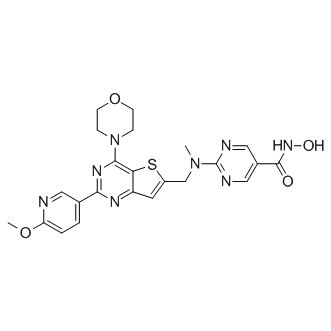
CAY10603 chemical structureDC8036

CAY10603

CAY10603 is a potent and selective HDAC6 inhibitor, with an IC50 of 2 pM; CAY10603 also inhibits HDAC1, HDAC2, HDAC3, HDAC8, HDAC10, with IC50s of 271, 252, 0.42, 6851, 90.7 nM.

View activity & prices
CUDC-907 (PI3K/HDAC InhibitorI) chemical structureDC3110

CUDC-907 (PI3K/HDAC InhibitorI)

Fimepinostat (CUDC-907) potently inhibits class I PI3Ks as well as classes I and II HDAC enzymes with an IC50 of 19/54/39 nM and 1.7/5.0/1.8/2.8 nM for PI3Kα/PI3Kβ/PI3Kδ and HDAC1/HDAC2/HDAC3/HDAC10 , respectively.

View activity & prices
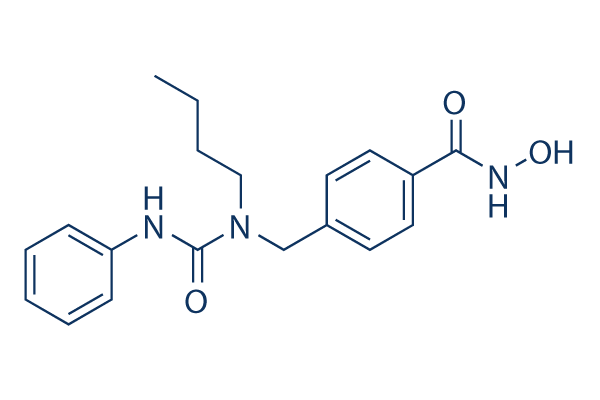
Nexturastat A chemical structureDC7548

Nexturastat A

Nexturastat A is a potent and selective HDAC6 inhibitor with IC50 of 5 nM; no inhibition on other HDAC forms.Nexturastat A displayed low micromolar activity compared to the low nanomolar activity against HDAC6.…

View activity & prices
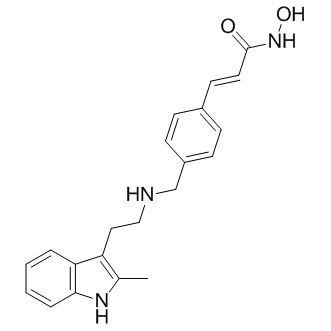
Belinostat (PXD101) chemical structureDC7082

Belinostat (PXD101)

Belinostat inhibits the growth of tumor cells (A2780, HCT116, HT29, WIL, CALU-3, MCF7, PC3 and HS852) with IC50 from 0.2-0.66 μM. PD101 shows low activity in A2780/cp70 and 2780AD cells, which are cisplatin and…

View activity & prices
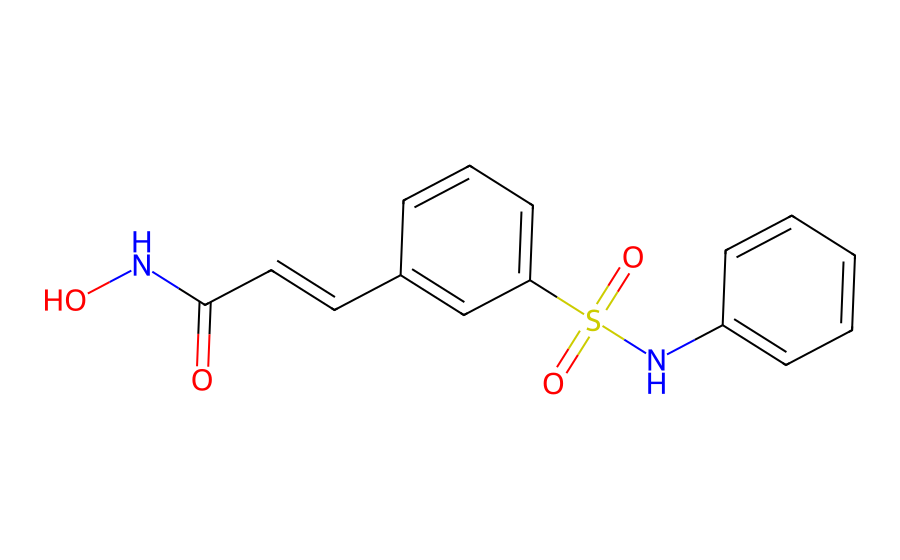
R306465(JNJ-16241199) chemical structureDC7037

R306465(JNJ-16241199)

R306465, also known as JNJ-16241199, is a novel hydroxamate-based histone deacetylase (HDAC) inhibitor with broad-spectrum antitumour activity against solid and haematological malignancies in preclinical models.

View activity & prices

Cart

Request quotation