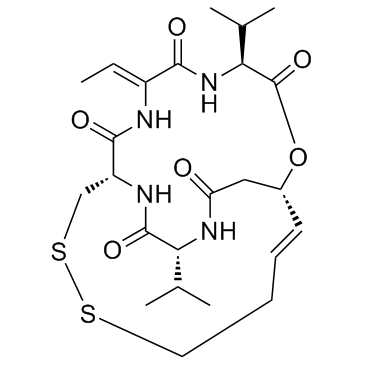
Romidepsin(FK-228) chemical structure
Chemical structureResearch use only
CAT. NO. DCAPI1434Featured

Romidepsin(FK-228)

Pack Sizes & Prices

TotalUS$950
We match the best price and quality on market.
Product overview

Description & Application

Romidepsin is a potent HDAC1 and HDAC2 inhibitor with IC50s of 36 and 47 nM, respectively.

ParameterValue
Chemical NameFK 228;  FR 901228;  NSC 630176;  depsipeptide,FK228
CAS No.128517-07-7
SynonymsFK 228;  FR 901228;  NSC 630176;  depsipeptide,FK228
FormulaC24H36N4O6S2
M.Wt540.7
SMILESO=C(N/C(C(N[C@H]1C(C)C)=O)=CC)[C@@](NC([C@](C(C)C)([H])NC(C2)=O)=O)([H])CSSCC/C=C[C@@]2([H])OC1=O
Purity>99%
Storage2 years -20°C Powder, 2 weeks 4°C in DMSO, 6 months -80°C in DMSO

Biological Activity

Romidepsin is a potent HDAC1 and HDAC2 inhibitor with IC50s of 36 and 47 nM, respectively.

In Vitro

Romidepsin potently inhibits HDAC1 and HDAC2 (IC50=36, 47 nM, respectively). Romidepsin has slightly inhibitory effects against HDAC4 and HDAC6 (IC50=510, 14000 nM, respectively). Romidepsin induces histone acetylation and p21 expression with an EC50 of 3.0 nM. Romidepsin is more strongly than redFK with EC50 of 11 nM due to the instability of redFK in HeLa cells[1]. Romidepsin is 100 times more potent than TSA and 1,000,000 times more potent than butyrate in inhibiting the proliferation of the A549 cells. Romidepsin causes mitotic arrest, and that the treatment with HDIs causes defects in chromosome segregation in mitosis[2]. Romidepsin inhibits the growth of U-937, K562, and CCRF-CEM cells with IC50 values of 5.92 nM, 8.36 nM, and 6.95 nM, respectively[3].

In Vivo

In a scid mouse lymphoma model, romidepsin treated mice once or twice a week survive longer than control mice, with median survival times of 30.5 (0.56 mg/kg) and 33 days (0.32 mg/kg), respectively (vs. 20 days in control mice). Remarkably, 2 out of 12 mice treated with romidepsin (0.56 mg/kg once or twice a week) survive past the observation period of 60 days. The apoptotic population of U-937 cells increases to 37.7% after 48 hr of treatment with romidepsin in a time dependent manner. In addition, romidepsin induces G1 and G2/M arrest and the differentiation of U-937 cells to the CD11b(+)/CD14(+) phenotype. Expression of p21(WAF1/Cip1) and gelsolin mRNA increases up to 654- and 152-fold, respectively, after 24 hr of treatment with romidepsin. Romidepsin causes histone acetylation in p21(WAF1/Cip1) promoter regions, including the Sp1-binding sites[3].

References & source

DC Chemicals original product information

Published experimental findings depend on the model and assay conditions. They do not guarantee equivalent performance in every application. For laboratory research use only.
Product documentation

Refer to the certificate supplied with your lot for batch-specific release results.

Handling guide

2 years -20°C Powder, 2 weeks 4°C in DMSO, 6 months -80°C in DMSO

Solution calculator

Related research products

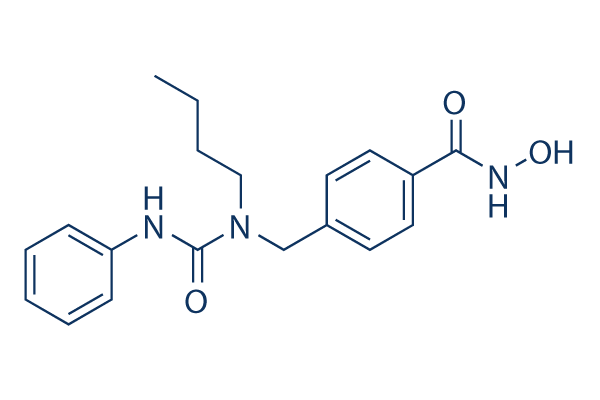
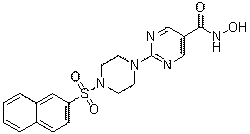
CAY10603 chemical structureDC8036

CAY10603

CAY10603 is a potent and selective HDAC6 inhibitor, with an IC50 of 2 pM; CAY10603 also inhibits HDAC1, HDAC2, HDAC3, HDAC8, HDAC10, with IC50s of 271, 252, 0.42, 6851, 90.7 nM.

View activity & prices
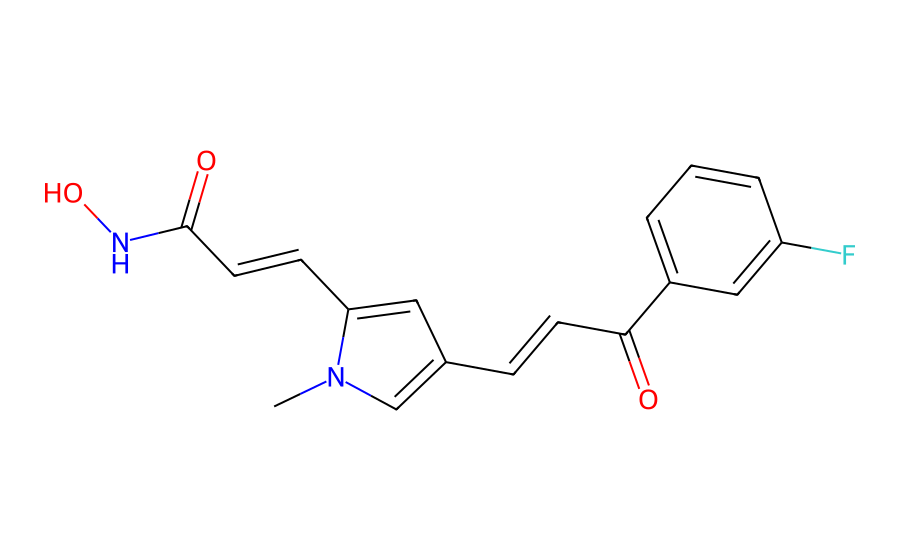
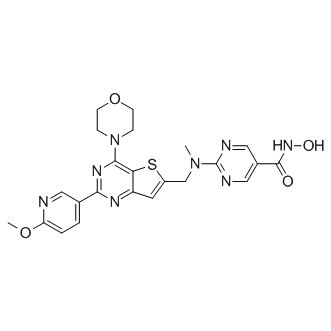
CUDC-907 (PI3K/HDAC InhibitorI) chemical structureDC3110

CUDC-907 (PI3K/HDAC InhibitorI)

Fimepinostat (CUDC-907) potently inhibits class I PI3Ks as well as classes I and II HDAC enzymes with an IC50 of 19/54/39 nM and 1.7/5.0/1.8/2.8 nM for PI3Kα/PI3Kβ/PI3Kδ and HDAC1/HDAC2/HDAC3/HDAC10 , respectively.

View activity & prices
Nexturastat A chemical structureDC7548

Nexturastat A

Nexturastat A is a potent and selective HDAC6 inhibitor with IC50 of 5 nM; no inhibition on other HDAC forms.Nexturastat A displayed low micromolar activity compared to the low nanomolar activity against HDAC6.…

View activity & prices
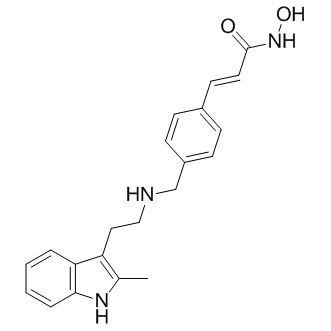
Belinostat (PXD101) chemical structureDC7082

Belinostat (PXD101)

Belinostat inhibits the growth of tumor cells (A2780, HCT116, HT29, WIL, CALU-3, MCF7, PC3 and HS852) with IC50 from 0.2-0.66 μM. PD101 shows low activity in A2780/cp70 and 2780AD cells, which are cisplatin and…

View activity & prices
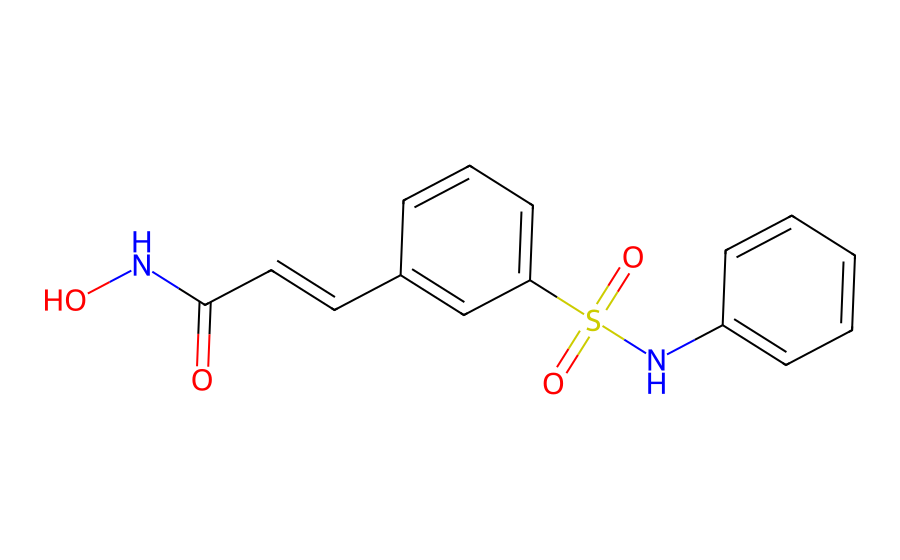
R306465(JNJ-16241199) chemical structureDC7037

R306465(JNJ-16241199)

R306465, also known as JNJ-16241199, is a novel hydroxamate-based histone deacetylase (HDAC) inhibitor with broad-spectrum antitumour activity against solid and haematological malignancies in preclinical models.

View activity & prices
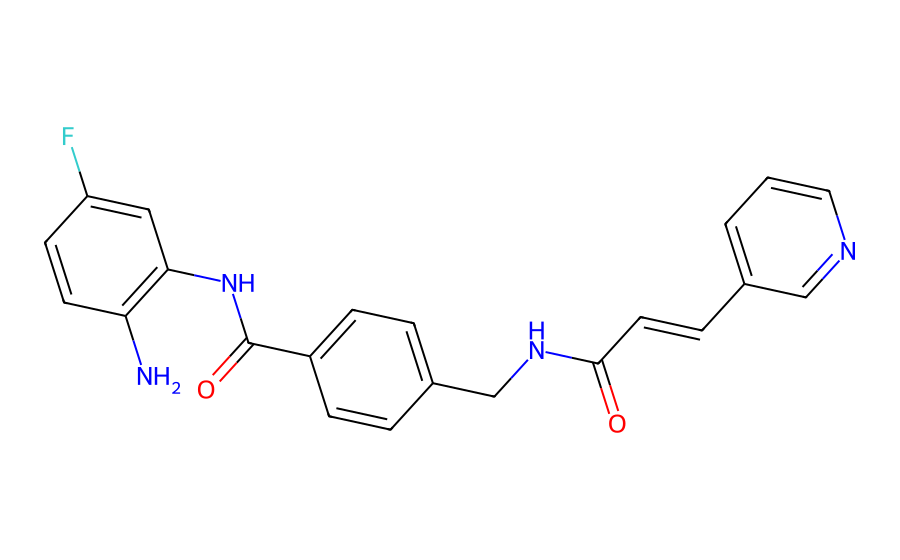
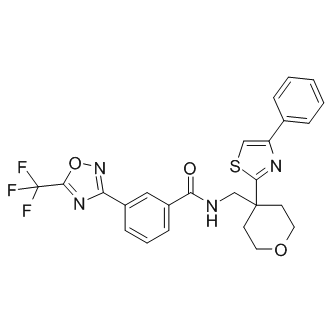
TMP269 chemical structureDC7716

TMP269

TMP269 is a novel and selective class IIa histone deacetylase (HDAC) inhibitor with IC50s of 157 nM, 97 nM, 43 nM and 23 nM for HDAC4, HDAC5, HDAC7 and HDAC9, respectively.

View activity & prices

Cart

Request quotation