Biological Activity
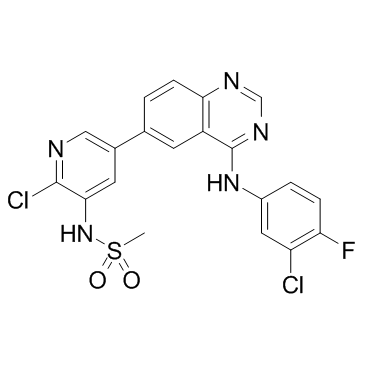
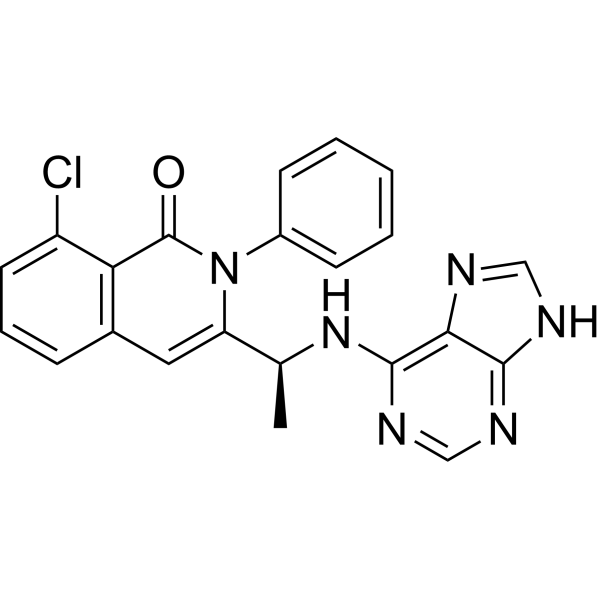
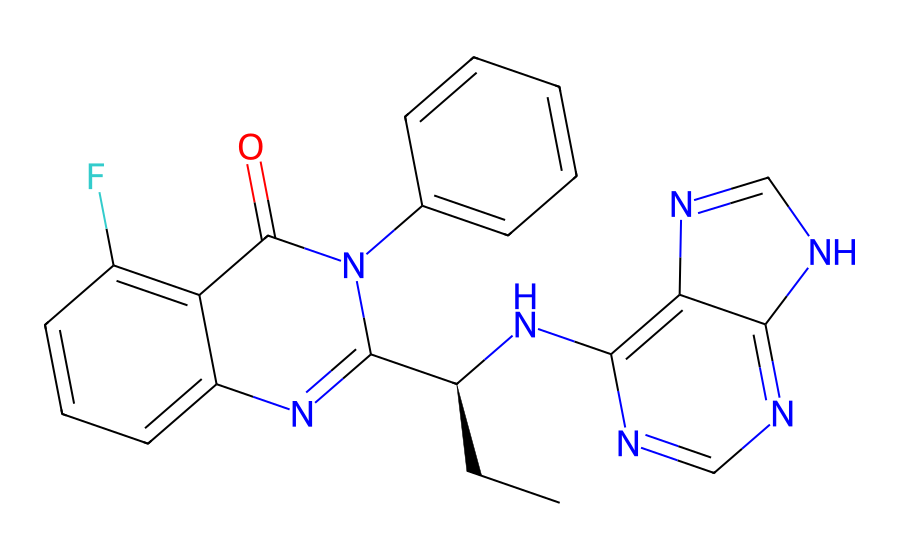
Idelalisib (CAL-101) is a highly selective and potent p110δ inhibitor with an IC50 of 2.5 nM, showing 40- to 300-fold selectivity for p110δ over other PI3K class I enzymes.
In Vitro
Idelalisib (CAL-101) is a highly selective and potent p110δ inhibitor (EC50=8 nM). Greater selectivity (400- to 4000-fold) is seen against related kinases C2β, hVPS34, DNA-PK, and mTOR, whereas no activity is observed against a panel of 402 diverse kinases at 10 μM. CAL-101 reduces PDGF-induced pAkt by only 25% at 10 μM. Idelalisib (CAL-101) inhibits LPA-induced pAkt with an EC50 of 1.9 μM. Idelalisib (CAL-101) blocks FcϵRI p110δ-mediated CD63 expression with an EC50 of 8 nM, whereas formyl-methionyl-leucyl-phenylalanine activation of p110γ is inhibited with an EC50 of 3 μM. Thus, in cell-based assays, CAL-101 has 240- to 2500-fold selectivity for p110δ over the other class I PI3K isoforms[1]. CAL-101Idelalisib (CAL-101)-induced apoptosis of chronic lymphocytic leukemia (CLL) cells is significant compare with vehicle treatment alone (P<0.001). Idelalisib (CAL-101) induces selective cytotoxicity in CLL cells independent of IgVH mutational status or interphase cytogenetics[2].
In Vivo
A significant reduction is observed in the CD11b+Ly6G+ neutrophils from brain homogenates of bothp110δD910A/D910A mice and Idelalisib (CAL-101) (40 mg/kg, i.v.) post-treated mice[3].
References & source
Published experimental findings depend on the model and assay conditions. They do not guarantee equivalent performance in every application. For laboratory research use only.