Biological Activity
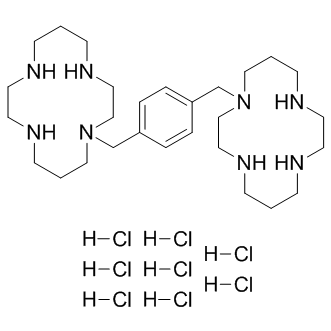
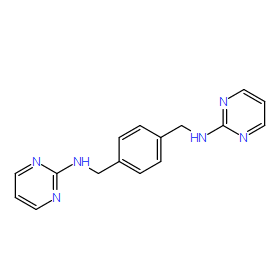
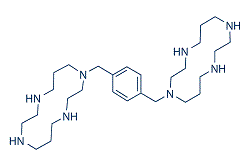
Plerixafor is a selective CXCR4 antagonist with an IC50 of 44 nM.
In Vitro
The CXCR4 inhibitor Plerixafor (AMD3100) is a potent inhibitor of CXCL12-mediated chemotaxis (IC50, 5.7 nM) with a potency slightly better than its affinity for CXCR4. Treating the cells with CCX771 or CXCL11 has no effect on CXCL12-mediated MOLT-4 or U937 TEM. In contrast, 10 μM Plerixafor inhibits CXCL12-mediated TEM in both cells lines[1]. Plerixafor (10 μM)-treated cells show a moderate reduction in cell proliferation compared to CXCL12-stimulated cells, which do not reach statistical significance[2].
In Vivo
Plerixafor (2 mg/kg) administration to UUO mice exacerbates renal interstitial T cell infiltration, resulting in increased production of the pro-inflammatory cytokines IL-6 and IFN-γ and decreased expression of the anti-inflammatory cytokine IL-10[3]. Both perivascular and interstitial fibrosis are significantly reduced by the CXCR4 antagonist, Plerixafor (AMD3100) at 8 weeks[4]. LD50, mouse, SC: 16.3 mg/kg; LD50, rat, SC: >50 mg/kg; LD50, mouse and rat, IV injection: 5.2 mg/kg.
Target
125I-CXCL12-CXCR4:44 nM (IC50)
Cell Assay
U87MG cells are seeded in 96-well plates at the density of 6×10³ cells in 200 μL/well and treated with CXCL12, Plerixafor or with peptide R. MTT (5 μg/mL) is added at each time point (24, 48, 72 h) during the final 2 h of treatment. After removing cell medium, 100 μL DMSO are added and optical densities measured at 595 nm with a LT-4000MS Microplate Reader. Measurements are made in triplicates from three independent experiments[2].
Animal Administration
Mice[3] Male C57bl/6 mice (6-7 weeks old, weighing 20 g) are used. The animals are acclimated to the housing environment, which is SPF and had a temperature of 22°C and a 12h/12h light/dark cycle for a week. Then, they are randomly divided into following experimental groups, with 8 mice in each group: normal (no specific intervention), UUO+AMD3100 (mice received UUO surgery and 2 mg/kg AMD3100), and UUO+PBS (mice received UUO surgery and the same volume of PBS). AMD3100 and PBS are administered via intraperitoneal injection every day until sacrifice. Rats[4] The CXCR4 antagonist, AMD3100 dissolved in H2O, is delivered in the type 2 diabetic sand rat model at a dose of 6 mg/kg per day for 8 weeks. In complementary studies, the effect of CXCR4 antagonism (AMD3100 6mg/kg/d) on regulatory T cell numbers is examined. For these studies, AMD3100 or vehicle is delivered via minipump for a period of one week.
References & source
[1]. Zabel BA, et al. Elucidation of CXCR7-mediated signaling events and inhibition of CXCR4-mediated tumor cell transendothelial migration by CXCR7 ligands. J Immunol. 2009 Sep 1;183(5):3204-11.
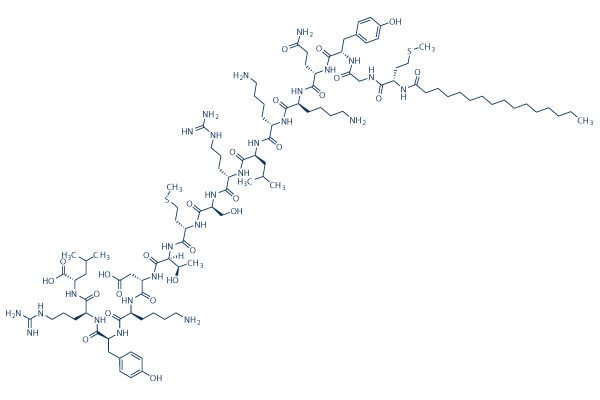
[2]. Mercurio L, et al. Targeting CXCR4 by a selective peptide antagonist modulates tumor microenvironment and microglia reactivity in a human glioblastoma model. J Exp Clin Cancer Res. 2016 Mar 25;35:55.
[3]. Yang J, et al. Continuous AMD3100 Treatment Worsens Renal Fibrosis through Regulation of Bone Marrow Derived Pro-Angiogenic Cells Homing and T-Cell-Related Inflammation. PLoS One. 2016 Feb 22;11(2):e0149926.
[4]. Chu PY, et al. CXCR4 Antagonism Attenuates the Development of Diabetic Cardiac Fibrosis. PLoS One. 2015 Jul 27;10(7):e0133616.
[5]. He G, et al. SDF-1 in Mammary Fibroblasts of Bovine with Mastitis Induces EMT and Inflammatory Response of Epithelial Cells. Int J Biol Sci. 2017 May 5;13(5):604-614.
[6]. Wei He, et al. Targeting CXC motif chemokine receptor 4 inhibits the proliferation, migration and angiogenesis of lung cancer cells. Oncol Lett. 2018 Sep;16(3):3976-3982.
Published experimental findings depend on the model and assay conditions. They do not guarantee equivalent performance in every application. For laboratory research use only.