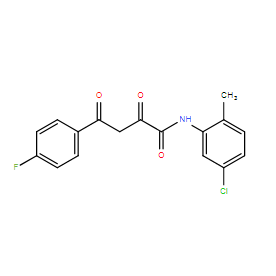
SEC inhibitor KL-2 (DC11392) chemical structure
Chemical structureResearch use only
CAT. NO. DC11392Featured

SEC inhibitor KL-2

Pack size & price

USD
Ready-made solution
Total$650
We match the best price and quality on market.
Product overview

Description & Application

KL-2 is a small-molecule disruptor of the super elongation complex for transcriptional elongation and MYC-dependent cancer research.

ParameterValue
Chemical NameN-(5-chloro-2-methylphenyl)-4-(4-fluorophenyl)-2,4-dioxobutanamide
CAS No.900308-51-2
SynonymsKL2,KL-2,KL 2
FormulaC17H13ClFNO3
M.Wt333.06
SMILESC1=CC(F)=CC=C1C(CC(C(=O)NC1=CC(Cl)=CC=C1C)=O)=O
PurityOn request
Storage2 years -20°C Powder, 2 weeks 4°C in DMSO, 6 months -80°C in DMSO
Super elongation complex / AFF4–P-TEFb · Literature evidence

Biological Activity

KL-2 is a small-molecule disruptor of the super elongation complex for transcriptional elongation and MYC-dependent cancer research. KL-2 is a related SEC-disrupting lead; the compounds impaired promoter-proximal pause release by RNA polymerase II.

In Vitro

EndpointModel / conditions / sourceReported result
SEC disruptionAFF4–P-TEFb interaction study of KL-2 and KL-1. [1]KL-2 is a related SEC-disrupting lead; the compounds impaired promoter-proximal pause release by RNA polymerase II.
Elongation responseCellular transcriptional assays. [1]SEC disruption reduced the average rate of processive transcription elongation.
Stress and MYC programsHeat-shock experiments and mammalian gene-expression analyses. [1]The study found weaker heat-shock induction and lower MYC-dependent transcription.

In Vivo

No compound-specific animal efficacy result is established by the sources summarized here.

Compound and Evidence Context

EndpointModel / conditions / sourceReported result
Compound-specific evidenceKL-1 and KL-2 are studied in one publication. [1]Shared mechanistic evidence does not establish identical potency or exposure. The abstract does not resolve a separate KL-2 animal dose-response dataset.

Interpretation

The study examines both KL-1 and KL-2. Shared abstract-level xenograft claims are not converted into compound-specific response rates.
Original studies

References

  1. Liang K, et al. Targeting Processive Transcription Elongation via SEC Disruption for MYC-Induced Cancer Therapy. Cell (2018).

Product documentation

Refer to the certificate supplied with your lot for batch-specific release results.

Handling guide

2 years -20°C Powder, 2 weeks 4°C in DMSO, 6 months -80°C in DMSO

For additional quantities or product documentation, contact info@dcchemicals.com.

Related research products

WM-1119 chemical structureDC10881

WM-1119

WM-1119 is a KAT6A/KAT6B inhibitor for epigenetic and cellular-senescence research. The primary study reports binding selectivity, lymphoma-cell growth inhibition and suppression of lymphoma progression in mice.

View activity & prices
WM-8014 chemical structureDC10880

WM-8014

WM-8014 is a KAT6A/KAT6B inhibitor for chromatin, cellular senescence and cancer research. Published work separates biochemical inhibition, fibroblast growth arrest and responses in a zebrafish liver cancer model.

View activity & prices
MC3343 chemical structureDC10940

MC3343

MC3343 is a nonnucleoside DNMT inhibitor for epigenetic reprogramming, osteoblastic differentiation and osteosarcoma research.

View activity & prices

Cart

Request quotation