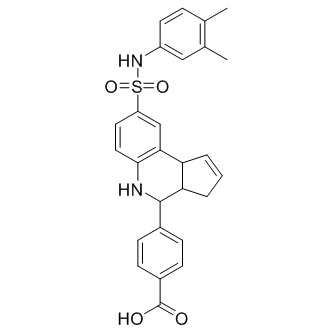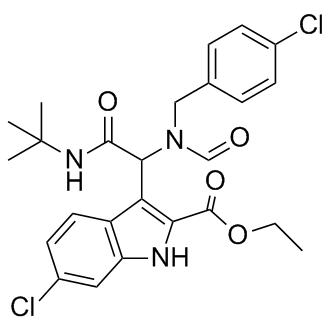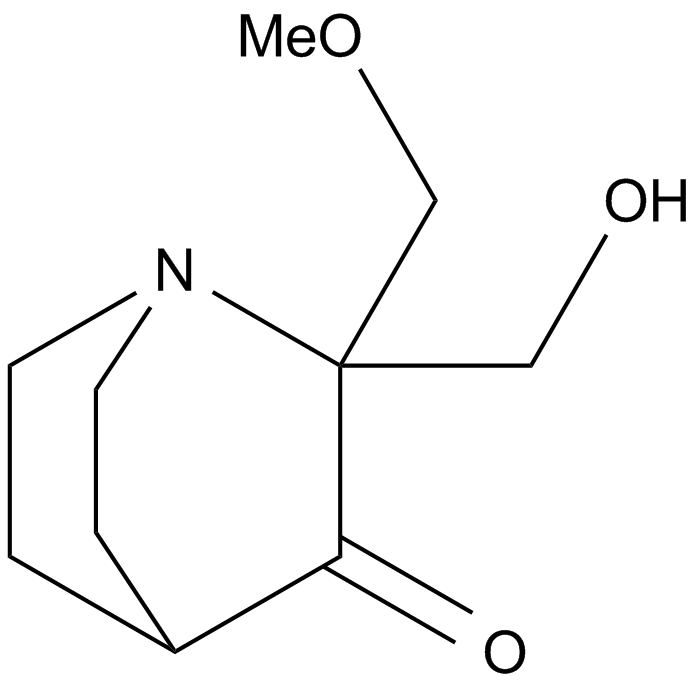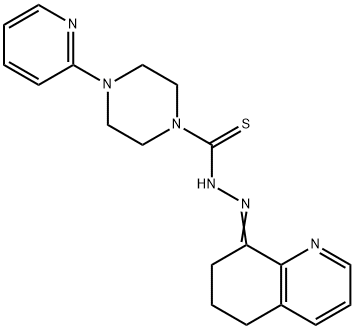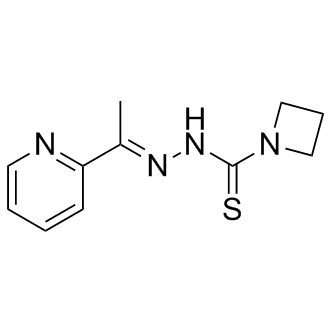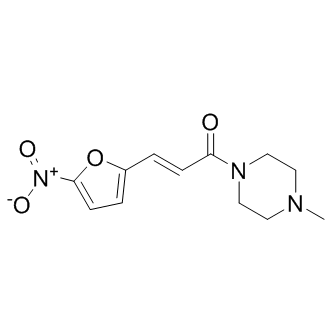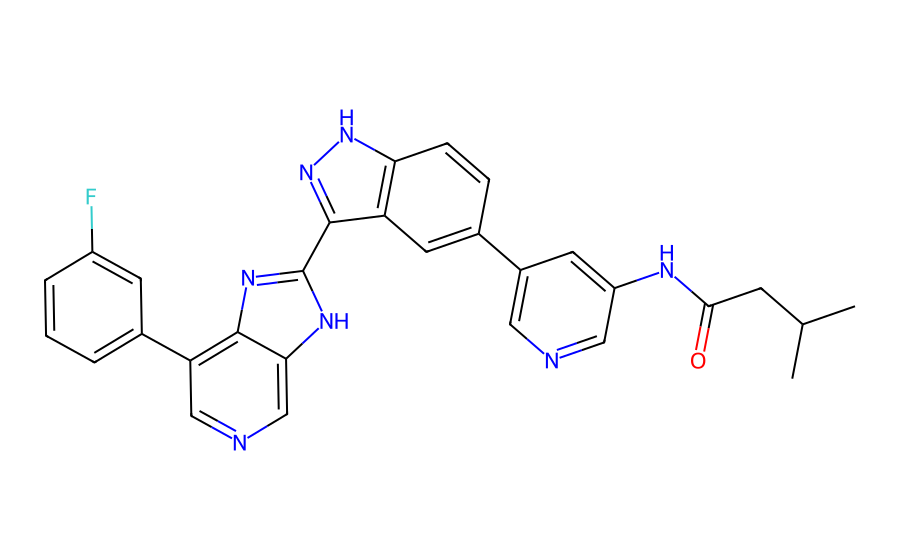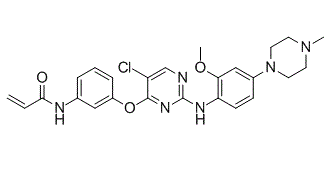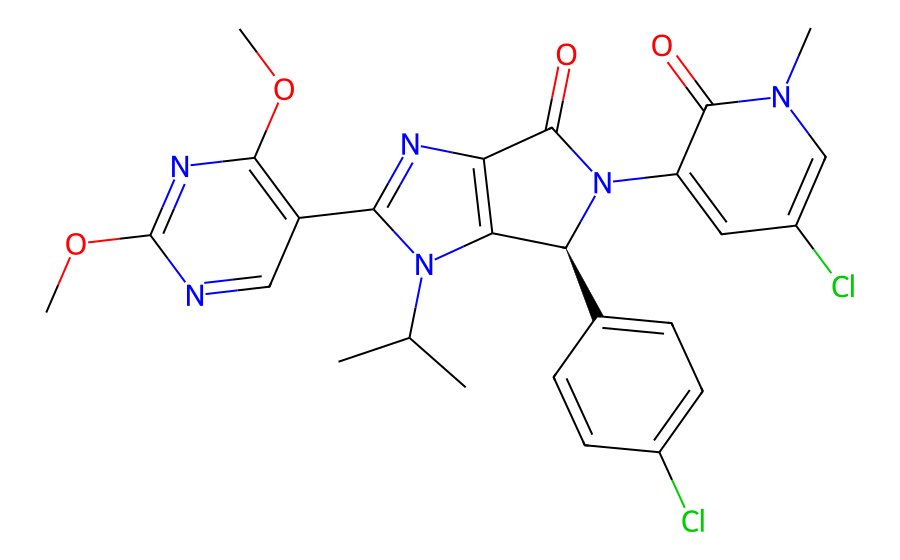
NVP-HDM201(Siremadlin ) chemical structure
Chemical structureResearch use only
CAT. NO. DC10613Featured

NVP-HDM201(Siremadlin )

Pack Sizes & Prices

TotalUS$700
We match the best price and quality on market.
Product overview

Description & Application

NVP-HDM201 (HDM201) is a potent and highly specific MDM-2/p53 inhibitor currently under phase I clinical trial.

ParameterValue
Chemical NameNVP-HDM201
CAS No.1448867-41-1
SynonymsPyrrolo[3,4-d]imidazol-4(1H)-one, 5-(5-chloro-1,2-dihydro-1-methyl-2-oxo-3-pyridinyl)-6-(4-chlorophenyl)-2-(2,4-dimethoxy-5-pyrimidinyl)-5,6-dihydro-1-(1-methylethyl)-, (6S)-;Siremadlin
FormulaC26H24Cl2N6O4
M.Wt555.41
SMILESO=C1N(C2=CC(Cl)=CN(C)C2=O)[C@@H](C3=CC=C(Cl)C=C3)C4=C1N=C(C5=CN=C(OC)N=C5OC)N4C(C)C
Purity>98%
Storage2 years -20°C Powder, 2 weeks 4°C in DMSO, 6 months -80°C in DMSO

Biological Activity

NVP-HDM201 (HDM201) is a potent and highly specific MDM-2/p53 inhibitor currently under phase I clinical trial.

In Vitro

NVP-HDM201 disrupts both human and murine TP53- MDM2 interactions, with nanomolar cellular IC50 values, blocking TP53 degradation[1].

In Vivo

NVP-HDM201 is an imidazolopyrrolidinone analogue, showing a very advantageous in vivo profile. NVP-HDM201 has recently entered Phase 1 clinical trials in cancer patients[2]. Constitutive PB mutagenesis in Arf−/− mice provides a collection of spontaneous tumors with characterized insertional genetic landscapes. Tumors are allografted in large cohorts of mice to assess the pharmacologic effects of NVP-HDM201. Sixteen out of 21 allograft models are sensitive to NVP-HDM201 but ultimately relapse under treatment. A comparison of tumors with acquired resistance to NVP-HDM201 and untreated tumors identified 87 genes that are differentially and significantly targeted by the PB transposon[1]. NVP-HDM201 administered either daily at a low dose or once at a high dose revealed a differentiated engagement of the p53 molecular response. In contrast to the daily low dose treatment regimen, the single high dose NVP-HDM201 regimen results in a rapid and dramatic induction of p53-dependent PUMA expression and apoptosis. This is consistent with the finding that a single high dose NVP-HDM201 treatment, administered orally or intravenously, results in a robust and sustained tumor regression. Overall, both daily and once every 3 weeks dosing regimen shows comparable long term efficacy in preclinical studies. The ongoing clinical trial is currently designed to compare both dosing regimens with regard to efficacy and tolerability[3].

References & source

DC Chemicals original product information

Published experimental findings depend on the model and assay conditions. They do not guarantee equivalent performance in every application. For laboratory research use only.
Product documentation

Refer to the certificate supplied with your lot for batch-specific release results.

Handling guide

2 years -20°C Powder, 2 weeks 4°C in DMSO, 6 months -80°C in DMSO

Solution calculator

Related research products

Tenovin-3 chemical structureDC7314

Tenovin-3

Tenovin-3 is able to increase p53 levels, determined in MCF-7 cells treated for 6 hr at 10 μM.Target: p53in vitro: Tenovins inhibit the activities of human SirT1 and SirT2, two members of the NAD+-dependent class III…

View activity & prices
Nutlin-3a chemical structureDC8454

Nutlin-3a

Nutlin 3a is an active enantiomer of Nutlin-3, acts as a murine double minute (MDM2) antagonist that inhibits MDM2-p53 interactions and stabilizes the p53 protein, and thereby induces cell cycle arrest and apoptosis.

View activity & prices
YH239-EE chemical structureDC9504

YH239-EE

YH239-EE, ethyl ester of the free carboxylic acid compound YH239, is a potent p53-MDM2 antagonizing and apoptosis-inducing agent.YH239-EE inhibits the growth of OCI-AML-3 cells with wild type p53 by inhibiting the…

View activity & prices
PRIMA-1MET(APR-246) chemical structureDC10070

PRIMA-1MET(APR-246)

PRIMA-1MET restores wild-type conformation and function to mutant p53, and triggers apoptosis in tumor cells. PRIMA-1MET also targets the selenoprotein thioredoxin reductase 1 (TrxR1), a key regulator of cellular redox…

View activity & prices
COTI-2 chemical structureDC10657

COTI-2

COTI-2 is a small molecule candidate anti-cancer drug which can convert mutant p53 to wild-type conformation.

View activity & prices
NSC319726 chemical structureDC8746

NSC319726

NSC319726 is a mutant p53R175 reactivator; inhibits growth of fibroblasts expressing the p53R175 mutation (IC50 = 8 nM); shows no inhibition for p53 wild-type cells.in vitro: For NSC319726, the effect was even greater…

View activity & prices
NSC59984 chemical structureDC9257

NSC59984

NSC59984 induces mutant p53 protein degradation via MDM2 and the ubiquitin-proteasome pathway. The EC50 of NSC59984 in most cancer cells is significantly lower than those of normal cells, with EC50 of 8.38 μM for…

View activity & prices
Adavivint chemical structureDC11886

Adavivint

Adavivint is a potent and selective inhibitor of canonical Wnt signaling, with an EC50 of 19.5 nM via a high-throughput TCF/LEF-reporter assay in SW480 colon cancer cells.

View activity & prices
WZ4002 chemical structureDC5090

WZ4002

WZ4002 is a mutant selective EGFR inhibitor with IC50s of 2, 8, 3 and 2 nM for EGFRL858R, EGFRL858R/T790M, EGFRE746_A750 and EGFRE746_A750/T790M, respectively.

View activity & prices

Cart

Request quotation