Biological Activity
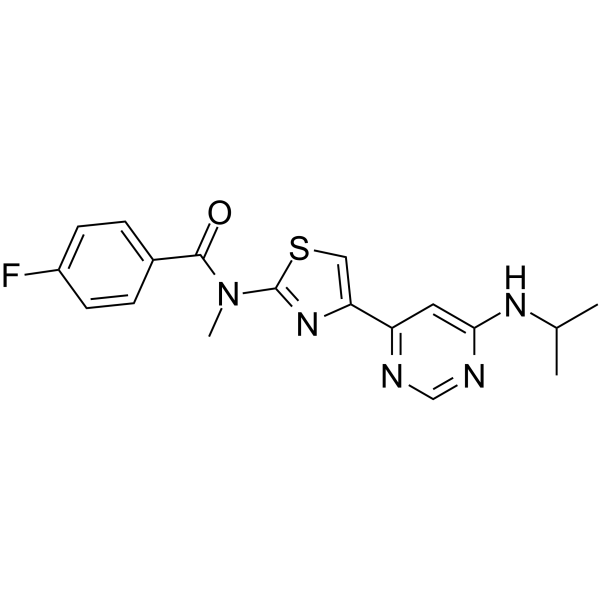
FITM is a negative allosteric modulator of mGlu1 receptor with a Ki of 2.5 nM.
In Vitro
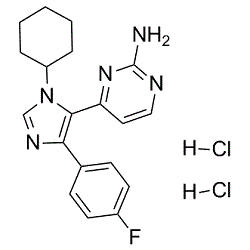
FITM fits tightly into the long and narrow pocket. Most of the ligand-receptor interactions are hydrophobic with the exception of the contacts of the pyrimidine-amine group with the T815 7.38 side chain. The mGlu1 binding pocket for FITM largely corresponds to mutagenic data for the common allosteric site in mGlus and likely extends to other class C GPCRs. FITM which shows high affinity and selectivity for mGlu1 over mGlu5[1]. FITM has the high hydrogen bonds occupancy with Thr815 and Tyr805 in dimer A and B of mGlu1 during molecular dynamics simulations. The nitrogen and hydrogen atoms of FITM form the dynamical hydrogen bonds with the hydrogen atom of Tyr805 and oxygen atom of Thr815, respectively. It indicates that there is a strong attraction interaction between FITM and allosteric sites[2].
In Vivo
The pretreatment of rats with unlabeled FITM (1 mg/kg) occupies an mGluR1 binding site of 18F-FITM by more than 99% and does not affect the input function. The Kd (nM) and Bmax (pmol/mL) obtained by the Scatchard analyses with the multidose ligand assays are 2.1 and 36.3, respectively, for the thalamus; 2.1 and 27.5, respectively, for the hippocampus; 1.5 and 22.2, respectively, for the striatum; and 1.5 and 20.5, respectively, for the cingulate cortex with a high confidence[3]. 18F-FITM shows excellent pharmacokinetics, namely the dense and specific accumulation in mGlu1-positive melanomas versus mGlu1-negative hepatoma and normal tissues. Furthermore, the accumulation levels of radioactivity corresponded to the extent of tumor and to levels of mGlu1 protein expression in melanomas and melanoma metastasis[4].
Animal Administration
Rats: Sprague–Dawley rats are treated with different doses of unlabeled FITM (0, 1, 5, or 30 μg/kg or 1 mg/kg) just before a bolus injection of 18F-FITM (17–18 MBq, 30–40 pmol, 0.1 mL). Estimations of equilibrium state and BPND were acquired[3].
References & source
[1]. Wu H, et al. Structure of a class C GPCR metabotropic glutamate receptor 1 bound to an allosteric modulator. Science. 2014 Apr 4;344(6179):58-64.
[2]. Bai Q, et al. Investigation of allosteric modulation mechanism of metabotropic glutamate receptor 1 by molecular dynamics simulations, free energy and weak interaction analysis. Sci Rep. 2016 Feb 18;6:21763.
[3]. Yamasaki T, et al. In vivo measurement of the affinity and density of metabotropic glutamate receptor subtype 1 in rat brain using 18F-FITM in small-animal PET. J Nucl Med. 2012 Oct;53(10):1601-7.
[4]. Xie L, et al. Molecular imaging of ectopic metabotropic glutamate 1 receptor in melanoma with a positron emission tomography radioprobe (18) F-FITM. Int J Cancer. 2014 Oct 15;135(8):1852-9.
Published experimental findings depend on the model and assay conditions. They do not guarantee equivalent performance in every application. For laboratory research use only.