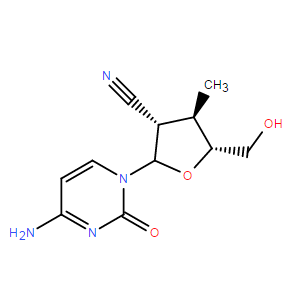
CNDAC chemical structure
Chemical structureResearch use only
CAT. NO. DC9799Featured

CNDAC

Pack Sizes & Prices

TotalUS$550
We match the best price and quality on market.
Product overview

Description & Application

CNDAC is the active component of sapacitabine. Sapacitabine is an oral nucleoside analog prodrug that acts through a dual mechanism. The compound interferes with DNA synthesis by causing single-strand DNA breaks and induces arrest of the cell division cycle at G2 phase.Both sapacitabine and its major metabolite, CNDAC, have demonstrated potent anti-tumor activity in both blood and solid tumors in preclinical studies. In a liver metastatic mouse model, sapacitabine was shown to be superior to gemcitabine or 5-FU, two widely used nucleoside analogs, in delaying the onset and growth of liver metastasis.

ParameterValue
Chemical Name(2R,3S,4S,5R)-2-(4-amino-2-oxopyrimidin-1-yl)-4-hydroxy-5-(hydroxymethyl)oxolane-3-carbonitrile;CNDAC
CAS No.135598-68-4
Synonyms(2R,3S,4S,5R)-2-(4-amino-2-oxopyrimidin-1-yl)-4-hydroxy-5-(hydroxymethyl)oxolane-3-carbonitrile;CNDAC
FormulaC10H12N4O4
M.Wt252.227
SMILESN#C[C@@H]1[C@@H](O[C@H](CO)[C@H]1O)N2C(=O)N=C(N)C=C2
Purity>98%
Storage2 years -20°C Powder, 2 weeks 4°C in DMSO, 6 months -80°C in DMSO

Biological Activity

CNDAC is the active component of sapacitabine. Sapacitabine is an oral nucleoside analog prodrug that acts through a dual mechanism. The compound interferes with DNA synthesis by causing single-strand DNA breaks and induces arrest of the cell division cycle at G2 phase.Both sapacitabine and its major metabolite, CNDAC, have demonstrated potent anti-tumor activity in both blood and solid tumors in preclinical studies. In a liver metastatic mouse model, sapacitabine was shown to be superior to gemcitabine or 5-FU, two widely used nucleoside analogs, in delaying the onset and growth of liver metastasis.

In Vitro

No in vitro data are provided in the current product source. Contact us for further information.

In Vivo

No in vivo data are provided in the current product source. Contact us for further information.

References & source

DC Chemicals original product information

Published experimental findings depend on the model and assay conditions. They do not guarantee equivalent performance in every application. For laboratory research use only.
Product documentation

Refer to the certificate supplied with your lot for batch-specific release results.

Handling guide

2 years -20°C Powder, 2 weeks 4°C in DMSO, 6 months -80°C in DMSO

Solution calculator

Related research products

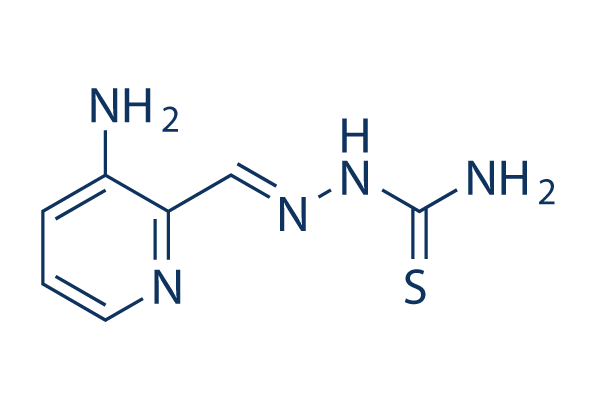
Triapine chemical structureDC7522

Triapine

Triapine is a novel inhibitor of the M2 subunit of ribonucleotide reductase (RR), and is a potent radiosensitizer.

View activity & prices
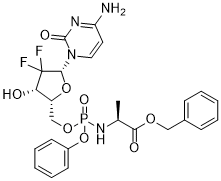
Acelarin chemical structureDC10318

Acelarin

Acelarin (NUC-1031) is a ProTide transformation and enhancement of the widely-used nucleoside analogue, gemcitabine.

View activity & prices
RX-3117 chemical structureDC7762

RX-3117

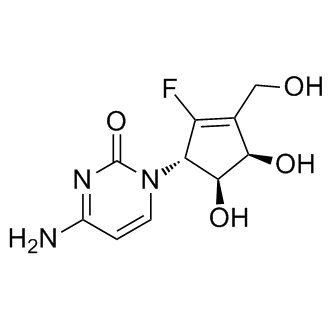
RX-3117(TV-1360; Fluorocyclopentenylcytosine) is novel a cytidine analog; shows anticancer activity in several cancer cell lines, including gemcitabine-resistant variants.

View activity & prices
5-Fluorouracil chemical structureDC8944

5-Fluorouracil

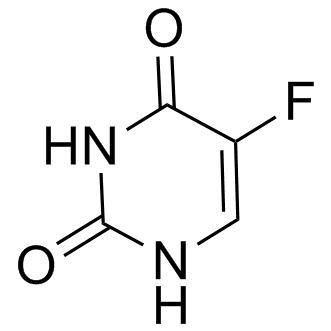
5-Fluorouracil is a potent antitumor agent that affects pyrimidine synthesis by inhibiting thymidylate synthetase thus depleting intracellular dTTP pools.5-Fluorouracil is metabolized to ribonucleotides and…

View activity & prices
TH7528 chemical structureDC73210

TH7528

TH7528 is a SAMHD1 inhibitor with IC50 of 4.5 μM/2.8 μM/2.6 μM against dGTP/Cl-F-ara-ATP/ara-CTP, respectively.

View activity & prices
AZD1152 chemical structureDC7060

AZD1152

AZD1152 is a pro-drug of Barasertib-hQPA, which is a highly selective Aurora B inhibitor with IC50 of 0.37 nM in a cell-free assay.

View activity & prices

Cart

Request quotation