Biological Activity
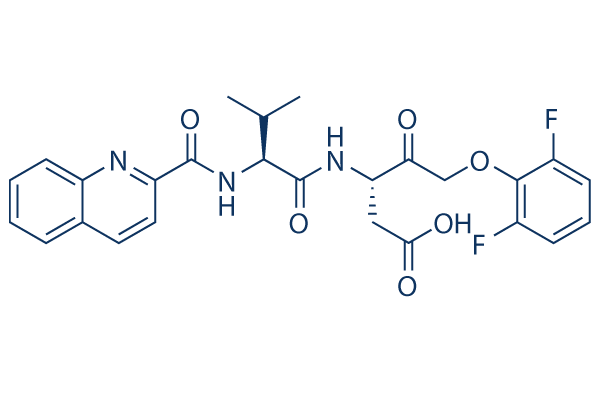
Q-VD-OPha is a irreversible pan-caspase inhibitor with potent antiapoptotic properties; inhibits caspase 7 with IC50 of 48 nM and 25-400 nM for other caspases including caspase 1, 3, 8, 9, 10, and 12. Q-VD-OPha is able to cross the blood-brain barrier.
In Vitro
Q-VD-OPh is a potent inhibitor of caspase-7 with an IC50 of 48 nM utilizing a cell-free assay consisting of human recombinant caspase-7, Q-VD-OPh, and the substrate AMC-DEVD-pNa[1]. Q-VD-OPh fully inhibits caspase-3 and -7 activity at 0.05 μM. Caspase-8 is also inhibited at low Q-VD-OPh concentrations. The cleavage of PARP-1 is fully prevented at 10 μM Q-VD-OPh. DNA fragmentation and disruption of the cell membrane functionality are both prevented at 2 μM Q-VD-OPh[2]. Q-VD-OPh is significantly more effective in preventing apoptosis than the widely used inhibitors, ZVAD-fmk and Boc-D-fmk, and is also equally effective in preventing apoptosis mediated by the three major apoptotic pathways, caspase 9/3, caspase 8/10, and caspase12. Q-VD-OPh is not toxic to cells even at extremely high concentrations[3]. QVD is also able to increase the expression of differentiation markers in acute myeloid leukemia (AmL) blasts. QVD alone or combined with VDDs increases differentiation and HPK1-cJun signaling in AmL cell context-dependent manner[4].
In Vivo
Chronic treatment with Q-VD-OPh prevents caspase-7 activation and limits the pathological changes associated with tau, including caspase cleavage. Q-VD-OPh could be a potential therapeutic compound for the treatment of Alzheimer's disease[1].
Target
Caspase-3:25-400 nM (IC50)
Caspase-7:48 nM (IC50)
Caspase-1:25-400 nM (IC50)
Caspase-8:25-400 nM (IC50)
Caspase-9:25-400 nM (IC50)
Caspase-10:25-400 nM (IC50)
Caspase-12:25-400 nM (IC50)
Animal Administration
Mouse: Stock solutions of Q-VD-OPh are prepared in DMSO and diluted in sterile PBS solution prior to injection. A final concentration of 10 mg/kg is chosen indicating neuroprotection at this concentration of Q-VD-OPh. Three-month old mice are divided into two groups: control, vehicle (n=3) or treated (n=2). Mice are injected i.p. three times a week with either Q-VD-OPh or vehicle for a total time period of 3 months[1].
References & source
[1]. Rohn TT, et al. Caspase activation in transgenic mice with Alzheimer-like pathology: results from a pilot study utilizing the caspase inhibitor, Q-VD-OPh. Int J Clin Exp Med. 2009 Nov 5;2(4):300-8.
[2]. Kuzelová K, et al. Dose-dependent effects of the caspase inhibitor Q-VD-OPh on different apoptosis-related processes. J Cell Biochem. 2011 Nov;112(11):3334-42.
[3]. Caserta TM, et al. Q-VD-OPh, a broad spectrum caspase inhibitor with potent antiapoptotic properties. Apoptosis. 2003 Aug;8(4):345-52.
[4]. Chen-Deutsch X, et al. Leuk Res. 2012 Jul;36(7):884-8.The pan-caspase inhibitor Q-VD-OPh has anti-leukemia effects and can interact with vitamin D analogs to increase HPK1 signaling in AML cells.
Published experimental findings depend on the model and assay conditions. They do not guarantee equivalent performance in every application. For laboratory research use only.