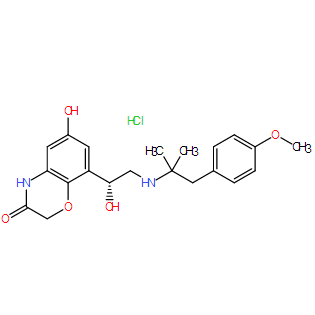
Olodaterol(BI-1744) hydrochloride chemical structure
Chemical structureResearch use only
CAT. NO. DC9248Featured

Olodaterol(BI-1744) hydrochloride

Pack Sizes & Prices

TotalUS$500
We match the best price and quality on market.
Product overview

Description & Application

Olodaterol (BI1744) hydrochloride is a selective, long acting β2-adrenoceptor (β2-AR) agonist (EC50=0.1 nM and pKi= 9.14 for human β2-adrenoceptor, respectively). Olodaterol can be used for chronic obstructive pulmonary disease (COPD) and pulmonary fibrosis[1][2][3].

ParameterValue
Chemical NameOlodaterol HCl
CAS No.869477-96-3
SynonymsOlodaterol hydrochloride; Olodaterol HCl; BI-1744; BI 1744; BI1744; Olodaterol; Striverdi
FormulaC21H27ClN2O5
M.Wt422.91
SMILESCC(C)(CC1=CC=C(C=C1)OC)NC[C@@H](C2=CC(=CC3=C2OCC(=O)N3)O)O.Cl
Purity>98%
Storage2 years -20°C Powder, 2 weeks 4°C in DMSO, 6 months -80°C in DMSO

Biological Activity

Olodaterol (BI1744) hydrochloride is a selective, long acting β2-adrenoceptor (β2-AR) agonist (EC50=0.1 nM and pKi= 9.14 for human β2-adrenoceptor, respectively). Olodaterol can be used for chronic obstructive pulmonary disease (COPD) and pulmonary fibrosis[1][2][3].

In Vitro

Olodaterol hydrochloride (0.1~10 nM; fibroblasts) interferes with FGF-induced phosphorylation of signalling cascades[2]. Olodaterol hydrochloride (0.001~10 nM; fibroblasts) attenuates growth factor-induced motility and proliferation[2]. Olodaterol hydrochloride (0.001~1000 nM; 0.5 hours; fibroblasts) increases intracellular cAMP in a concentration-dependent manner. Olodaterol hydrochloride (0~10 nM; 0.5 hours; fibroblasts) concentration-dependently inhibits the PICP increase with maximal efficacy of 70 % at 10 nM. Olodaterol hydrochloride has a subnanomolar affinity for the β2-AR (pKi=9.14) and is selective for this receptorin comparison with the β1-AR and β3-AR subtypes[2]. Western Blot Analysis[2] Cell Line: Fibroblasts Concentration: 0.1~10 nM Incubation Time: Result: Interfered with FGF-induced phosphorylation of signalling cascades. Cell Proliferation Assay[2] Cell Line: Fibroblasts Concentration: 0.001~10 nM Incubation Time: Result: Attenuated growth factor-induced motility and proliferation.

In Vivo

Olodaterol (1 mg/kg; inhal.; 21 days) accelerats body weights recovery back to control levels (at day 21) and attenuats TGF-β-induced lung fibrosis[2]. Olodaterol (0.1~3 μg/kg; inhal.; 5 hours) induces a dose-dependent bronchoprotection[3]. Olodaterol (0.3 and 0.6 μg/kg; inhal.; 24 hours) induces a maximal bronchoprotection of approximately 60 % after 0.5 hours[3]. Animal Model: Lung fibrosis C57BL/6 mice Dosage: 1 mg/mL Administration: Inhal.; 21 days Result: Accelerated body weight recovery back to control levels (at day 21) and attenuated TGF-β-induced lung fibrosis. Animal Model: Guinea Pigs Dosage: 0.1~3 μg/kg Administration: Inhal.; 5 hours Result: Induced a dose-dependent bronchoprotection. Animal Model: Dogs Dosage: 0.3 and 0.6 μg/kg Administration: Inhal.; 24 hours Result: Olodaterol (0.6 μg/kg) induced a maximal bronchoprotection of approximately 60 % after 0.5 h.

References & source

DC Chemicals original product information

Published experimental findings depend on the model and assay conditions. They do not guarantee equivalent performance in every application. For laboratory research use only.
Product documentation

Refer to the certificate supplied with your lot for batch-specific release results.

Handling guide

2 years -20°C Powder, 2 weeks 4°C in DMSO, 6 months -80°C in DMSO

Solution calculator

Related research products

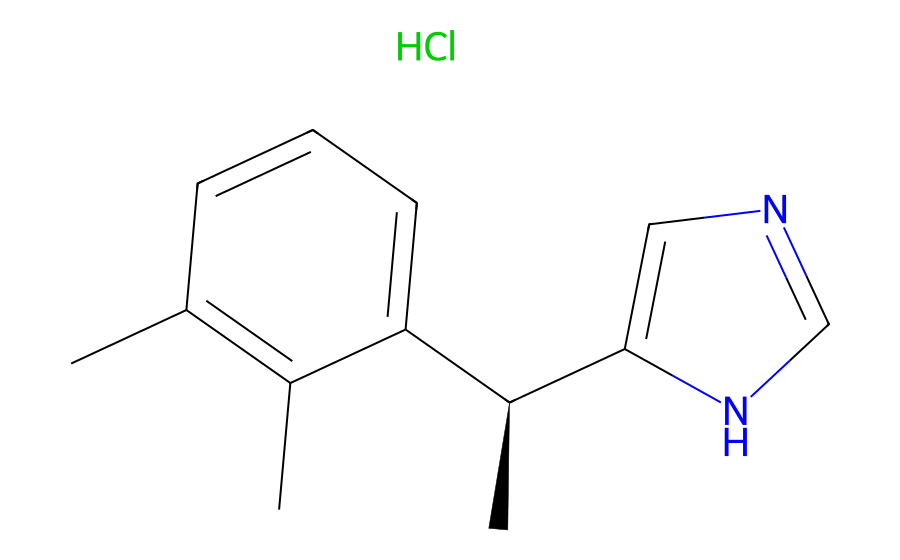
Dexmedetomidine hydrochloride chemical structureDC4240

Dexmedetomidine hydrochloride

Dexmedetomidine, acting at alpha(2A) adrenoceptors, must be present during the encoding process to decrease discrete cue fear memory; however, its ability to suppress contextual memory is likely the result of blocking…

View activity & prices
BMY 7378 chemical structureDC7377

BMY 7378

BMY 7378 is a multi-targeted inhibitor of α2C-adrenoceptor and α1D-adrenoceptor with pKi of 6.54 and 8.2, respectively, and acts as a mixed agonist and antagonist for 5-HT1A receptor with pKi of 8.3.

View activity & prices
SR59230A chemical structureDC28102

SR59230A

SR59230A is a potent, selective, and blood-brain barrier penetrating β3-adrenergic receptor antagonist[1] with IC50s of 40, 408, and 648 nM for β3, β1, and β2 receptors, respectively[2].

View activity & prices
Timolol Maleate chemical structureDC9137

Timolol Maleate

(S)-Timolol maleate, is a potent non-selective β-adrenergic receptor antagonist (Ki values are 1.97 and 2.0 nM for β1 and β2 receptor subtypes respectively).(S)-Timolol, 50% bioavailability following oral…

View activity & prices
Indacaterol chemical structureDC8914

Indacaterol

Indacaterol is a potent, orally administered ultra-long-acting β2 adrenergic receptor (ADRB2) agonist, widely recognized for its therapeutic potential in respiratory and cardiovascular conditions. By selectively…

View activity & prices

Cart

Request quotation