Biological Activity
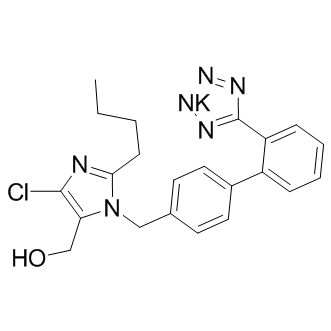
Losartan (potassium) is an angiotensin II receptor type 1 (AT1) antagonist, competing with the binding of angiotensin II to AT1 with an IC50 of 20 nM.
In Vitro
Losartan competes with the binding of angiotensin II to AT1 receptors. The concentration that inhibits 50% of the binding of angiotensin II (IC50) is 20 nM[1]. Losartan (40 μM) affects ISC but prevents the effect of ANGII on ISC[2]. Losartan significantly reduces Ang II-mediated cell proliferation in endometrial cancer cells. The combination of losartan and anti-miR-155 has a significantly greater antiproliferative effect compared to each drug alone[3].
In Vivo
Losartan (0.6 g/L, p.o.) -treated Fbn1C1039G/+ mice show a reduction in distal airspace caliber relative to placebo-treated Fbn1C1039G/+ animals. The doses of losartan and propranolol are titrated to achieve comparable hemodynamic effects. Analysis of pSmad2 nuclear staining reveals that losartan antagonizes TGF-β signaling in the aortic wall of Fbn1C1039G/+ mice. Losartan can improve disease manifestations in the lungs, an event that cannot plausibly relate to improved hemodynamics[4]. Losartan (10 mg/kg, intraarterial injection) increases blood angiotensin levels four- to sixfold. Losartan (10 mg/kg, i.p.) increases plasma renin levels 100-fold; plasma angiotensinogen levels decreases to 24% of control; and plasma aldosterone levels are unchanged[5].
References & source
Published experimental findings depend on the model and assay conditions. They do not guarantee equivalent performance in every application. For laboratory research use only.