Biological Activity
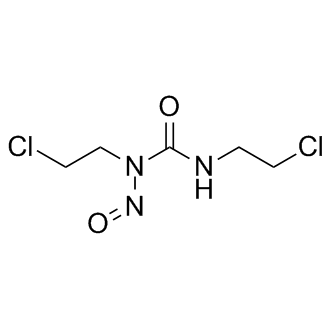
Carmustine is an antitumor chemotherapeutic agent, which works by akylating DNA and RNA.
In Vitro
Carmustine is an antitumor chemotherapeutic agent. Carmustine (8, 80, and 800 µM) decreases N-acetyltransferase (NAT) activities for 2-aminofluorene (AF) and p-aminobenzoic acid (PABA) in rat glial tumor cytosol and intact cells. In rat glial tumor cells, the DNA-AF adduct increases, and carmustine decreases the formation of DNA-AF adduct[1].
In Vivo
Carmustine (BCNU; 25 mg/kg, i.p.) causes higher levels of the rhe ratio of liver weight to body weight and plasma conjugated bilirubin, and lower biliary flow, oxidised glutation levels (GSSG) and reduced glutation (GSH)/GSSG values compared with control rats[2].
References & source
Published experimental findings depend on the model and assay conditions. They do not guarantee equivalent performance in every application. For laboratory research use only.