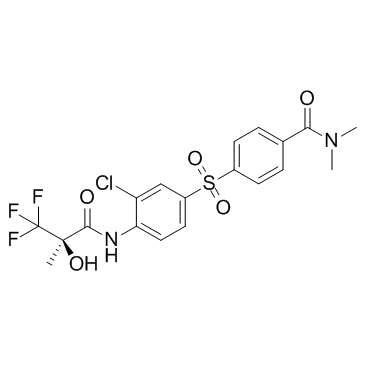
AZD-7547 chemical structure
Chemical structureResearch use only
CAT. NO. DC8837Featured

AZD-7547

Pack Sizes & Prices

TotalUS$600
We match the best price and quality on market.
Product overview

Description & Application

AZD7545 is a novel, selective small-molecule inhibitor of PDHK2 (PDH kinase2) with an IC50 of 36.8 nM and 6.4 nM for PDHK1 and PDHK2 respectively.

ParameterValue
Chemical Name4-[3-Chloro-4-[[(2R)-3,3,3-trifluoro-2-hydroxy-2-methylpropanoyl]amino]phenyl]sulfonyl-N,N-dimethylbenzamide
CAS No.252017-04-2
Synonyms(R) - N - {2 - Chloro - 4 - [4 - (N,N - dimethylcarbamoyl)phenylsulphonyl]phenyl} - 2 - hydroxy - 2 - methyl - 3,3,3 - trifluoropropanamide;(2,4-Dihydroxy-5-isopropylphenyl){5-[(4-methyl-1-piperazinyl)meth yl]-1,3-dihydro-2H-isoindol-2-yl}methanone;(R) - N - {2 - Chloro - 4 - [4 - (N,N - dimethylcarbamoyl)phenylsulphonyl]phenyl} - 2 - hydroxy - 2 - methyl - 3,3,3 - triflu;AZD7545;AZD-7545;4-[(3-Chloro-4-{[(2r)-3,3,3-Trifluoro-2-Hydroxy-2-Methylpropanoyl]amino}phenyl)sulfonyl]-N,N-Dimethylbenzamide;4-{3-chloro-4-[(2R)-3,3,3-trifluoro-2-hydroxy-2-methylpropanamido]benzenesulfonyl}-N,N-dimethylbenzamide;DTDZLJHKVNTQGZ-GOSISDBHSA-N;AZD 7545;2q8g;Azd4575;C19H18ClF3N2O5S;GTPL9362;AOB6866;BCP07524;4-[3-chloro-4-[[(2R)-3,3,3-trifluoro-2-hydroxy-2-methylpropanoyl]amino]phenyl]sulfonyl-N,N-dimethylbenzamide;E
FormulaC19H18ClF3N2O5S
M.Wt478.8698
SMILESClC1C([H])=C(C([H])=C([H])C=1N([H])C([C@](C([H])([H])[H])(C(F)(F)F)O[H])=O)S(C1C([H])=C([H])C(C(N(C([H])([H])[H])C([H])([H])[H])=O)=C([H])C=1[H])(=O)=O
Purity>98%
Storage2 years -20°C Powder, 2 weeks 4°C in DMSO, 6 months -80°C in DMSO

Biological Activity

AZD7545 is a novel, selective small-molecule inhibitor of PDHK2 (PDH kinase2) with an IC50 of 36.8 nM and 6.4 nM for PDHK1 and PDHK2 respectively.

In Vitro

The IC50 values for inhibition of PDHK2 and PDHK1 by AZD7545 were 6.4 ± 2.2 nM (n = 6) and 36.8 ± 18 nM (n = 3) respectively. Other compounds in this series inhibited both PDHK1 and PDHK2 and a consistent trend of reduced potency (5-15-fold) towards PDHK1, as compared with PDHK2, was observed. In contrast, AZD7545 and related compounds failed to inhibit PDHK4 and paradoxically, at higher concentrations (>10 nM), AZD7545 stimulated PDHK4 activity [1]. In the presence of PDHK2, AZD7545 increased PDH activity with an EC(50) value of 5.2 nM. In rat hepatocytes, the rate of pyruvate oxidation was stimulated 2-fold (EC(50) 105 nM) [2].

In Vivo

A single dose of AZD7545 to Wistar rats increased the proportion of liver PDH in its active, dephosphorylated form in a dose-related manner from 24.7 to 70.3% at 30 mg/kg; and in skeletal muscle from 21.1 to 53.3%. A single dose of 10 mg/kg also significantly elevated muscle PDH activity in obese Zucker (fa/fa) rats. Obese, insulin-resistant, Zucker rats show elevated postprandial glucose levels compared with their lean counterparts (8.7 versus 6.1 mM at 12 weeks old). AZD7545 (10 mg/kg) twice daily for 7 days markedly improved the 24-h glucose profile, by eliminating the postprandial elevation in blood glucose [2]. An interestingobservation is that administration of maximally effective doses of AZD7545 and related compounds to rats results in the near-complete activation of PDH activity in liver, where PDHK2 is the major isoenzyme, while only partial activation of PDH activity is achieved in skeletal muscle and heart, tissues which express high levels of PDHK4. For example, following administration of a maximally effective dose of compound K (30 mg/kg) the percentage of PDH present in the active (dephosphorylated) state in liver is elevated from 35.3 ± 4.0% to 90.2 ± 2.2% while in skeletal muscle and heart PDH activity plateaus at 64.3 ± 2.3% and 61.8 ± 4.3% respectively. Further evidence for a link between in vitro isoenzyme selectivity and in vivo activity comes from the observation that in fasted rats the ability of AZD7545 toelevate PDH activity in liver is intact, while the activation of skeletal muscle PDH activity in response to the compound is severely blunted [1].

References & source

DC Chemicals original product information

Published experimental findings depend on the model and assay conditions. They do not guarantee equivalent performance in every application. For laboratory research use only.

Product documentation

Refer to the certificate supplied with your lot for batch-specific release results.

Handling guide

2 years -20°C Powder, 2 weeks 4°C in DMSO, 6 months -80°C in DMSO

Solution calculator

Related research products

Fluzoparib chemical structureDC22228

Fluzoparib

Fluzoparib (SHR-3162) is a novel, potent and orally available inhibitor of PARP; potently inhibited PARP1 enzyme activity and induced DNA double-strand breaks, G2/M arrest and apoptosis in homologous recombination…

View activity & prices
PF-670462 chemical structureDC2086

PF-670462

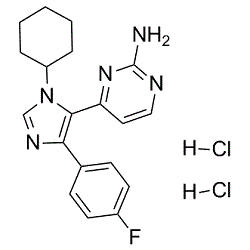
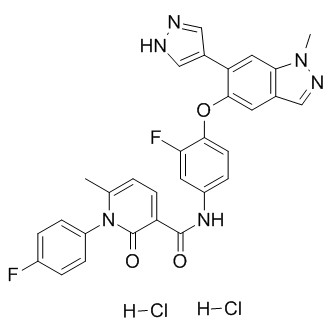
PF-670462 is a potent and selective inhibitor of casein kinase (CK1ε and CK1δ), with IC50s of 7.7 nM and 14 nM, respectively.

View activity & prices
PBIT chemical structureDC7550

PBIT

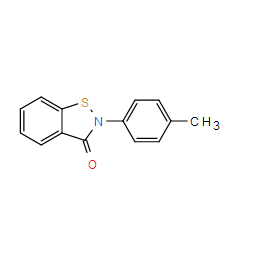
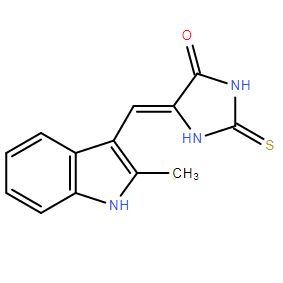
PBIT is a specific inhibitor of the Jumonji AT-rich Interactive Domain 1(JARID1) enzymes. PBIT inhibits JARID1B (KDM5B or PLU1 ) histone demethylase an IC50 of about 3 μM . PBIT also inhibits JARID1A and JARID1C with…

View activity & prices
Fenoldopam (mesylate) chemical structureDC9424

Fenoldopam (mesylate)

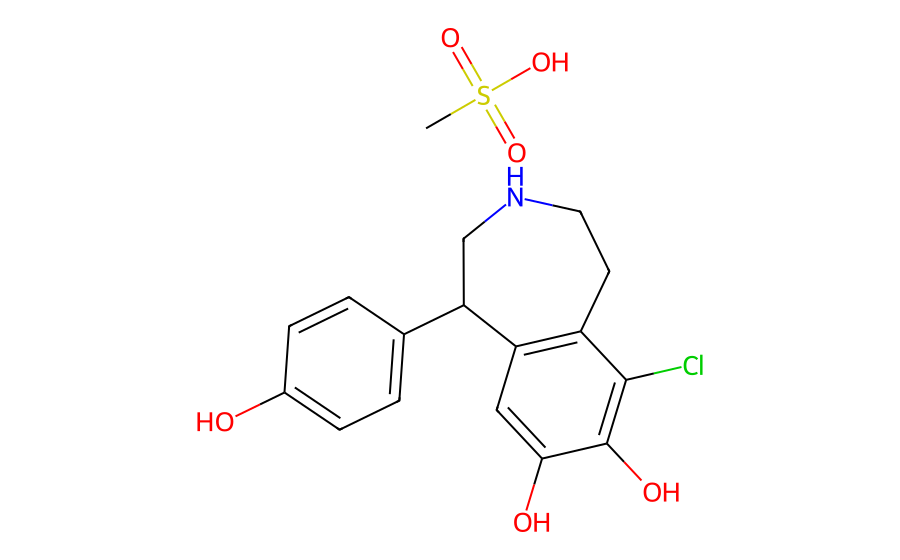
Fenoldopam(SKF 82526) mesylate is a drug and synthetic benzazepine derivative which acts as a selective D1 receptor partial agonist.Target: D1 ReceptorFenoldopam is a selective dopamine-1 (DA1) agonist with…

View activity & prices
PKG drug G1 chemical structureDC10821

PKG drug G1

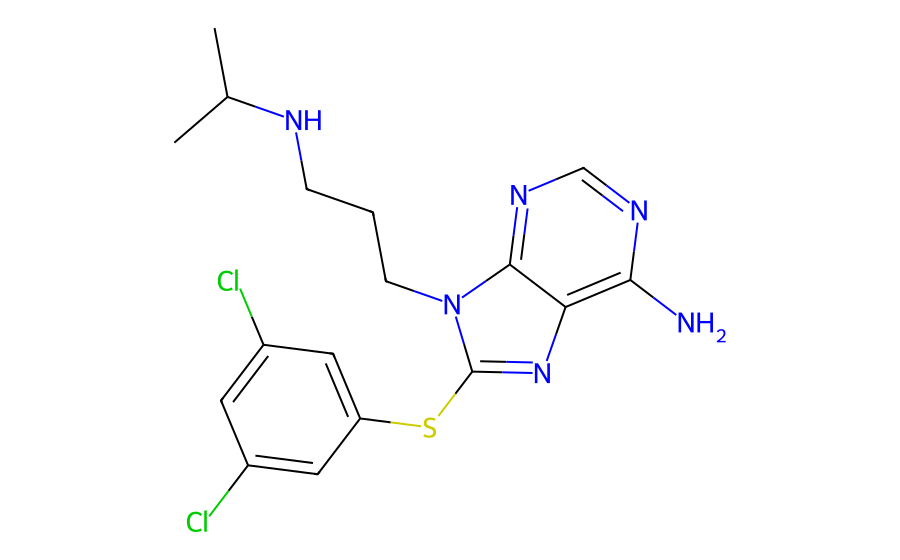
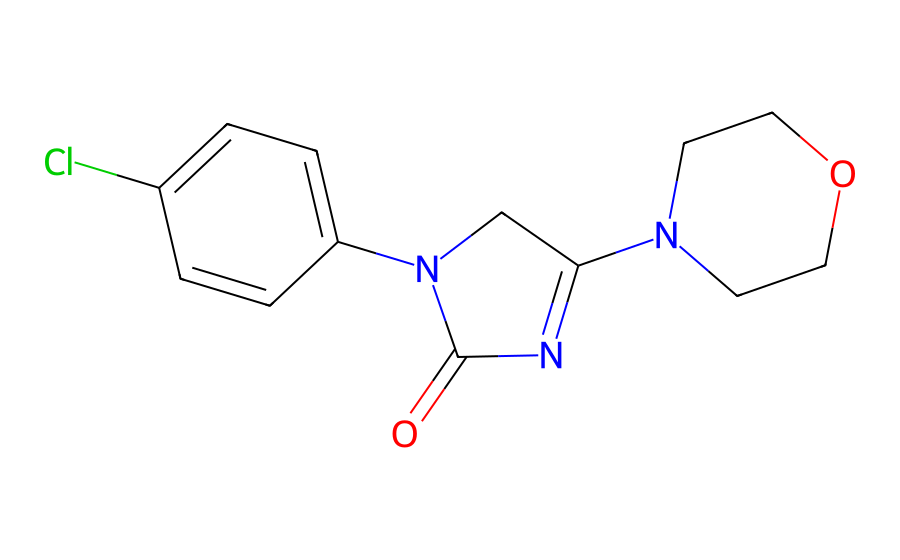
PKG drug G1 targets C42 of PKG Iα. PKG drug G1 can couple to vasodilation and blood pressure lowering by a C42 PKG Iα-independent mechanism.

View activity & prices

Cart

Request quotation