Biological Activity
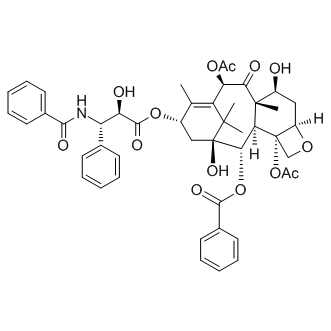
Paclitaxel is a potent anticancer medication which can promote microtubule (MT) assembly, inhibit MT depolymerization, and change MT dynamics required for mitosis and cell proliferation.
In Vitro
Paclitaxel at 0.1, 0.5, and 1 μM reduces the proliferation and survival of CCRF-HSB-2 cells in a dose-dependent fashion and that the IC50 value of taxol is about 0.25 μM[1]. Paclitaxel directly associates with the endoplasmic reticulum to stimulate the release of calcium into the cytosol, contributing to the induction of apoptosis[2].
In Vivo
In a SCID mouse xenograft model, low dose metronomic Paclitaxel treatment decreases lung dissemination of EGI-1 cells without significantly affecting their local tumor growth[3]. Low doses of paclitaxel promot liver metastasis in mouse xenografts, which correlats with changes in estrogen metabolism in the host liver[4]. Paclitaxel (2 mg/kg per treatment, black circles) induces mechanical hypersensitivity in the glabrous skin of the hindpaw[5].
References & source
Published experimental findings depend on the model and assay conditions. They do not guarantee equivalent performance in every application. For laboratory research use only.