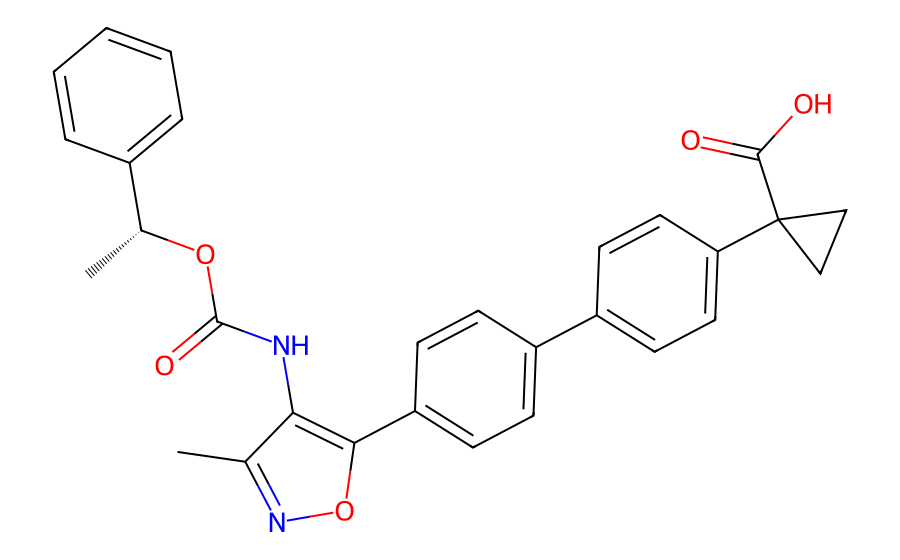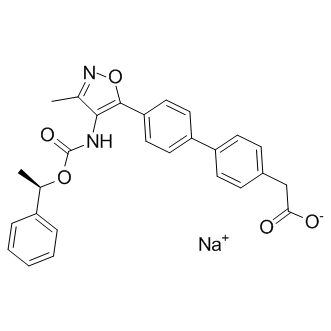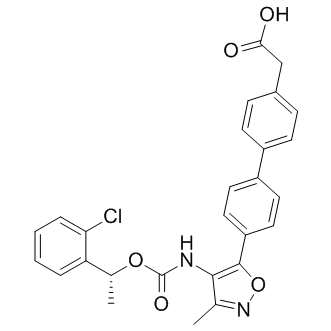
AM966 chemical structure
Chemical structureResearch use only
CAT. NO. DC8623Featured

AM966

Pack Sizes & Prices

TotalUS$550
We match the best price and quality on market.
Product overview

Description & Application

AM966 is a high affinity, selective, oral LPA1-antagonist, inhibits LPA-stimulated intracellular calcium release (IC50=17 nM).

ParameterValue
Chemical NameAM966,AM-966,AM 966
CAS No.1228690-19-4
SynonymsAM966,AM-966,AM 966
FormulaC27H23ClN2O5
M.Wt490.93
SMILESCC1=NOC(C2=CC=C(C3=CC=C(CC(=O)O)C=C3)C=C2)=C1NC(=O)OC(C)C1=CC=CC=C1Cl
Purity>98%
Storage2 years -20°C Powder, 2 weeks 4°C in DMSO, 6 months -80°C in DMSO

Biological Activity

AM966 is a high affinity, selective, oral LPA1-antagonist, inhibits LPA-stimulated intracellular calcium release (IC50=17 nM).

In Vitro

AM966 is a potent, selective, orally bioavailable LPA1 receptor antagonist. AM966 inhibits LPA1-mediated chemotaxis of human A2058 melanoma cells (IC50=138±43 nM), IMR-90 human lung fibroblasts (IC50=182±86 nM) and CHO mLPA1 cells (IC50=469±54 nM)[1]. LPA-induced ERK1/2 activation is completely blocked by AM966 (100 nM), which selectively antagonizes LPA1 over LPA2-5, with an IC50 value of 3.8±0.4 nM. Pre-treatment with AM966 (100 nM) completely blocks ERK1/2 phosphorylation induced by either amitriptyline or mianserin[2].

In Vivo

AM966 (30 mg/kg, BID) reduces vascular leakage, inflammation and lung injury and inflammation in a 3 day bleomycin model. AM966 inhibits lung fibrosis, maintains mouse body weight and decreases lung inflammation 14 days after bleomycin lung injury. AM966 reduces vascular leakage, tissue injury and pro-fibrotic cytokine production in the 14 day bleomycin study. AM966 demonstrates greater efficacy compared to pirfenidone in the 14 day bleomycin model. AM966 decreases mortality and fibrosis at late time points after bleomycin injury[1].

References & source

DC Chemicals original product information

Published experimental findings depend on the model and assay conditions. They do not guarantee equivalent performance in every application. For laboratory research use only.
Product documentation

Refer to the certificate supplied with your lot for batch-specific release results.

Handling guide

2 years -20°C Powder, 2 weeks 4°C in DMSO, 6 months -80°C in DMSO

Solution calculator

Related research products

Ki16425 chemical structureDC7179

Ki16425

Ki16425 is a subtype-selective, competitive antagonist of the EDG-family receptors, LPA1 and LPA3 with Kis of 0.34 μM and 0.93 μM, respectively.

View activity & prices
BAF312 (Siponimod) chemical structureDC7694

BAF312 (Siponimod)

Siponimod (BAF-312) is a potent and selective sphingosine-1-phosphate (S1P) receptor modulator. It is selective for S1P1 and S1P5 receptors over S1P2, S1P3, and S1P4 (EC50s of 0.39, 0.98, >10,000, >1,000, and 750 nM,…

View activity & prices
BMS-986020 chemical structureDC10459

BMS-986020

BMS-986020 is an LPA1 antagonist.target: LPA1BMS-986020 is in Phase 2 clinical development for treating idiopathic pulmonary fibrosis. BMS-986020 selectively inhibits the LPA receptor, which is involved in binding of…

View activity & prices
CYM5442 chemical structureDC8088

CYM5442

CYM5442 is a potent, highly-selective and orally active sphingosine 1-phosphate (S1P1) receptor agonist with an EC50 of 1.35 nM. CYM5442 is inactive against S1P2, S1P3, S1P4, and S1P5. CYM5442 activates S1P1-dependent…

View activity & prices
Etrasimod(APD334) chemical structureDC10040

Etrasimod(APD334)

Etrasimod (APD334) is a potent, selective and orally available antagonist of the sphingosine-1-phosphate-1 (S1P1) receptor with an IC50 value of 1.88 nM in CHO cells.

View activity & prices
AM095 chemical structureDC8621

AM095

AM095 is a potent LPA1 receptor antagonist with IC50 values of 0.98 and 0.73 μM for recombinant human or mouse LPA1 respectively. AM095 is an LPA1 receptor antagonist with good oral exposure and antifibrotic activity…

View activity & prices
Adavivint chemical structureDC11886

Adavivint

Adavivint is a potent and selective inhibitor of canonical Wnt signaling, with an EC50 of 19.5 nM via a high-throughput TCF/LEF-reporter assay in SW480 colon cancer cells.

View activity & prices

Cart

Request quotation