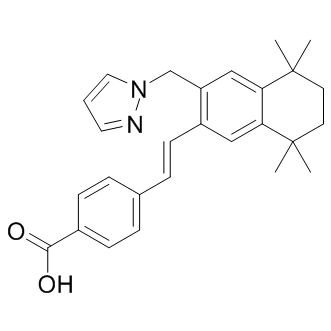
Palovarotene(R 667) chemical structure
Chemical structureResearch use only
CAT. NO. DC8459Featured

Palovarotene(R 667)

Pack Sizes & Prices

TotalUS$450
We match the best price and quality on market.
Product overview

Description & Application

Palovarotene is a nuclear retinoic acid receptor γ (RAR-γ) agonist.

ParameterValue
Chemical NameR667,R 667,R667,RO-3300074,RO 3300074,RO3300074
CAS No.410528-02-8
SynonymsR667,R 667,R667,RO-3300074,RO 3300074,RO3300074
FormulaC27H30N2O2
M.Wt414.54
SMILESOC(C1=CC=C(/C=C/C2C(CN3N=CC=C3)=CC3C(CCC(C)(C)C=3C=2)(C)C)C=C1)=O
Purity>98%
Storage2 years -20°C Powder, 2 weeks 4°C in DMSO, 6 months -80°C in DMSO

Biological Activity

Palovarotene is a nuclear retinoic acid receptor γ (RAR-γ) agonist.

In Vitro

No in vitro data are provided in the current product source. Contact us for further information.

In Vivo

Palovarotene suppresses post-traumatic chondrogenesis and osteogenesis and mitigated trauma-induced ectopic bone formation. Palovarotene inhibits subcutaneous and intramuscular heterotopic ossification (HO) in mice. Palovarotene is given orally for 14 days at 1 mg/kg/day starting on post-operative day (POD) 1 or POD-5, and HO amount, wound dehiscence and related processes are monitored for up to 84 days post injury. Compared to vehicle-control animals, Palovarotene significantly decreases HO by 50 to 60% regardless of when the treatment started and if infection is present[1]. Starting from day 1 of injury, half of the Acvr1cR206H/+ mice are treated with Palovarotene by daily gavage for 14 days and the other half received vehicle as control. Analysis by mCT and 3D image reconstruction at day 14 shows that large HO tissue masses have formed in the targeted leg of Acvr1cR206H/+ mutant mice receiving vehicle, but HO formation is greatly diminished in Palovarotene-treated companions by more than 80% based on bone volume/total volume quantification[2].

References & source

DC Chemicals original product information

Published experimental findings depend on the model and assay conditions. They do not guarantee equivalent performance in every application. For laboratory research use only.

Product documentation

Refer to the certificate supplied with your lot for batch-specific release results.

Handling guide

2 years -20°C Powder, 2 weeks 4°C in DMSO, 6 months -80°C in DMSO

Solution calculator

Related research products

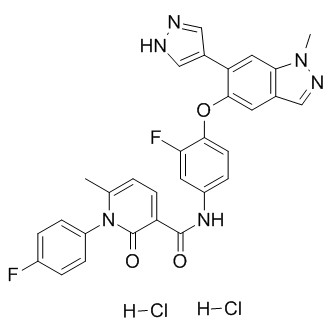
Fluzoparib chemical structureDC22228

Fluzoparib

Fluzoparib (SHR-3162) is a novel, potent and orally available inhibitor of PARP; potently inhibited PARP1 enzyme activity and induced DNA double-strand breaks, G2/M arrest and apoptosis in homologous recombination…

View activity & prices
PF-670462 chemical structureDC2086

PF-670462

PF-670462 is a potent and selective inhibitor of casein kinase (CK1ε and CK1δ), with IC50s of 7.7 nM and 14 nM, respectively.

View activity & prices
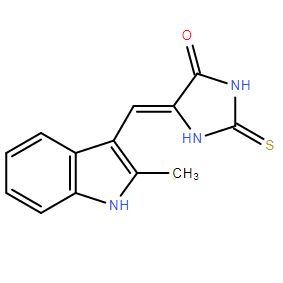
PBIT chemical structureDC7550

PBIT

PBIT is a specific inhibitor of the Jumonji AT-rich Interactive Domain 1(JARID1) enzymes. PBIT inhibits JARID1B (KDM5B or PLU1 ) histone demethylase an IC50 of about 3 μM . PBIT also inhibits JARID1A and JARID1C with…

View activity & prices
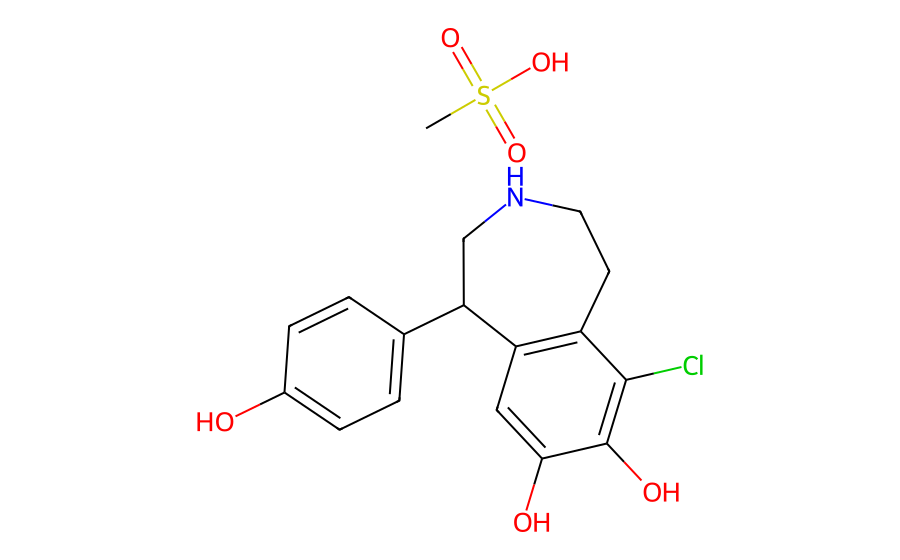
Fenoldopam (mesylate) chemical structureDC9424

Fenoldopam (mesylate)

Fenoldopam(SKF 82526) mesylate is a drug and synthetic benzazepine derivative which acts as a selective D1 receptor partial agonist.Target: D1 ReceptorFenoldopam is a selective dopamine-1 (DA1) agonist with…

View activity & prices
PKG drug G1 chemical structureDC10821

PKG drug G1

PKG drug G1 targets C42 of PKG Iα. PKG drug G1 can couple to vasodilation and blood pressure lowering by a C42 PKG Iα-independent mechanism.

View activity & prices

Cart

Request quotation