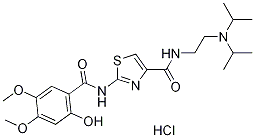
Acotiamide HCl chemical structure
Chemical structureResearch use only
CAT. NO. DC8285Featured

Acotiamide HCl

Pack Sizes & Prices

TotalUS$200
We match the best price and quality on market.
Product overview

Description & Application

Acotiamide monohydrochloride trihydrate is an orally active and first-in-class gastroprokinetic agent for the treatment of functional dyspepsia. Acotiamide monohydrochloride trihydrate enhances acetylcholine released by enteric neurons through muscarinic receptor antagonism and acetylcholinesterase (AChE) inhibition, thereby enhancing gastric emptying and gastric accommodation[1][2].

ParameterValue
Chemical NameAcotiamide hydrochloride trihydrate
CAS No.773092-05-0
SynonymsYM443; YM-443; YM 443; Z338; Z-338; Z 338; Acotiamide; Acotiamide hydrochloride trihydrate; Brand name: Acofide.
FormulaC21H37ClN4O8S
M.Wt541.06
SMILESO=C(C1=CSC(NC(C2=CC(OC)=C(OC)C=C2O)=O)=N1)NCCN(C(C)C)C(C)C.[H]Cl.O.O.O
Purity>98%
Storage2 years -20°C Powder, 2 weeks 4°C in DMSO, 6 months -80°C in DMSO

Biological Activity

Acotiamide monohydrochloride trihydrate is an orally active and first-in-class gastroprokinetic agent for the treatment of functional dyspepsia. Acotiamide monohydrochloride trihydrate enhances acetylcholine released by enteric neurons through muscarinic receptor antagonism and acetylcholinesterase (AChE) inhibition, thereby enhancing gastric emptying and gastric accommodation[1][2].

In Vitro

In in vitro studies, Acotiamide inhibits acetylcholine-induced activation of muscarinic M1 and M2 receptors in transformed Xenopus oocytes, with IC50 values of 1.8 and 10.1 μM, respectively. Acotiamide shows no/limited affinity for serotonin 5HT2, 5HT3 or 5HT4 receptors and dopamine D2 receptors[1]. Acotiamide inhibits AChE activity, inhibits both the slow (competitively) and fast (noncompetitively) inward currents induced by acetylcholine, enhances electrically stimulated contraction of gastric fundus and gastric body, facilitates acetylcholine release from enteric neurons and, using patch-clamp techniques, potentiates L-type voltagedependent Ca2+ current and inhibits GABA-induced current in area postrema neurons[1].

In Vivo

In in vivo animal models, Acotiamide stimulates postprandial gastroduodenal and/or colonic motor activity, and improves delayed but not normal gastric emptying. For example, Acotiamide significantly improves delayed gastric emptying and feeding inhibition in a restraintstress-induced rat model, but does not affect normal gastric emptying or feeding in intact rats[1].

References & source

DC Chemicals original product information

Published experimental findings depend on the model and assay conditions. They do not guarantee equivalent performance in every application. For laboratory research use only.

Product documentation

Refer to the certificate supplied with your lot for batch-specific release results.

Handling guide

2 years -20°C Powder, 2 weeks 4°C in DMSO, 6 months -80°C in DMSO

Solution calculator

Related research products

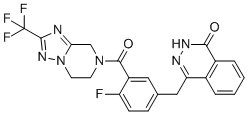
Fluzoparib chemical structureDC22228

Fluzoparib

Fluzoparib (SHR-3162) is a novel, potent and orally available inhibitor of PARP; potently inhibited PARP1 enzyme activity and induced DNA double-strand breaks, G2/M arrest and apoptosis in homologous recombination…

View activity & prices
PF-670462 chemical structureDC2086

PF-670462

PF-670462 is a potent and selective inhibitor of casein kinase (CK1ε and CK1δ), with IC50s of 7.7 nM and 14 nM, respectively.

View activity & prices
PBIT chemical structureDC7550

PBIT

PBIT is a specific inhibitor of the Jumonji AT-rich Interactive Domain 1(JARID1) enzymes. PBIT inhibits JARID1B (KDM5B or PLU1 ) histone demethylase an IC50 of about 3 μM . PBIT also inhibits JARID1A and JARID1C with…

View activity & prices
Fenoldopam (mesylate) chemical structureDC9424

Fenoldopam (mesylate)

Fenoldopam(SKF 82526) mesylate is a drug and synthetic benzazepine derivative which acts as a selective D1 receptor partial agonist.Target: D1 ReceptorFenoldopam is a selective dopamine-1 (DA1) agonist with…

View activity & prices
PKG drug G1 chemical structureDC10821

PKG drug G1

PKG drug G1 targets C42 of PKG Iα. PKG drug G1 can couple to vasodilation and blood pressure lowering by a C42 PKG Iα-independent mechanism.

View activity & prices

Cart

Request quotation