Biological Activity
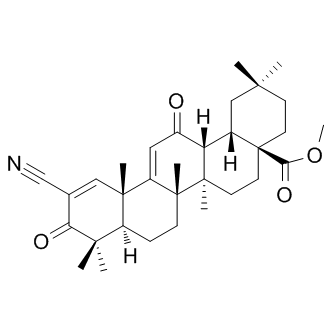
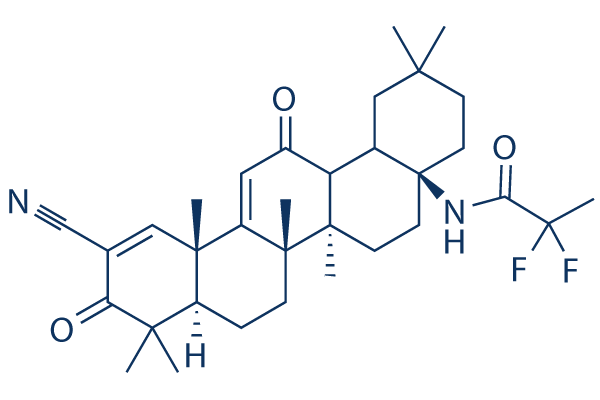
RTA-408 is an antioxidant inflammation modulator (AIM), which activates Nrf2 and suppresses nitric oxide (NO).
In Vitro
To evaluate the anti-inflammatory activity of RTA-408, RAW 264.7 mouse macrophage cells are treated with RTA-408 for two hours and then IFNγ is added to stimulate NO production and release into the media. RTA-408 dose-dependently reduces NO concentrations in the media with an IC50 value of 4.4±1.8 nM. The potency of RTA-408 in this assay is similar to that of Bardoxolone methyl, which has an IC50 value of 1.9±0.8 nM. Nrf2 activation is required for AIM-mediated NO suppression. A decrease in nitric oxide synthase 2 (Nos2) protein levels is observed in bardoxolone methyl-treated RAW 264.7 cells, which is attenuated when Nrf2 mRNA levels are reduced by siRNA. To evaluate the anticancer activity of RTA-408, a panel of eight human cell lines derived from tumors of different origin are treated with RTA-408 and measured cell growth 72 hours later using the sulforhodamine B (SRB) assay. RTA-408 inhibits the growth of all tumor lines with an average GI50 value of 260±74 nM. To determine whether RTA-408 induces apoptosis, the panel of tumor cells are treated with RTA-408 and the caspase substrate, DEVD-AFC, for 24 hours. RTA-408 dose-dependently increases DEVD-AFC cleavage, indicating that RTA-408 treatment triggers caspase activation in cancer cells. Caspase-3 and caspase-9 cleavage is also observed by western blot at the same concentrations of RTA-408 that increases DEVD-AFC cleavage[1].
In Vivo
To determine whether RTA-408 is an effective mitigator of hematopoietic acute radiation syndrome after bone marrow-lethal doses of total-body irradiation (TBI), mice are administered 3 daily injections of 17.5 mg/kg RTA-408 beginning 24 h after TBI. Teatment with RTA-408 results in the 35 day survival of 100% of 7 Gy (LD40/35) TBI mice (P<0.05) and 60% of 7.5 Gy (LD100/13) TBI mice (P<0.0001)[2].
Target
Nrf2[1]
Cell Assay
MEFs, PANC-1, A549, A375, A549/NF-κB-Luc and HeLa/NF-κB-Luc cells are cultured in Gibco high glucose DMEM with 10% FBS. G-361 cells are cultured in McCoy’s 5A medium with 10% FBS. All other cell lines are cultured in RPMI 1640 medium with 10% FBS. For growth inhibition assays, cells are plated in duplicate 96-well culture dishes at 3×10³ cells per well. The following day, one plate is treated with RTA-408 (200, 400, 600, 800 and 1000 nM) and the other is immediately processed for the sulforhodamine B (SRB) assay (time 0). Cells in the RTA-408-treated plate are processed for the SRB assay 72 hours after the start of treatment. Percentage of growth relative to vehicle-treated cells is calculated. Dose-response curves are plotted in GraphPad Prism and GI50 values are calculated. For cell counting experiments, MEFs are plated in 6-well culture dishes at 5×10⁴ cells per well and treated with RTA-408 the following day. Following treatment, cells are counted using a Vi-CELL XR cell analyzer. For clonogenic assays, wild-type (1×10³ cells per well) and Keap1-/- (0.5×10³ cells per well) MEFs are seeded in 6-well dishes. Six hours later, MEFs are treated with RTA-408. After seven days, colonies are fixed with a 1:7 solution of acetic acid:MeOH and stained with 0.5% crystal violet in MeOH. Colonies consisting of ≥50 cells are counted[1].
Animal Administration
Mice[2] For radiation survival experiments, wild-type C57Bl/6 CD45.2 mice (6-8 weeks old) are used. Congenic wild-type C57Bl/6 CD45.1 and C57Bl/6 CD45.1/CD45.2 hybrid host mice are used as recipients in transplantation experiments. RTA-408 stock solutions for vehicle control (DMSO) are prepared within 1 h before injection. RTA-408 (17.5 mg/kg) or DMSO is administered intraperitoneally at 24, 48 and 72 h after irradiation. Whole-body irradiation (7-8 Gy) is performed using a 250-kVp X-ray machine with 50 cm source-to-skin distance and a 2 mm copper filter. The dose rate is approximately 1.4 Gy/min.
References & source
[1]. Probst BL, et al. RTA 408, A Novel Synthetic Triterpenoid with Broad Anticancer and Anti-Inflammatory Activity. PLoS One. 2015 Apr 21;10(4):e0122942.
[2]. Goldman DC, et al. The triterpenoid RTA 408 is a robust mitigator of hematopoietic acute radiation syndrome in mice. Radiat Res. 2015 Mar;183(3):338-44
[3]. Peng Han, et al. RTA-408 Protects Kidney from Ischemia-Reperfusion Injury in Mice via Activating Nrf2 and Downstream GSH Biosynthesis Gene. Oxid Med Cell Longev. 24 December 2017.
Published experimental findings depend on the model and assay conditions. They do not guarantee equivalent performance in every application. For laboratory research use only.