Biological Activity
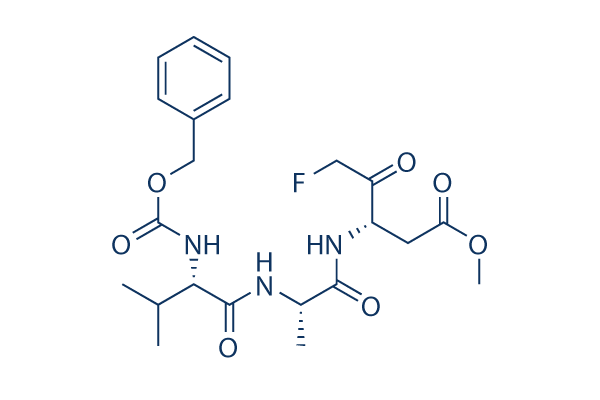
Z-VAD(OMe)-FMK is a cell-permeable and irreversible pan-caspase inhibitor.
In Vitro
Z-VAD(OMe)-FMK is a broad-spectrum caspase inhibitor, has been shown to inhibit the intracellular activation of caspase-like proteases. The injection of Z-VAD(OMe)-FMK suppresses the caspase-3 activity in lung tissues, and significantly decreases the number of terminal dUTP nick-end labeling-positive cells[1]. Z-VAD(OMe)-FMK is administered intraperitoneally at 1 hour before and 6 hours after SAH. Expression of caspase-3 and positive TUNEL is examined as markers for apoptosis. Z-VAD(OMe)-FMK suppresses TUNEL and caspase-3 staining in endothelial cells, decreases caspase-3 activation, reduces BBB permeability, relieves vasospasm, abolishes brain edema, and improves neurological outcome[2]. Z-VAD(OMe)-FMK is a cell-permeable caspase inhibitor, efficiently blocks cell death induced by SMN deficiency[3].
In Vivo
The survival rate of mice is prolonged significantly by the injection of Z-VAD(OMe)-FMK. All mice succumbed to LPS within 30 hours. By contrast, the mice treated with Z-VAD(OMe)-FMK survive significantly longer and 27% of the mice survived more than 7 days[1].
Target
Caspase
Cell Assay
PCR products containing coding sequences for the dSMN (forward primer: 5′-TAA TAC GAC TCA CTA TAG GG AAG ACG TAC GAC GAG TCG-3′; and reverse primer: 5′-TAA TAC GAC TCA CTA TAG GG GTG GTG CTG GCT TCT TTC-3′; product length, 601bps; bold and italics letters represent T7 promoter sequences) and control Drosophila Presenilin (dPsn) gene (forward primer: 5′-TAA TAC GAC TCA CTA TAG GG TG GCT GCT GTC AAT CTC-3′; and reverse primer: 5′-TAA TAC GAC TCA CTA TAG GG CGA TAG CAA CGC TTC TTG-3′; product length: 543bps) are obtained and gel-purified. Double-stranded RNAs (dsRNA) are generated by transcription with Ribomax T7 Transcription kit and digested with Rnase-free DNase. The dsRNA products are ethanol precipitated and annealed by incubation at 65°C for 30 min and then slowly allowed to cool at room temperature. The annealed dsRNA products are analyzed on a 1% agaorse gel to ensure the majority of dsRNA existed as a single band. The dsRNA (2 μg) and/or plasmid DNAs (2 μg) are introduced into cells by using Cellfectin. Caspase inhibition is achieved by using 50 μM of Z-VAD(OMe)-FMK in the culture medium[3].
Animal Administration
Mice[1] Mice used in this study are 5- to 6-week-old (20 to 22 g) ICR males. Mice are injected with 30 mg/kg LPS from E. coli serotype O111:B4 through the tail vein. A single intravenous injection of Z-VAD(OMe)-FMK (0.25 mg) is made 15 minutes before LPS injection, followed by three intravenous injections of Z-VAD(OMe)-FMK (0.1 mg each) per hour. Control mice are injected with the same volume of 1% DMSO in sterile saline. Rats[2] Male Sprague-Dawley rats weighing 300 to 350 g are anesthetized with α-chloralose (40 mg/kg IP) and urethane (400 mg/kg IP). Animals are intubated, and respiration is maintained with a small animal respirator. Rectal temperature is maintained at 37±0.5°C with a heating pad. The left external carotid artery is isolated and a 4.0 monofilament nylon suture is inserted through the internal carotid artery to perforate the middle cerebral artery. SAH is confirmed at autopsy in each rat. Sham-operated rats underwent the same procedures except that the suture is withdrawn after resistance is felt. Z-VAD(OMe)-FMK (50 μM per 0.3 mL) is injected intraperitoneally at 1 hour before and 6 hours after SAH induction. In vehicle group, rats underwent SAH induction and are treated with the same volume of vehicle (DMSO diluted in physiological buffer solution). No treatment is applied in sham-operated animals.
References & source
[1]. Kawasaki M, et al. Protection from lethal apoptosis in lipopolysaccharide-induced acute lung injury in mice by a caspaseinhibitor. Am J Pathol. 2000 Aug;157(2):597-603.
[2]. Park S, et al. Neurovascular protection reduces early brain injury after subarachnoid hemorrhage. Stroke. 2004 Oct;35(10):2412-7.
[3]. Ilangovan R, et al. Inhibition of apoptosis by Z-VAD-fmk in SMN-depleted S2 cells. J Biol Chem. 2003 Aug 15;278(33):30993-9.
Published experimental findings depend on the model and assay conditions. They do not guarantee equivalent performance in every application. For laboratory research use only.