Biological Activity
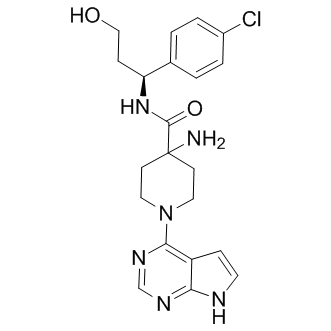
Capivasertib (AZD5363) is a potent pan-AKT kinase inhibitor with IC50 of 3, 7 and 7 nM for Akt1,Akt2 and Akt3, respectively.
In Vitro
Capivasertib, a novel pyrrolopyrimidine-derived compound, inhibits all AKT isoforms with a potency of 10 nM or less and inhibits phosphorylation of AKT substrates in cells with a potency of approximately 0.3 to 0.8 μM. Capivasertib inhibits phosphorylation of these substrates with an IC50 value of 0.06 to 0.76 μM in the 3 cell lines. Capivasertib effectively inhibits phosphorylation of S6 and 4E-BP1 in these cell lines, whereas it increases phosphorylation of AKT at both ser473 and thr308. In BT474c cells, Capivasertib induces FOXO3a nuclear translocation with EC50 value of 0.69 μM; a concentration of 3 μM is sufficient to almost completely localize FOXO3a to the nucleus. AZD5363Capivasertibhibitor MK-2206 is much less active (IC50>30 μM)[1].
In Vivo
Oral dosing of Capivasertib (AZD5363) to nude mice causes dose- and time-dependent reduction of PRAS40, GSK3β, and S6 phosphorylation in BT474c xenografts (PRAS40 phosphorylation EC50 ~0.1 μM total plasma exposure), reversible increases in blood glucose concentrations, and dose-dependent decreases in 2[18F]fluoro-2-deoxy-D-glucose (18F-FDG) uptake in U87-MG xenografts. Chronic oral dosing of Capivasertib caused dose-dependent growth inhibition of xenografts derived from various tumor types, including HER2+ breast cancer models that are resistant to trastuzumab. Capivasertib also significantly enhances the antitumor activity of docetaxel, lapatinib, and trastuzumab in breast cancer xenografts[1].
References & source
Published experimental findings depend on the model and assay conditions. They do not guarantee equivalent performance in every application. For laboratory research use only.